Cuba and the end of apartheid
It is probably little known, but the Cuba of Fidel Castro and Che Guevara began to put an end to South African apartheid and to colonialism in Africa.

It is probably little known, but the Cuba of Fidel Castro and Che Guevara began to put an end to South African apartheid and to colonialism in Africa by intervening militarily and then providing doctors and educators. So it is no surprise that Nelson Mandela travelled to Cuba in 1991, on his first visit to Latin America.
The short answer
- The idea: Cuba intervened militarily in Angola from 1975 to support the MPLA against South Africa, and that intervention weakened the apartheid regime.
- The key moment: the battle of Cuito Cuanavale (1987–1988), whose outcome is disputed, but after which an agreement was signed (22 December 1988) that led to the withdrawal of foreign troops and the independence of Namibia.
- The flag: when apartheid ended, South Africa adopted a new flag in 1994, with six colours.
Timeline
1652
The first Dutch settlers, the Boers, arrive in South Africa.
1948
The first racial segregation laws are passed: apartheid begins.
15 January 1975
The Alvor Agreement prepares Angola’s independence, but the three movements (MPLA, FNLA and UNITA) fail to govern together.
14 October 1975
South Africa launches Operation Savannah, in support of UNITA and the FNLA.
5 November 1975
Cuba sends combat troops to Angola (Operation Carlota), at the MPLA’s request.
11 November 1975
Angola declares independence.
1987–1988
Battle of Cuito Cuanavale.
22 December 1988
Tripartite accord (New York) leading to the withdrawal of Cuban and South African troops.
1990
Independence of Namibia and release of Nelson Mandela.
1991
The Cuban intervention and the main apartheid laws end.
27 April 1994
First elections in which the whole country votes, and a new South African flag.
Cuito Cuanavale: one battle, two versions
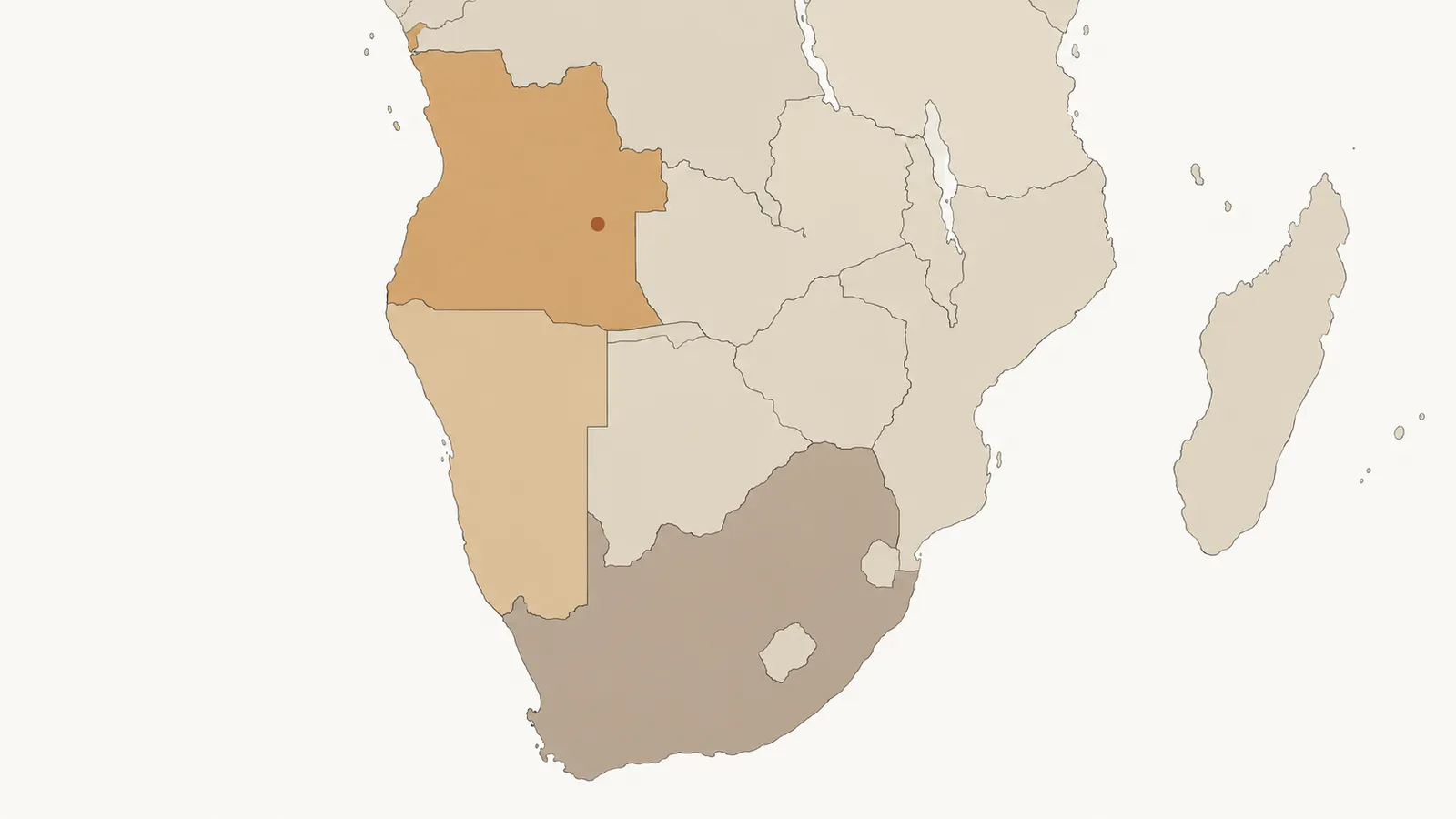
Angola (orange), Namibia (beige) and South Africa (brown). The dot marks the Cuito Cuanavale area, in south-eastern Angola, only approximately. AI-generated illustration, indicative.
It was fought intermittently from 14 August 1987 to 23 March 1988, south and east of Cuito Cuanavale (Angola). On one side were the Angolan forces (FAPLA) and the Cubans; on the other, the South African army and UNITA. The South African and UNITA forces stopped the Angolan offensive, but the Cuban and Angolan troops held their positions and the South Africans withdrew in March 1988.
Both sides claim victory. South Africa says it achieved its basic objectives and chose not to occupy Cuito Cuanavale; the Cuban and Angolan commanders present their stand as a successful defence. What is accepted is the diplomatic result: some authors believe the battle helped start the first round of three-way negotiations, mediated by the United States, which led to the 22 December 1988 agreement.
Casualty figures are much disputed and depend on the source. For example, according to the sources cited by Wikipedia, 38 South Africans died (later reports say 43), about 3,000 UNITA fighters, 4,768 FAPLA and 42 Cuban soldiers and 7 pilots.
Cuba’s numbers in Angola
According to the sources Wikipedia cites, Cuba sent about 36,000 soldiers in 1976 and between 55,000 and 60,000 in 1988. Over the whole conflict between 337,033 and 380,000 Cubans served. 2,016 Cubans died (786 in combat, 524 from disease and 706 in accidents). These are figures from different sources that do not fully agree.
Let us recall what apartheid consisted of:
In 1652 some 90 settlers arrived in South Africa, mostly Dutch and German, but there were also a few Flemish and French. Known as Boers (meaning «farmers») or Afrikaners, they settled in the territory we now know as South Africa.

They expanded to the north and east of South Africa, defeating the imperial troops of the United Kingdom and the Bantu (a group of ethnic groups living in the centre and south of the African continent). The Boers established themselves in several republics, the most important being the South African Republic (Transvaal) and the Orange Free State.

Flag of the Orange Free State

Flag of the Transvaal Republic (Vierkleur)

Alongside these two republics there were other territories: the British colonies of the Cape and Natal and the short-lived Boer republic of Stellaland
In 1880 the First Boer War broke out between the Boers and the United Kingdom because of the growing expansion of the British Empire in the area. The Boers won and the United Kingdom officially recognised the Boer republics. In the Second Boer War (1899) the United Kingdom won, since it had a larger army, and ended up dominating the Boer republics. The Boers recognised British sovereignty and helped rebuild the areas devastated by the war. With this gesture they were able to obtain their own autonomy.

In the early 1920s the Afrikaner nationalist party gradually gained strength, breaking away from the United Kingdom. During the Second World War many members of the party sympathised with Nazi Germany and in 1948 the first racial segregation laws were passed. The population that year was 21 % white, 68 % black and 11 % mixed-race and Asian.

Flag of South Africa from 1928 to 1994, showing the union of the republics
Mixed-race marriages were banned, and it was a crime to have sexual relations between races. In the cities buses, ambulances, hospitals, services, schools and beaches carried signs saying who could use them. Black people also could not vote or hold public office, among other prohibitions.

South Africa had in fact been independent since 1910 (Union of South Africa). In 1960 a referendum, in which only white people voted, approved becoming a republic, proclaimed in 1961; the country thereby ceased to belong to the Commonwealth, forced by pressure from other members, mainly because of apartheid.
SWAPO (South-West African People’s Organization), the Namibian independence guerrilla founded in 1960, began armed struggle against the South African army in 1966. In 1975 SWAPO began to operate from Angola, with the resulting South African invasion. This is where Cuba and the USSR came into action. By the end of the conflict the apartheid regime was greatly weakened.
In 1991 the main apartheid laws were repealed and in 1994 the first elections in which the whole country could vote were held, and Nelson Mandela was elected president by a resounding absolute majority.

The last stronghold of white supremacy in South Africa was led by the far-right group AWB (Afrikaner Weerstandsbeweging, Afrikaner Resistance Movement). Founded in 1973, it came to the fore towards the end of apartheid with some armed action, for example in 1994 in Bophuthatswana.

Operation Carlota
In 1975 Cuba began its largest military operation outside the country, with more than 300,000 Cubans over the years (including doctors, teachers, workers, soldiers…), a great deal of weaponry and a clear idea: to put an end to colonialism in Africa.
In the early 1960s many African colonies began to become independent. The case followed most closely in Cuba was the colony of the Congo (the Belgian Congo at that time), because many Cubans are descended from enslaved Africans, including from the Congo region. In 1959 Fidel Castro overthrew the regime of Fulgencio Batista; from then on Castro and Che Guevara took an interest in all these movements, since the internationalist struggle of the peoples of the world was one of their ideals.

King Baudouin of Belgium visited the Congo to declare its independence in 1960, but the speech he gave was not what Patrice Lumumba (Prime Minister of the Congo) expected, since it was a paternalistic speech when the Congo had suffered injustice, exploitation and aggression from the Belgians, an apartheid.
Lumumba gave an unscheduled speech at the king’s ceremony in which he recalled the dark times of his country, which the king did not like at all. After independence, Belgian officers stayed in command of the Force Publique, the country’s army, and of much of the administration. Here a new conflict began, since the Congolese soldiers did not want to play a secondary role at that moment and began a witch-hunt against white people.

This led Belgium to send troops to protect its citizens and halt the mutinous soldiers, all this ten days after the declaration of independence. Lumumba asked the USA for help but did not arouse the necessary sympathy and the help was denied. The Congolese leader’s next step was to contact Moscow. This move did not please Washington at all, which saw the Congo turning towards communism.
The USSR viewed it favourably and sent help and, along the way, gained a presence in Africa. Here the conflict became internationalised and the Cold War between the USSR and the USA began.
The Congo was at that time the world’s leading producer of cobalt in the Western world, a metal needed, for example, in the manufacture of engines or high-tech equipment. The USA imported cobalt and buying it from the USSR was not a good option.
The USA was left in the shade and the UN came into action. At that moment Mobutu, head of the Congolese army (appointed by Lumumba), carried out a coup d’état backed by the USA that ended with the execution of Patrice Lumumba himself.
Lumumba’s followers were persecuted and organised themselves into guerrillas. This assassination meant that Cuba did not stand by with its arms crossed. The first step was for Che Guevara to visit African areas where there was resistance to colonialism, incognito, especially in the Congo. According to Fidel Castro and Che Guevara, if the Congo achieved real independence the other African peoples would achieve it one after another.
At that moment Fidel Castro made a definitive rapprochement with the USSR and declared the Cuban Revolution a socialist movement. From then on, military aid arrived on the island, and in October 1962 the Cuban Missile Crisis was triggered. The US economic embargo against Cuba, decreed in February of that year, was already in force.

Cuba would give strategic and combat aid to the Congolese rebels, without sending troops on a large scale. A small contingent of Cuban fighters (those who could pass as Congolese) was sent, with Che Guevara at its head. Che had to change his appearance so as not to be recognised and captured in Africa, so his presence had to be disguised.

When the Cubans arrived in the Congo the situation was rather unfavourable, since the putschists, with the help of American mercenaries, had occupied a large part of the territory; the rebels had to be organised and taught to fight as guerrillas.
Some Congolese picked up a weapon and did not aim, they fired blindly.
Everything was difficult, since the language problem and certain customs complicated things; for example, digging a hole in the ground in a trench for protection was frowned upon by the Congolese, since for them holes in the ground were used to bury the dead and they were not keen on getting into one.
The first fighting did not go at all well for them: they suffered defeats and casualties, and there was a danger that Che Guevara’s presence in the area would be discovered. The rebels were increasingly surrounded by the artillery and bombing of Mobutu’s army.

Once it became known that there were Cubans in the area, the Organisation of African Unity (OAU, predecessor of the African Union) disapproved of the presence of foreign troops and also of the putschist Mobutu. Che Guevara’s presence was already a fact that the CIA had confirmed, and the small Cuban contingent left the Congo in November 1965. The mission was a failure.
But Cuba did not give up helping the peoples of Africa and turned to the small Portuguese colony of Guinea-Bissau; helping this colony to independence could trigger the fall of the other Portuguese colonies (Angola and Mozambique, which were much richer) and create a domino effect in the independence of the rest of Africa’s colonies.
This time technicians, engineers, doctors and men who could help with combat training were sent, so the Cubans were not supposed to go into battle.
In a short time the Guinean fighters gained ground and weakened Portuguese morale until 25 April 1974 and the Carnation Revolution arrived. The fascist regime of Portugal had fallen and in October that year the Portuguese army left Guinea-Bissau.
Angola was next. In this country there were three important anti-colonial movements:
MPLA (helped by Cuba and the USSR) FNLA (helped by the USA and South Africa) UNITA (also receiving help from the USA and later from South Africa)
These movements were rivals, but they reached an agreement to negotiate Angola’s liberation from the Portuguese and signed the Alvor Agreement with Portugal on 15 January 1975. War began between the 3 movements to gain control of the capital (Luanda) in order to be recognised internationally as the leader of the country.
At this point the racist regime of South Africa, the Boers, did not look kindly on having communism on their doorstep and saw themselves as the next target; so they invaded Angola from the south to help the FNLA and, indirectly, UNITA. So the FNLA advanced from the north and UNITA with South Africa from the south.
In 1975 the MPLA asked Cuba for help and Cuba responded generously: the first thousands of soldiers (by 1976 there were already about 36,000, and in 1987–1988 more than 50,000) and a great deal of weaponry. This is where Operation Carlota began.

In Fidel Castro’s words, Cuba could not allow apartheid to establish itself in Angola and helped with everything. This move did not please Moscow much, but because of the ties between the two countries they ended up accepting. Cuba always stressed that it was not seeking material interests in Angola, only to feed the internationalist struggle of the peoples of the world.
Kifangondo was the first major battle in which the Cuban army took part, and it deployed its arsenal. When the MPLA saw all the weapons the Cubans had, they were simply amazed. Especially the multiple rocket launchers, heirs of the Katyusha (also known as Stalin’s organ), which had wreaked havoc on the Nazi ranks in the Second World War.

The FNLA was not used to such a volume of fire and panic spread through its ranks. The MPLA–Cuba alliance won the battle and on 11 November they declared independence and Agostinho Neto became the first president of Angola. That was not the end of it: the USA did not recognise the president but banned the supply of arms to the FNLA and UNITA, so over time the MPLA contained its regional rivals.
The South Africans left Angola, but UNITA would still be helped by the apartheid regime. The victory gave Cuba the results it wanted and Fidel Castro was received with honours in all the former colonies. Cuba had international weight.
But the war was not over yet… in the south UNITA was still active. And finally came the last piece of the puzzle: Namibia and SWAPO. The USA wanted the Cuban army out of Angola, but the Angolans wanted Cuban protection against the apartheid army, and the demand was that the South Africans leave Namibia so that the Cubans could go.

This option was well regarded for Cuba, since the racist regime had been driven out and another country, Namibia, would be helped to freedom. Negotiations were opened between all sides but while fighting continued in the south and the Angolans, advised by the USSR, were being defeated, until Cuba intervened again. In 1987 Cuba sent more troops and weapons to Angola to put an end to the conflict once and for all.
The last battle took place at Cuito Cuanavale. Three armies faced each other: Angolans and Cubans against South Africans. It was the largest conventional battle in Africa since the Second World War and lasted several months (1987–1988); casualty figures are highly disputed depending on the side.
In 1988 an agreement was reached that the Cubans would withdraw from Angola, which white South Africans would see as a victory, and the South Africans would withdraw from Namibia, which in Cuba would be seen as a triumph for its help in Angola against apartheid. Nelson Mandela was then released and apartheid came to an end, since the military machine had been greatly weakened and world pressure was increasingly strong to end the Boer regime.
With the end of apartheid, South Africa adopted on 27 April 1994, the day of the first multiracial elections, a new six-colour flag that replaced the 1928–1994 one and symbolises the convergence of the country’s different peoples.