Dannebrog: the 1219 legend and what the documents say
The flag of Denmark is linked to a battle in 1219, but the legend is late. What is known from documents, what is tradition and what «the oldest» means.
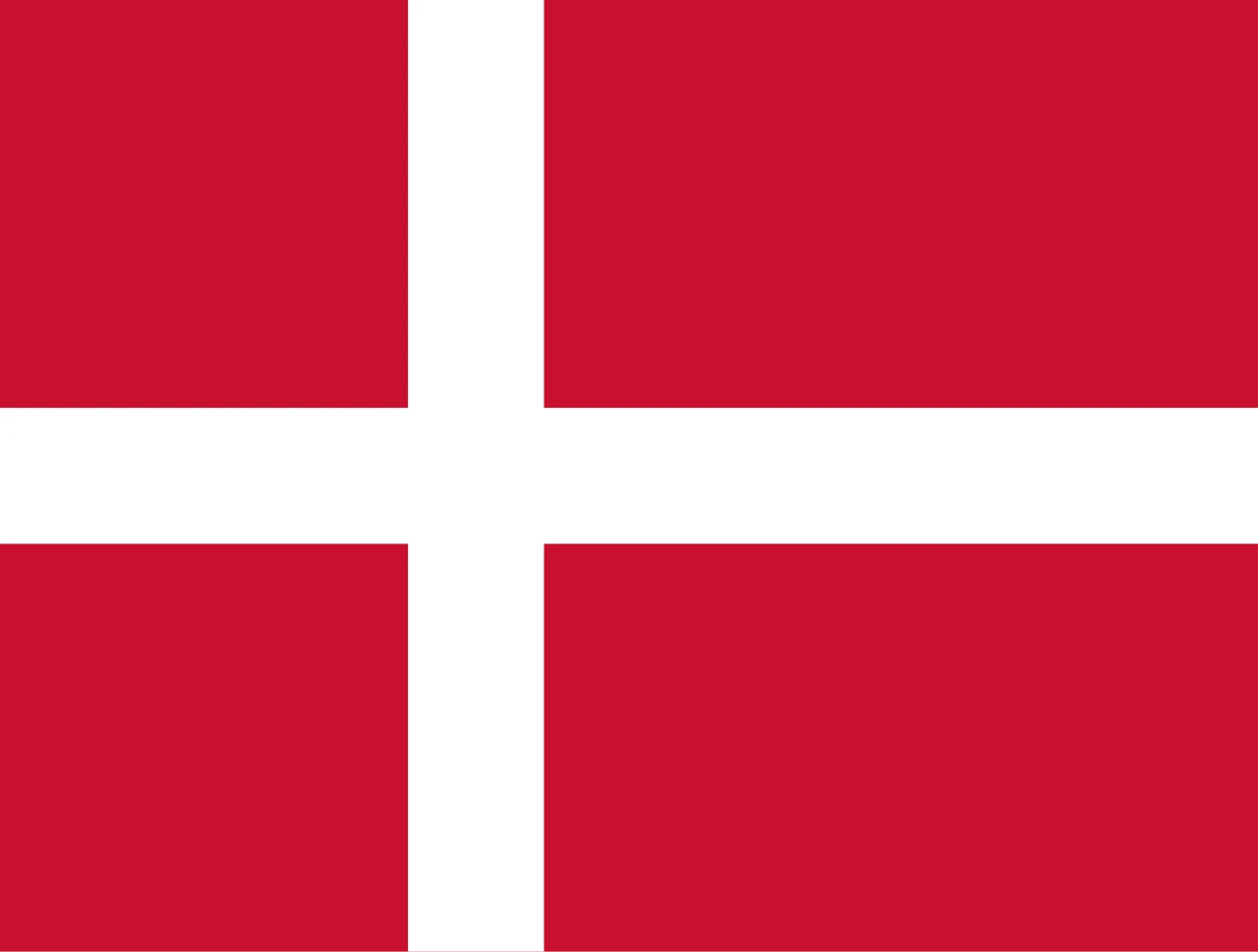
The Dannebrog, Denmark’s red flag with a white Scandinavian cross, is often presented as «the oldest flag in the world» and dated to 1219. The two ideas rest on different things: a legend, and a record that refers to something else.
The Dannebrog today: a white cross on a red field.
The legend
Tradition places the origin at the Battle of Lindanise (Lyndanisse), near present-day Tallinn (Estonia), on 15 June 1219, during a campaign by King Valdemar II. According to the story, the flag «fell from the sky» when the Danes were losing, and the battle was won.
The oldest text that tells this is Christiern Pedersen’s Danske Krønike, written between 1520 and 1523: more than three hundred years after the date it gives. Another chronicler, Petrus Olai (d. around 1570), tells a similar episode, but in a battle in 1208 near Fellin; the 1219 version appears in a later work of his.
What the documents show
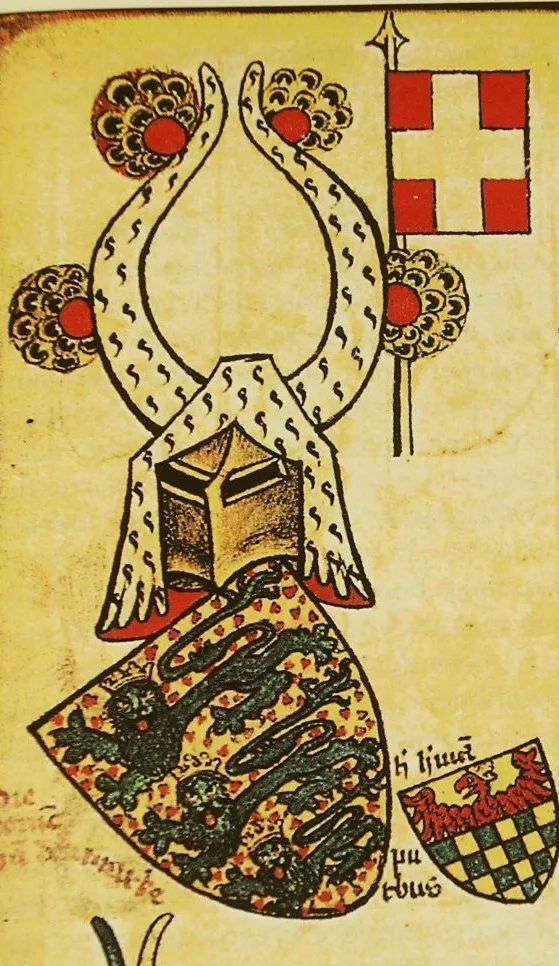
The Gelre Armorial: the Danish royal arms and, top right, a flag with a white cross on red. Public domain.
Around 1340–1370
The Gelre Armorial shows a flag with a white cross on red next to the Danish royal arms. It is the oldest colour image that is not disputed.
1356
The seal of King Valdemar IV includes a cross in his arms.
1398
A seal of Eric of Pomerania, of the Kalmar Union, shows three lions holding a small flag with the cross.
1514
An edition of Saxo Grammaticus has the flag on its title page.
In other words: its use by the Danish kings is documented from the 14th century. Before that, there is no written proof linking the flag to the battle of 1219.
What historians think
Since the 19th century Danish historians have debated whether the legend has a real basis:
- Caspar Paludan-Müller (1873) proposed that it might have been a banner sent by the Pope during the Livonian crusade.
- A. D. Jørgensen (1875) suggested that the legend arose from a confusion around Bishop Theoderich’s tent, and linked the banner to the Hospitallers.
- L. P. Fabricius (1934) placed the origin at the battle of Fellin in 1208, as the earliest source.
- Helge Bruhn (1949) compared it with other medieval legends of miraculous crosses in the sky.
None of these hypotheses has prevailed.
«The oldest»: what it means
Guinness World Records considers the Dannebrog the oldest continuously used national flag, and dates it to 1625 (8 May), not 1219. It is a statement about its status as a national flag in use, not about the age of its design. As a maritime flag it was already in use in the 16th century.
Some facts
- Proportions: 28:37 for the national flag; 56:107 for the state flag; 7:17 for the naval flag.
- Private use: a circular of 1834 banned it, and a regulation of 1854 allowed it again.
- Army: it was introduced as a regimental flag in 1785 and for the whole army in 1842.