History of the Amazigh flag
The Amazigh flag: who the Amazigh or Berbers are, what their colours and the letter yaz mean, when it became official and what Yennayer, their New Year, is.

If you see a flag with three stripes, blue, green and yellow, and a red letter in the centre, you are looking at the Amazigh flag: the symbol of one of the oldest peoples of North Africa. In this article we tell you who they are, what their flag means and how it has spread.
Amazigh or Berber: who are they?
The Amazigh (plural Imazighen), also known as Berbers, live in different regions of North Africa and the Sahel, an area they call Tamazgha. Many prefer the name “Amazigh”, because “Berber” resembles the Arabic word for “barbarian” and they consider it pejorative. “Amazigh” is sometimes translated as “free man” or “noble”; this translation is disputed.
They are estimated at between 25 and 36 million people. Most live in Morocco (between 14 and 20 million) and Algeria (between 7 and 13 million); there are also communities in Niger (about 2.6 million), France (2 million), Mali, Libya, Belgium, Tunisia and Egypt, among other countries.
They are not a single group: there are Kabyles, Chaouis, Riffians, Chleuhs, Tuareg and Mozabites, among others. Historically the ancient Numidians and the Guanches of the Canary Islands are also considered to be of Amazigh origin. These peoples are not all the same, but they share cultural and linguistic roots.
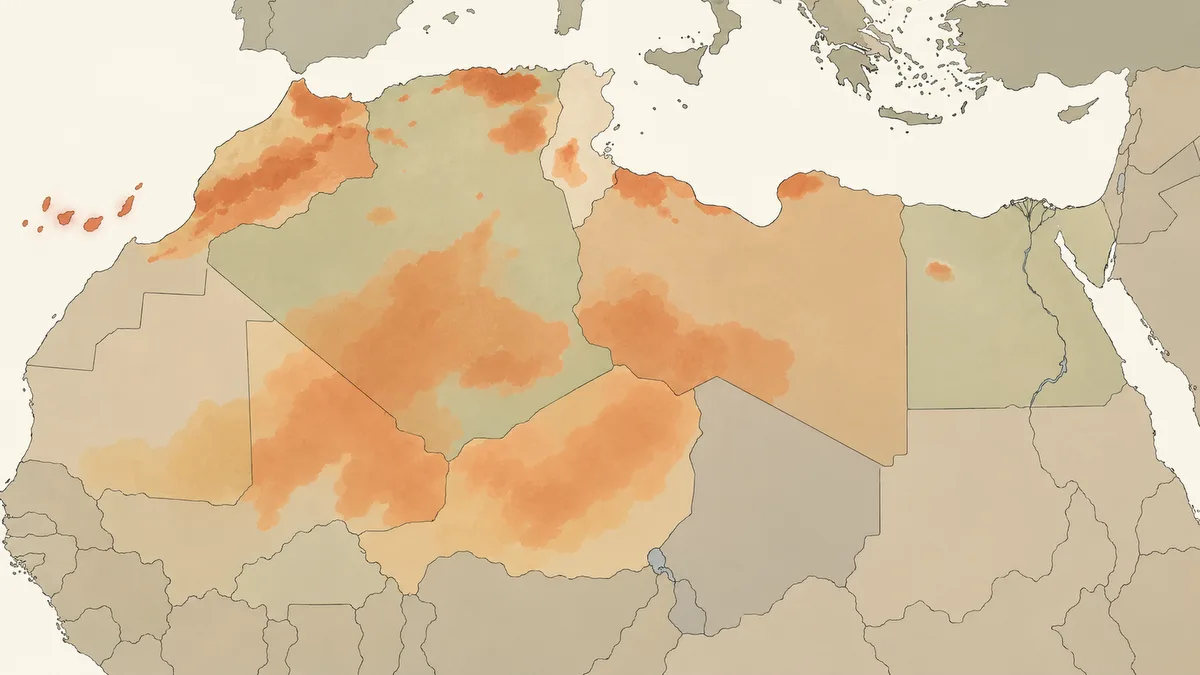
Indicative map: the orange areas are approximate and do not mark exact boundaries.
A history of resistance
The Amazigh peoples have resisted invasions and colonisations by Greeks, Romans, Arabs, Spaniards and French for centuries. A few names from that history:
- Jugurtha, a Numidian king of Amazigh origin, who fought Rome in the Jugurthine War.
- Dihya, a 7th-century religious and military leader, whose coalition was defeated at the Battle of Tabarka in 703.
- 739–740: an Amazigh revolt against heavy taxation and the second-class treatment of converts, in the time of the Umayyads.
- 11th to 16th centuries: Amazigh dynasties such as the Zirids, the Almoravids and the Almohads ruled parts of North Africa and the Iberian Peninsula.
The flag
The first proposal for the Amazigh people to have their own flag was made in 1970, according to the most widespread account, by the Berber Academy (Agraw Imazighen) of Mohand Arav Bessaoud, as a cultural and identity symbol. The authorship of the design is disputed: other sources attribute it to Youcef Medkour, an Algerian Kabyle veteran, who is said to have inaugurated it in Kabylia. The sources do not settle it and give both versions.
It is a 2:3 flag with three equal horizontal stripes (blue, green and yellow) and, in the centre, the letter yaz (ⵣ) of the Tifinagh alphabet, in red. That letter represents the word Amazigh. In the Tamazight language, the flag is called Acenyal Amaziɣ (ⴰⵛⵏⵢⴰⵍ ⴰⵎⴰⵣⵉⵖ).

Proposed flag with the stars of the Amazigh peoples, at a congress.
What the colours mean
According to the most common explanations, each colour corresponds to an aspect of Tamazgha:
- Blue: the sea (the Atlantic Ocean and the Mediterranean Sea).
- Green: the mountains and the land.
- Yellow: the desert.
- Red (the letter yaz): resistance and free men, the Amazigh martyrs.
These are readings attributed by scholars, not official definitions.
When it became official
The Berber Academy adopted it in 1970, and the World Amazigh Congress made it official in 1997, in Tafira (Las Palmas de Gran Canaria), with representatives of all the Amazigh peoples. A few years later, 30 August was proposed as the world day of Amazigh culture and flag.

The Amazigh flag, with the letter yaz in red.
Other proposals

Berber flag with the symbol in black.

Flag with the order of the colours changed.
The flag in the street and in sport
It is not accepted equally everywhere. In Algeria, during the Hirak movement of 2019, its use was banned.

Former FC Barcelona player Ibrahim Afellay, with the flag.

Amazigh demonstration in Paris.
Yennayer: the Amazigh New Year
Yennayer is the first month of the Amazigh calendar and the New Year, celebrated with a big family dinner on the evening of 12 January. This calendar was created in 1980 by the Algerian scholar Ammar Negadi, who set its year 1 at 950 BC (in fact 943 BC), the year Shoshenq I took the throne of Egypt. To know which Amazigh year it is, add 950 to the current year: in 2026 it is 2976. This link with Shoshenq I has disputed sources.
The dishes change with the region: trida or chakhchoukha in the Aurès, asfel with couscous in Kabylia, or tagula (barley with smen and argan oil) in the Sous, in southern Morocco. Algeria declared it an official holiday on 27 December 2017, and the first official celebration was on 12 January 2018. Morocco did so on 3 May 2023.