The creation of Gran Colombia
Have you ever wondered why Colombia, Venezuela and Ecuador share the same pattern on their national flags? Because long ago they were one and the same country.

Have you ever wondered why Colombia, Venezuela and Ecuador share the same pattern on their national flags? Because long ago they were one and the same country, Gran Colombia, or the Republic of Colombia. It was a project led by Simón Bolívar, which began in 1819 through the Fundamental Law of Colombia and was completed in 1821 at the Congress of Cúcuta, in Colombia.
First, New Granada/Cundinamarca (today’s Colombia) and Venezuela joined under the name Republic of Colombia. Panama joined in 1821, after declaring its independence from Spain. After these events, Simón Bolívar went off to fight for the independence of Ecuador (Quito), which also joined the Republic of Colombia in 1822, and on the front for the liberation of Peru.

First proposal for the flag of Gran Colombia, from 1819 to 1820.

Second proposal for the flag, from 1820 to 1821.
The short answer
- What it was: a country that existed between 1819 and 1831 and united what are now Colombia, Venezuela, Ecuador and Panama. Its official name was the Republic of Colombia; historians use “Gran Colombia” to tell it apart from the present-day country.
- Who led it: Simón Bolívar, appointed president, with Francisco de Paula Santander as vice-president.
- Why it matters for flags: the flags of Colombia, Ecuador and Venezuela are sisters because all three derive from the flag of Gran Colombia.
Key dates
17 December 1819
The Congress of Angostura approves the Fundamental Law of the Republic of Colombia.
30 August 1821
The Constitution of Cúcuta comes into force.
19 November 1831
The state is dissolved. Venezuela, Ecuador and New Granada become independent states.
Its capital was Bogotá, and it had an area of about 3,064,800 km².
Why are the three flags so alike?
The yellow, blue and red design is attributed to Francisco de Miranda, who made a flag with those colours for the First Republic of Venezuela (the Venezuelan congress approved it in 1811). It was first raised on 12 March 1806 in Jacmel (Haiti). It is not known for certain what inspired him: he himself described a conversation with Goethe about primary colours in 1785, remembered a fresco of Columbus with a similar flag, and noted the yellow, blue and red standard of Hamburg’s Civic Guard.
The Congress of Gran Colombia adopted those colours on 17 December 1819. When the country dissolved, each new state kept the colours and kept adjusting them. Colombia’s is today a horizontal tricolour in a 2:1:1 proportion (yellow on top, half the flag). The government attributes these meanings: yellow, wealth, sovereignty and the sun; blue, the sky, the seas and the rivers; red, the blood shed for independence. Ecuador’s is almost identical in proportions and layout, and is told apart by its shade and by the coat of arms on its state flag. Venezuela’s uses equal stripes.
Below you will find the history of each flag, country by country.
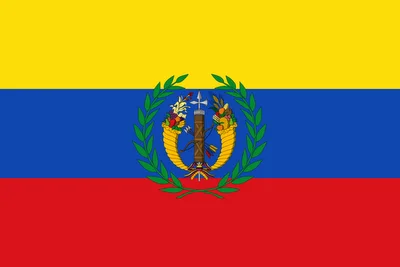
Definitive flag of the Republic of Colombia.
Besides these territories, there was also part of north-western Brazil and northern Peru, and it claimed the Essequibo region, in Guiana. Simón Bolívar wanted to create a strong country to face a possible Spanish reconquest of these territories. The Republic of Gran Colombia officially existed for 10 years, from 1821 to 1831.

Simón Bolívar led the wars of independence from the Spanish Empire in Venezuela, Colombia, Ecuador, Panama and Peru, and Bolivia bears his name. He was known as ‘El Libertador’.
The ten years of life of the new country were marked by internal rivalries: first the centralism of the country, the location of the capital, Bogotá, which was much questioned from Venezuela, and the political ambitions of some leaders, since Simón Bolívar held all the power. In Venezuela the independence movement grew to the point that in 1830 they declared their constitution and their new president, General Páez. Ecuador followed, declaring its separation from the union, and the Venezuelan Juan José Flores headed the country. Panama finally separated in 1903; years earlier there had already been attempts at separation, a movement led by Juan Eligio Alzuru.
New Granada
New Granada made adjustments to the flag of the Republic until it reached Colombia’s current design:

Flag of New Granada, first version after the dissolution of Gran Colombia.

Flag of New Granada adopted in 1834.

Flag of the United States of New Granada, used from 26 July until 26 November 1861.

Current flag of Colombia, adopted in 1861.
Venezuela
Venezuela went through the following changes to its flag:

Keeping the format of the Colombian Republic but changing the text to ‘State of Venezuela’, from 1830 to 1836.

The first after the Republic, in force from 1836 to 1859.

Flag of the Venezuelan Federation. Official from 1859 to 1863.
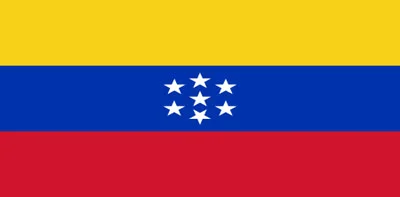
This flag headed the country from 1863 to 1905. Change made by President Juan Crisóstomo Falcón.

Flag changed by the officer Cipriano Castro, from 1905 to 1930.

Flag with the seven stars, but arranged in a semicircle. Official from 1930 to 1954.

Flag of Venezuela with coat of arms and the seven stars, official from 1954 to 2006.

Current flag of Venezuela.
Ecuador
In Ecuador the following evolution took place:

Flag of Ecuador, still keeping the format of the Gran Colombia flag, from 1830 to 1833.

In 1833 the coat of arms on the flag was replaced; this flag was used until 1835.

From 1835 to 1845 the colours were kept but the coat of arms was removed.

At the end of the revolution of 6 March 1845, the flag was replaced by one with three vertical stripes of blue and white. The three stars stood for the departments of Quito, Guayaquil and Cuenca.

In November 1845 seven stars were added, representing the provinces of the country. This flag stayed in use until 1860.

On 26 September 1860, García Moreno signed the decree to return to the tricolour flag, which is the one still in use today.
Panama
And finally Panama, which had the following variants:

While the union with Colombia lasted this flag was used, until 1903.

This proposal was revoked as the country’s flag. Philippe Bunau-Varilla, who represented Panama before the United States (he was not its president), travelled to New York, where this flag was prepared. Clearly inspired by the USA, the colours of the stripes were a tribute to the colours of Spain and the suns meant the union that Panama makes between North and South America.

Finally, in 1903 Manuel Encarnación Amador represented on the flag the two political movements of the time, in harmony and with the white of peace. The stars represent the purity and strength of the Panamanians.

A year later, the flag changed the order of the design, making it more visually striking, and was definitively ratified in 1941.