The Cultrún
The cultrún, a Mapuche ritual drum, and its role on the Mapuche flag (wenufoye): what the flag’s origin says, what is attributed to the symbol and what scholars say.
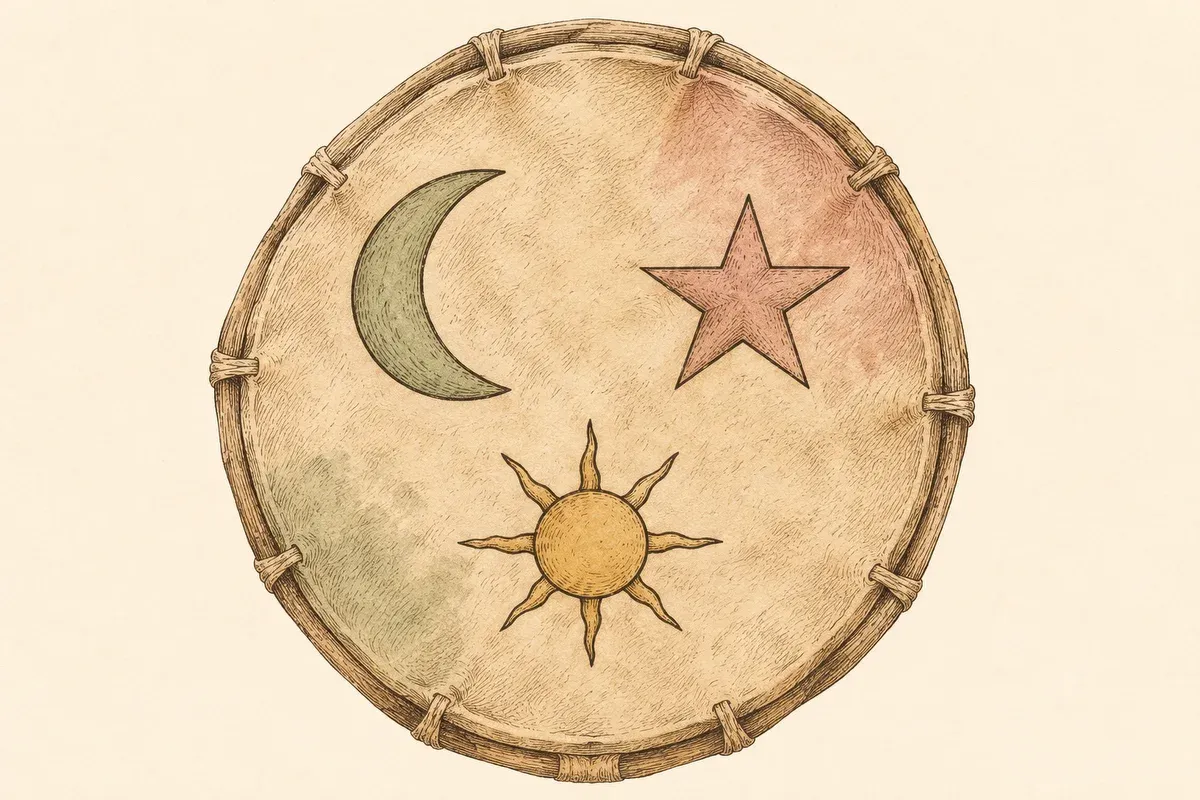
A wooden drum with a face painted in four parts: that is the cultrún, the most important musical instrument in Mapuche culture. Today you see it mainly on the wenufoye, the Mapuche flag, but before becoming an emblem it was a ceremonial object. Here we separate what the history of the flag says, what is attributed to the symbol and what scholars say.
Where the name comes from
«Cultrún» comes from Spanish; in Mapudungun, the Mapuche language, it is called kultrung. Mapuche people in Chile and Argentina play it. The machi, the healer, uses it to lead ceremonies, and it also sounds during the ngillatun, the annual rogation.
What it looks like and how it is played
- Body: wooden.
- Use: the machi may hold it in one hand and strike it with a drumstick, or rest it on the ground and play it with two sticks.
- Face: painted with a design that represents the world: the four cardinal points, with the sun, the moon and the stars between them.
The Mapuche flag
The wenufoye, which in Mapudungun means «canelo del cielo» («sky canelo»), was chosen from about 500 designs in a competition that began in March 1991. The organisation Aukiñ Wallmapu Ngulamon adopted it on 5 October 1992. It is not a state flag: it is an emblem that some Chilean municipalities fly alongside the national flag. A 2010 ruling by Chile’s Comptroller General authorised its use at ceremonies.
The design includes the cultrún and the guemil, a stepped motif. The meaning of the colours was spread by its creators; it is not a rule:
- Yellow: renewal and the sun.
- Blue: life, order and the universe; also the sacred.
- White: healing, wisdom and longevity.
- Red: strength and the history of struggle.
- Green: earth and nature, and the machi.
What is attributed and what is documented
- Creators’ reading: the cultrún on the flag represents knowledge of the world. It is a modern reading of the symbol, not a record from before the conquest.
- Academic reading: Grebe (1973) described it as a «symbolic microcosm» of the Mapuche world.
- Gender: many Mapuche conceive the drum as a womb, and the painted face is read as four pairs of male and female figures. Some authors read it as the family of the god Ngünechen: an old man, an old woman, a young man and a young woman. These are academic interpretations, not a closed doctrine.
- Origin: most scholars consider it of Indigenous origin. Salvo (2015) argues for an African origin, a minority thesis.
A warning: there is no single list of meanings. Those cited for the flag come from its creators and from popular accounts, and Mapuche tradition is passed on mainly orally.
Where it appears
- Mapuche flag (wenufoye): an emblem in use since 1992, mainly in Chile.
- Other flags: at the same time, five flags were created for Mapuche territories and subgroups: Huenteche, Lafquenche, Nagche, Pehuenche and Huilliche.