The Dragon
Bhutan and Wales both carry a dragon on their flags, but they are two different dragons. What each flag officially says, its colours and its origin.
Two flags of different states carry a dragon: that of Bhutan and that of Wales. They are alike in that both show a dragon, but they have no relation to each other. Each has its own colour, shape, history and official text. Here they are separated into two sections so you do not confuse them.
The white dragon of Bhutan
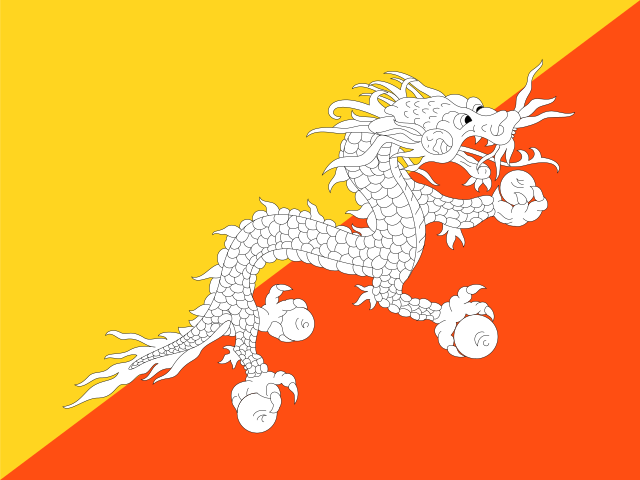
The Bhutanese flag is divided diagonally, from the lower corner at the hoist: the upper half is yellow and the lower half is orange. A white dragon appears on the dividing line. The current version has been in use since 1969, and the 2008 Constitution describes it in its First Schedule.
The constitutional text associates yellow with the secular tradition and orange with the spiritual tradition. The dragon, which sits on the division, symbolises the name of the kingdom (Druk) and the pure thoughts of its people. Wikipedia adds that the dragon holds a jewel in each claw, a detail the constitutional text does not record.
The red dragon of Wales
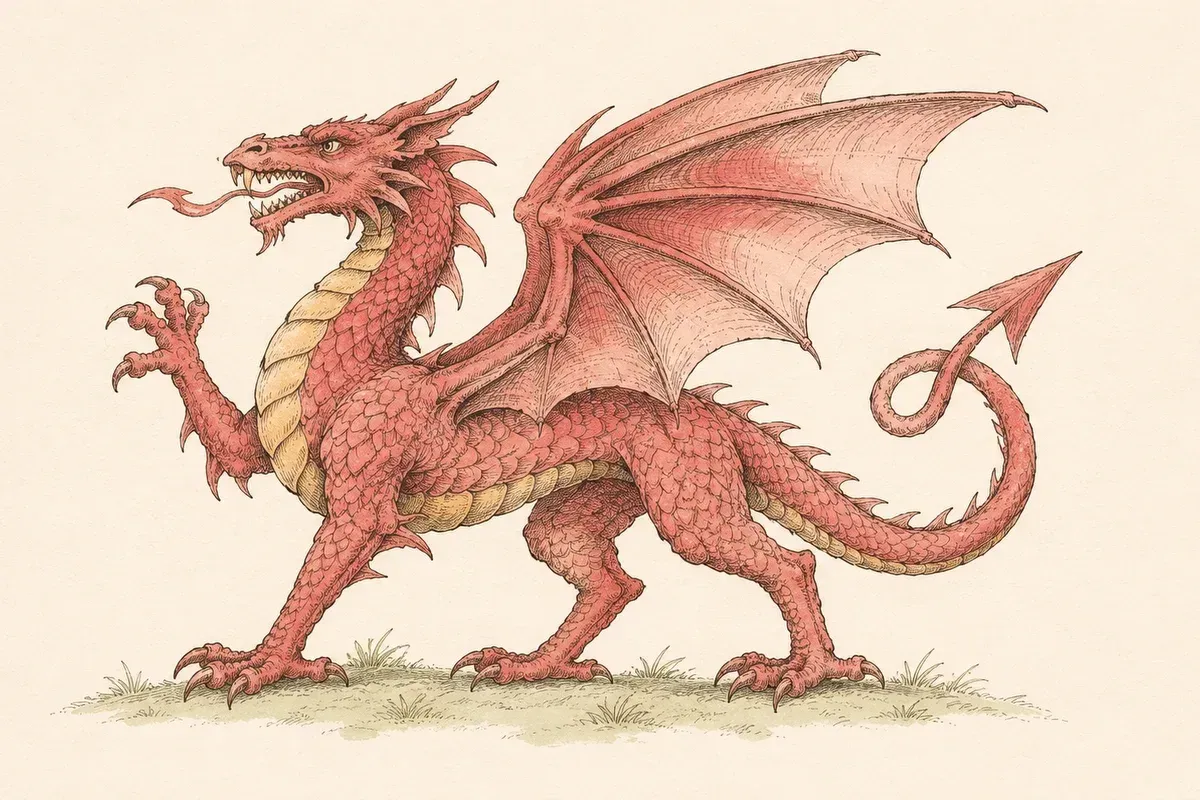
The flag of Wales shows a red dragon passant on a field divided horizontally: white above and green below. It is the Y Ddraig Goch, with a ratio of 3:5. It was officially recognised in 1959.
The dragon is much older than the flag. The Historia Brittonum (c. 828) describes it as red for the Britons, and the Flag Institute links it to King Cadwaladr of Gwynedd around the year 655. In 1485, Henry Tudor carried it at Bosworth. Green and white are the colours of the Tudor dynasty.
Recent history is shorter: in 1807 the dragon on a green mount became the royal badge of Wales. In 1953 a flag with a motto was made, widely criticised, and in 1959 the government adopted the current flag.
Two dragons, two flags
- Bhutan: white dragon, diagonal field of yellow and orange (Pantone 116 and 165).
- Wales: red dragon, horizontal field of white and green (Pantone Green 354 and Red 186, according to the Flag Institute).