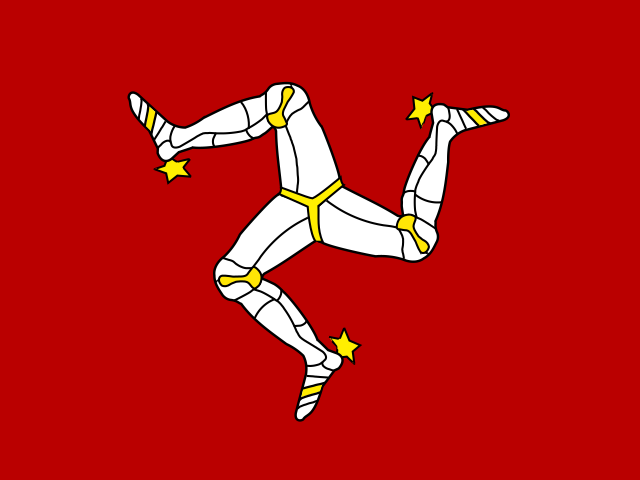
The Triskele
The triskelion, the symbol of three spirals or legs: where its name comes from, how old it is, what it is said to mean and the flags it appears on, such as the Isle of Man’s and Sicily’s.

Three spirals, or three bent legs, coming out of one centre and turning in the same direction: this is the triskelion. You can see it on the flags of the Isle of Man and Sicily, but it is much older than both. Here we explain where it comes from, what it means and where it appears.

Where the name comes from
The word “triskelion” comes from the Greek triskelḗs, “three-legged” (from tri-, “three”, and skelos, “leg”). The name of the symbol is modern: it was introduced in French (triskèle) by Honoré Théodoric d’Albert de Luynes in 1835. What it meant to the Greeks is not recorded directly; the link with Hecate, the triple goddess, is Luynes’s reconstruction. It must not be confused with the triquetra, which is a different motif.
A very old symbol
- Triple spirals: they appear in Malta (4400–3600 BC), at Newgrange, Ireland (c. 3200 BC), and on Mycenaean vessels, such as a jug from the 14th century BC.
- Three legs: the triskelion with legs appears on archaic Greek pottery (an Attic hydria from the late 6th century BC) and on Greek coins.
- Sicily: coins minted by Dionysius I of Syracuse from about 382 BC carry the symbol. In the Sicilian version there is the head of Medusa (gorgoneion) in the centre.
- Celtic art: the triskelion appears in La Tène Iron Age art, and later in rock carvings in Castro culture settlements in Galicia, Asturias and northern Portugal.

What does it mean?
Many people attribute meanings to it: day, night and dusk; past, present and future; beginning, end and reincarnation… These are modern interpretations, not meanings documented from the period. Today Irish hospitals and care centres use it as an end-of-life symbol, with the three spirals associated with birth, life and death; neopagan and Celtic reconstructionist groups also use it, partly because of its link with Manannán mac Lir, the sea god.
A warning: some neo-Nazi groups have adopted triskelion variants, among them South Africa’s AWB. Depending on the context, its use can be prosecutable in Germany.
The triskelion on flags
- Isle of Man: three armoured legs with golden spurs on a red field, in a 1:2 proportion. It has been official since 1 December 1932 (sources differ on the exact date). It comes from the arms of the King of Mann, recorded in the 13th century. In Manx it is called ny tree cassyn, “the three legs”. A civil ensign was also approved on 27 August 1971, with the Union Jack in the canton.
- Sicily: the triskelion (the Trinacria) with the head of Medusa in the centre. It was reintroduced on flags from 1848 and officially adopted on the flag in 2000.
- Others: Füssen (Bavaria), on a seal from 1317; Dukla (Poland), among others.
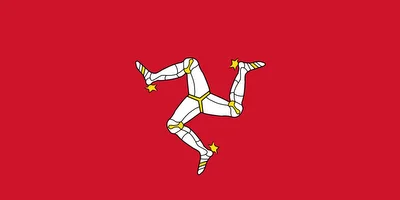
Isle of Man.
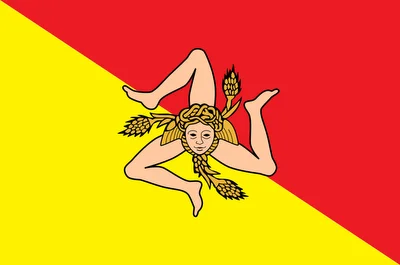
Sicily.