The white horse
The white horse as a symbol: the legend of Hengist and Horsa, what is documented, and the coats of arms and flags where it appears, such as those of Kent, Lower Saxony or Westphalia.
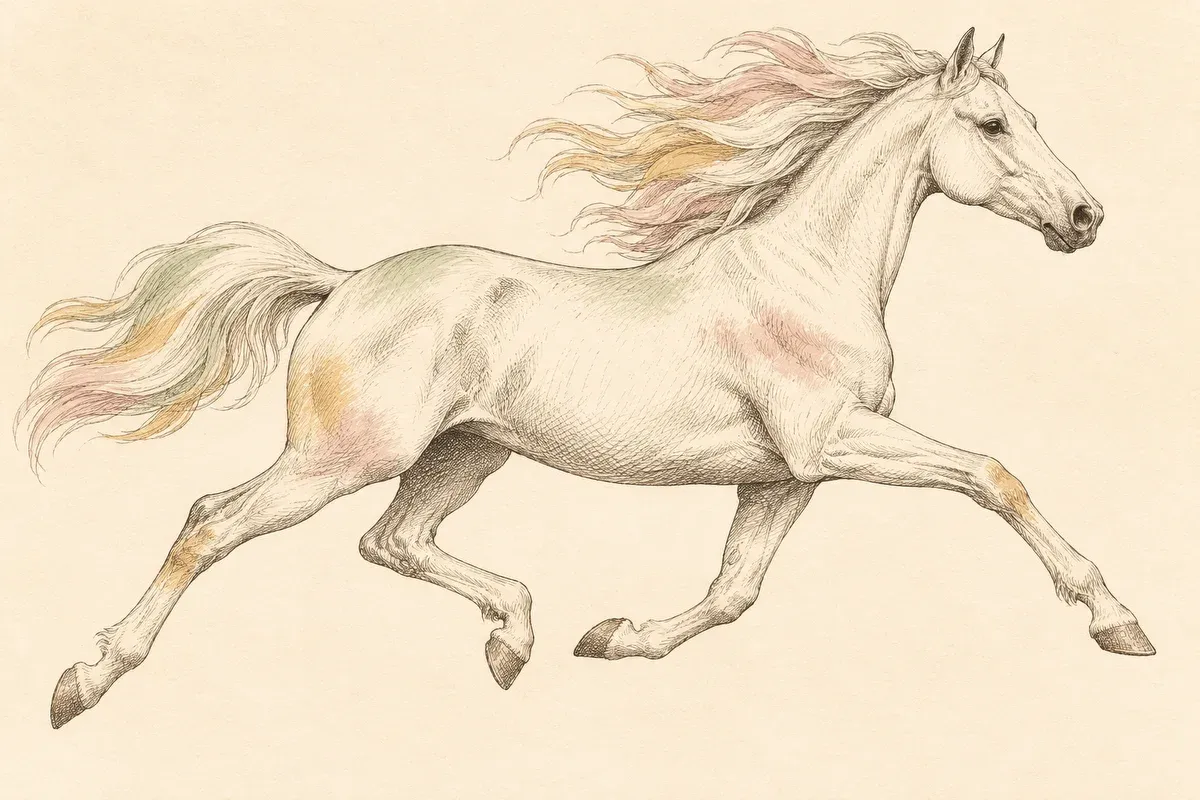
A white horse on a coloured field: that is how it appears in the arms of Kent, in those of Lower Saxony and in those of Westphalia. Yet they do not share the same origin or the same legal status. Here we separate the legend, the documentary record and the law, which is what determines what is official.
Hengist, Horsa and the name
Bede the Venerable mentions Hengist and Horsa as leaders of the Jutes who arrived in Kent. In Old English, their names mean “stallion” and “horse”. Many historians regard them as legendary. According to tradition, they carried a banner with a white horse, and the White Horse Stone at Aylesford was erected in Horsa’s honour.
Legend and record
- Legend: the banner of Hengist and Horsa. As a historical fact, it is not documented.
- Record: the earliest printed record of a Kent banner with a horse dates from 1605, in a work by Richard Verstegan, which places it in the hands of Hengist and Horsa.
- Spread: in the 18th century the horse spread through its link with the House of Hanover. The accession of George I in 1714 and the use of the horse by the Kentish Post in 1722 helped make it a common emblem of the county.
- Origin: unknown. Coins of pre-Roman rulers, such as Dubnovellaunus, have been proposed, but they remain hypotheses.
The Kent horse: arms and flag
- Arms (law): Kent County Council received its coat of arms with the horse on 17 October 1933, confirmed in 1975. It is a documented heraldic grant.
- Flag (tradition): a white horse rearing on a red field, in a 3:5 proportion. The Flag Institute registers it as the traditional flag of the county, not as an official one. It is also known as the Invicta flag, after the county motto. According to FOTW, the council flew it daily until it adopted a new logo in the 1990s; its current use is uncertain.
Lower Saxony: a horse in the law
The arms of Lower Saxony are a half-round shield with a white horse leaping (springendes weißes Ross) on a red field. They are fixed by the law of 8 March 2007, in force since 1 June 2007. The flag has the colours black, red and gold, with the arms slightly shifted towards the hoist, and a 3:2 proportion. It was introduced on 13 April 1951 by the provisional constitution. The horse is called Sachsenross, “Saxon horse”.
Westphalia: a flag without a horse
The flag of Westphalia consists of two horizontal bands, white above and red below, with no horse. Its colours derive from the Westphalian arms. A decree of 22 October 1882 introduced it for the Prussian province; the Reich flag law of 1935 abolished it. The Landschaftsverband Westfalen-Lippe has used it since 1986, with or without the arms in the centre. The horse belongs to the historic arms, a white Sachsenross on red. The source consulted does not link it to Hengist.
What is law and what is not
- Law: the arms of Kent (1933), the Lower Saxony arms law (2007) and the Westphalian decree of 1882, now abolished.
- Tradition: the Kent flag and the legend of Hengist and Horsa.
- No firm source: the origin of the horse as a symbol of Kent.