Skip to content

Wiki Banderas
Open menu

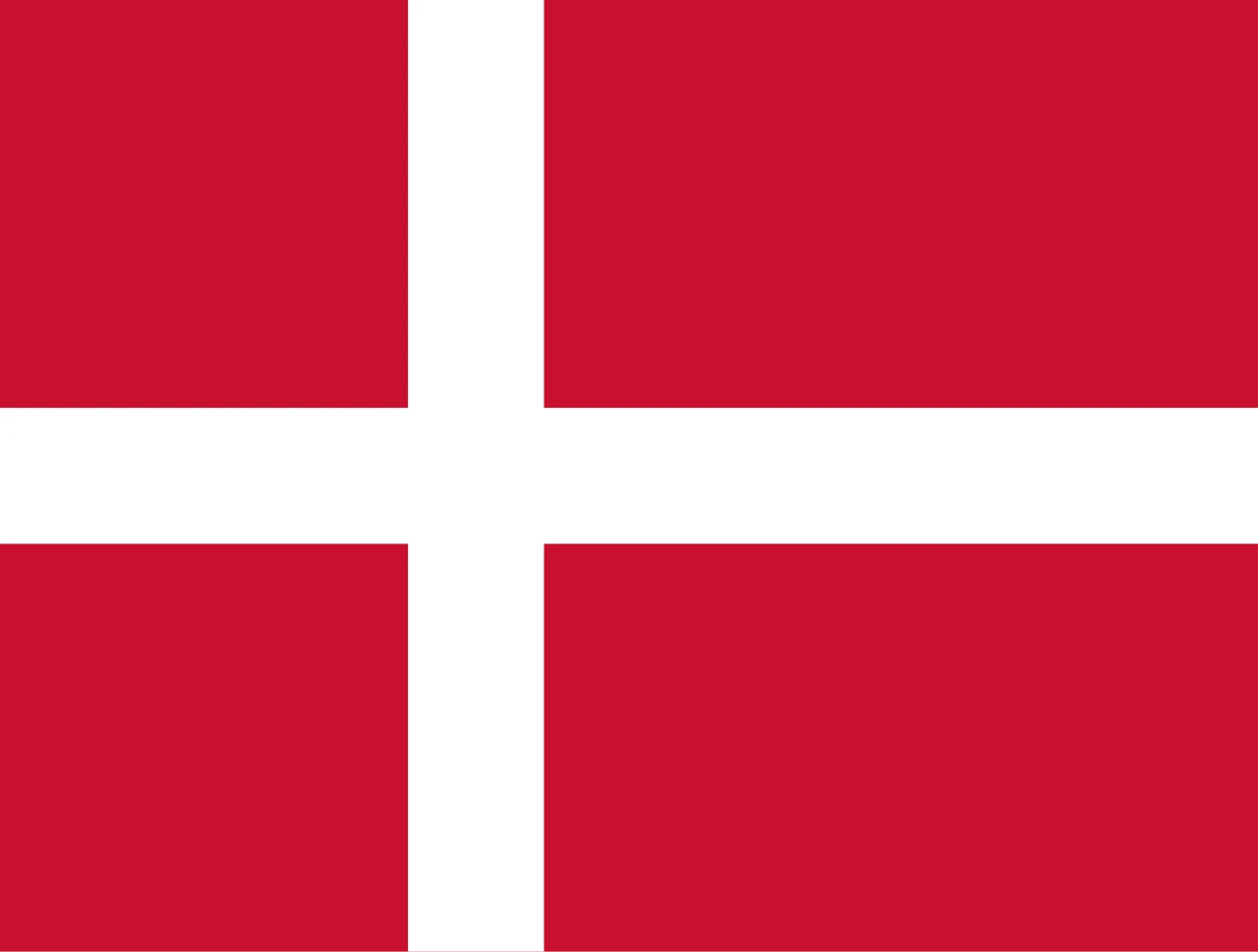
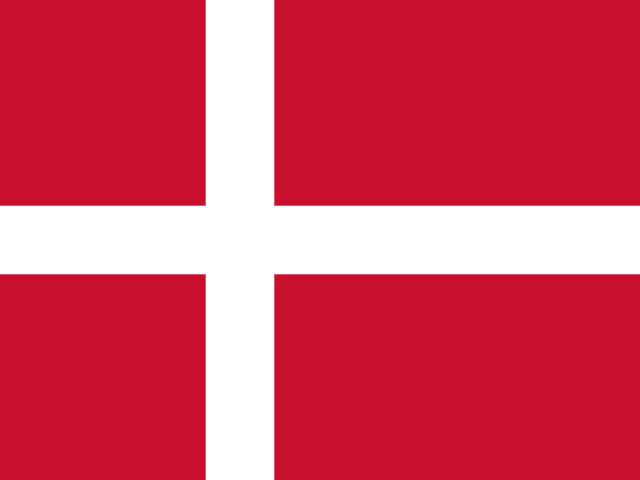
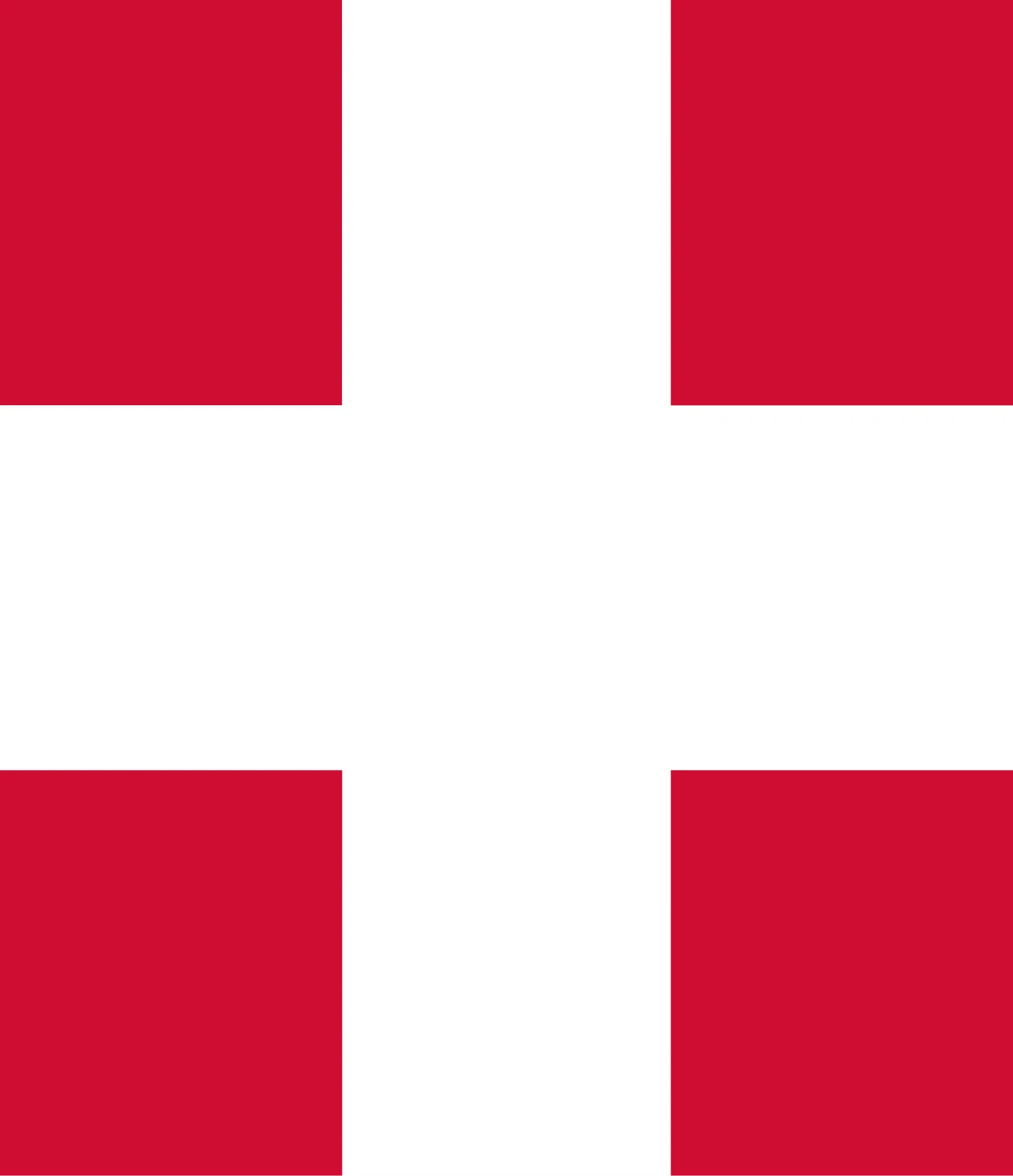
Flag of Denmark

A white cross on a red field: the oldest national flag still in use and the model for all the Nordic crosses.

Flag of Denmark
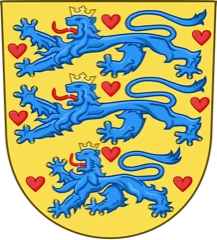
Coat of arms

The flag, in figures

Every fact about the flag, each with what it means.

Proportions
28:3737 wide for every 28 high. 1 flags in the catalogue share it.
Properties
Normal flagFIAV symbol: the form of the flag.
Use
Civil, on land and at seaFIAV symbol: who may fly the flag.
Adopted
174811 June 1748 · 278 years ago
Colours
  • red
  • white
Reference shades: the official one may vary slightly.
Coat of arms
YesIt carries the coat of arms on the cloth.
12

Take a closer look

  1. The red cloth

  2. 1

    The white cross

  3. 2

    The four red quarters

How it is described

The flag in the words of vexillology and heraldry.

Vexillological description

It is a rectangular field with a 28:37 ratio, red, with a white cross shifted towards the flagpole (the type called a Nordic cross).

Cross
its two arms measure 12 units wide on a height of 28: it leaves, on each side, red stripes of 7 units both vertically and horizontally.
Ratio
the 28:37 measure is recommended by the army since 1893, though the law does not require it.
Field
no other figures: it is the Dannebrog, “the flag of the Danes”.
What it carries

Each element and how many of the 1,390 flags in the catalogue carry it. In yellow, the rarest.

The full story

How it was born, how it has changed and what it means.

The flag of Denmark is red with a white cross. The Danes call it the Dannebrog, which means “cloth of the Danes” or “red cloth”. It is the oldest national flag still in use today and the model from which all the other Nordic flags came.

How it came about

Nobody knows exactly when it began to be used. The oldest evidence is a fourteenth-century Dutch book of coats of arms, the Armorial Gelre, which draws a red standard with a white cross next to the arms of the king of Denmark.

Tradition tells another story. On 15 June 1219, in a battle in Estonia, the troops of King Valdemar II were losing when the flag fell from the sky and gave them victory. It is a legend: nobody wrote it down until the sixteenth century, nearly three hundred years later. Historians think the cross comes from the Christian standards carried by the crusaders of that time.

How it has changed

The colours have been the same since the Middle Ages; what has changed is the position of the cross.

  1. Red standard with a white cross in the centre
    Sodacan · Public domain

    14th century

    At first the cross is in the centre, as in many medieval standards.

  2. 1748

    Over time the vertical arm has moved closer to the mast and the horizontal one has lengthened towards the other side: it is the Nordic cross. A rule fixes the thickness of the cross and the size of each red rectangle.

  3. Current flag of Denmark

    1893

    A slightly longer version is allowed, the one with a 28:37 ratio, which is now the most usual.

What it means

No law gives it a meaning, but its elements are understood as follows:

  • White cross

    Christianity, as on the standards of the medieval kings and crusaders.

  • Red

    the ground of the old war standard of the Danish kings.

  • Cross shifted towards the mast

    the drawing that Sweden, Norway, Finland, Iceland and the Faroe Islands later copied.

Fun facts

  1. A world record

    The Guinness Book of Books recognises it as the national flag used without interruption for the longest time, at least since 1625.

  2. From forbidden to omnipresent

    In 1834 private citizens were forbidden to fly it: it was a thing of the army. In 1854 the ban was lifted. Today the Danes put it on birthday cakes and, since the mid-nineteenth century, also on the Christmas tree.

  3. Only the Danish one

    From 1915, flying the flag of another country on Danish soil was forbidden, with a few exceptions. The rule was lifted in 2023, after a ruling of the Supreme Court.

  4. Two reds

    The Danish Navy uses a darker red than the flag flown on land.

Country facts

Where it is and what borders it.

Capital
Copenhagen
Area
43,094 km²
Country
Kingdom of Denmark
Continent
Europe
Subregion
Northern Europe
Independent state
Yes
UN member
Yes
ISO code
DNK · DK

1 neighbouring countries

How much have you learnt?

Test what you have read about the flag of Denmark.

  1. 1. Which one is the flag of Denmark?

  2. 2. Which of these elements appears on the flag?

  3. 3. In which year was the current flag adopted?

Sources

Text based on the article “Bandera de Dinamarca” from the Spanish Wikipedia, published under the licence CC BY-SA 4.0.

Sources consulted:

Credits

Flag image: Madden and others, Wikimedia Commons · Public domain.

More flags

Accessibility preferences

Accessibility statement

Quick profiles

Text and reading

Text size
Default
Line height
Default
Letter spacing
Default
Word spacing
Default

Colour

Motion and orientation

Cursor