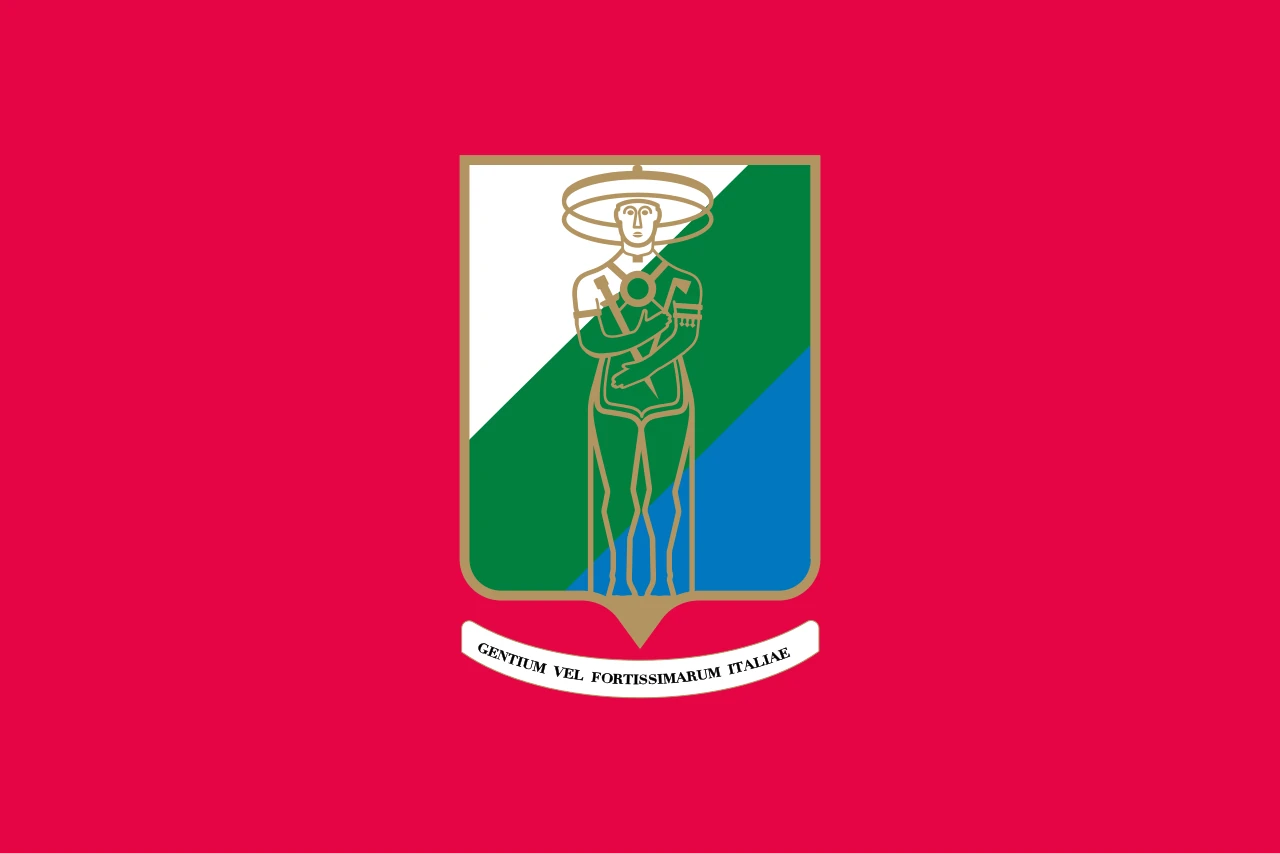
A garnet field with a gold border and the Samnite shield of Abruzzo, whose three diagonal bands run from the snow of the Apennines to the Adriatic Sea.
Every fact about the flag, each with what it means.
Proportions
2:33 wide for every 2 high. 989 flags in the catalogue share it.
Properties
Normal flagFIAV symbol: the form of the flag.
Use
CivilFIAV symbol: who may fly the flag.
Adopted
199921 de mayo de 1999 · 27 years ago
Colours
maroon
white
green
blue
yellow
Reference shades: the official one may vary slightly.
Coat of arms
YesIt carries the coat of arms on the cloth.
Take a closer look
Field
Border
Coat of arms
How it is described
The flag in the words of vexillology and heraldry.
Vexillological description
It is a rectangular field with a 2:3 ratio, in bright garnet with a golden border all around it. In the centre goes the coat of arms of the region, which takes up three fifths of the height of the field.
Field (the cloth)
garnet, with no stripes or divisions.
Border
a gold band surrounding the field on all four sides.
Coat of arms
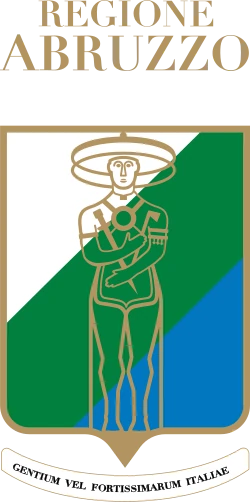
Samnite in shape and divided into three diagonal bands, white, green and blue, with the figure of the Warrior of Capestrano laid over it. It measures three fifths of the height of the flag and goes in the centre.
What it carries
Each element and how many of the 1,390 flags in the catalogue carry it. In yellow, the rarest.
Abruzzo is an Italian region that has existed as a present-day administrative region since 1970
1986
The coat of arms and the gonfalon —the ceremonial standard— were defined in 1986
1999
The flag came later: regional law number 29, of 21 May 1999, approved it for the first time,…
2022
That coat of arms had already been approved in 2022
2023
In December 2023 a new regional law —number 59— reformed the coat of arms: the Warrior of Capestrano
The full story
How it was born, how it has changed and what it means.
The flag of Abruzzo is a garnet field with the coat of arms of the region in the centre. What is interesting about the coat of arms is that it is not an abstract drawing: its three diagonal bands follow the real relief of the region, from the snow of the Apennines in the high mountains to the blue of the Adriatic Sea.
How it came about
Abruzzo is an Italian region that has existed as a present-day administrative region since 1970, but the name is much older: in 1273 King Charles I of Anjou divided the territory into two justice districts with their own stamp.
The coat of arms and the gonfalon —the ceremonial standard— were defined in 1986, by regional law number 26, of 22 July. The flag came later: regional law number 29, of 21 May 1999, approved it for the first time, and it did so without embroidering the name of the region on the field, unlike other Italian regions.
How it has changed
It has changed more times than most Italian regional flags. In December 2023 a new regional law —number 59— reformed the coat of arms: the Warrior of Capestrano, laid over the Samnite shield, was redrawn by the artist Mimmo Paladino and coloured in gold. That coat of arms had already been approved in 2022; the 2023 law closed it off.
What it means
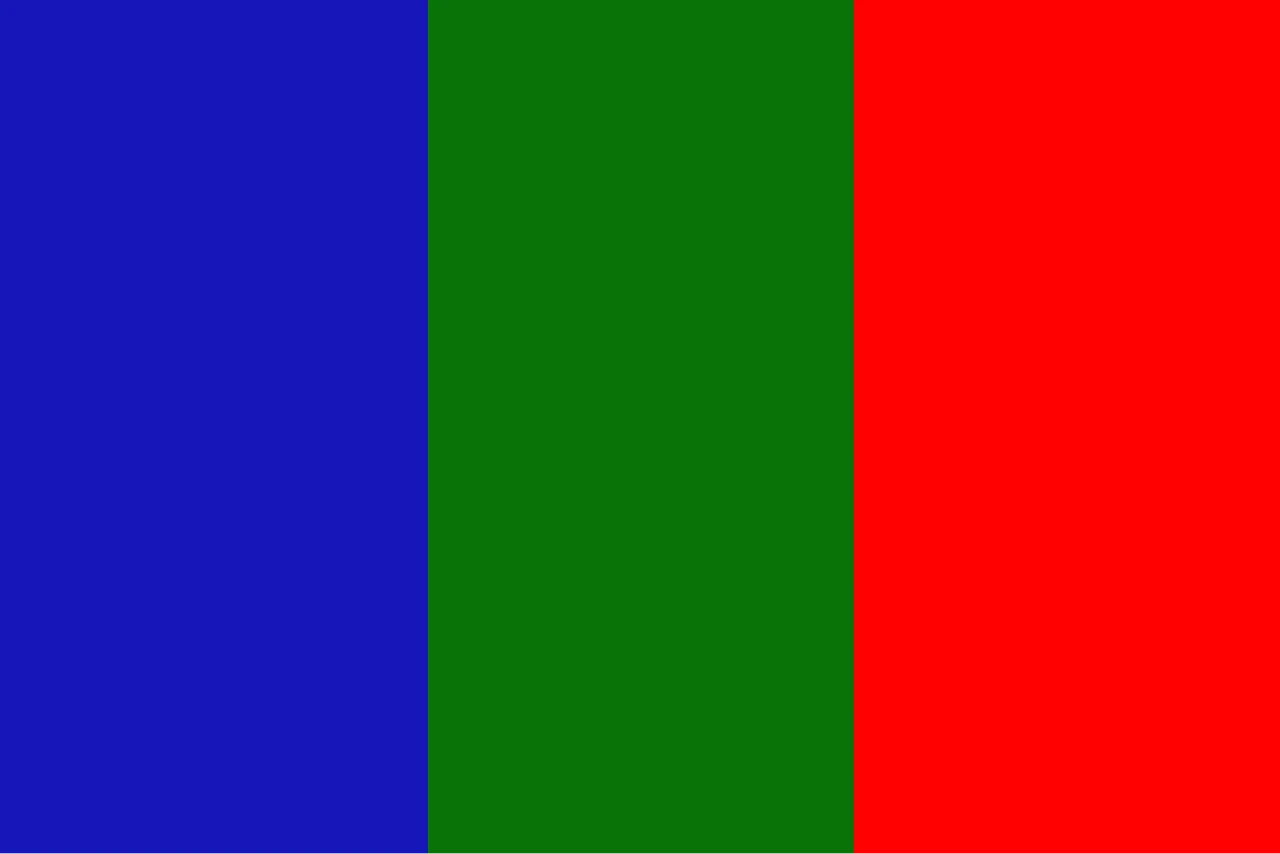
The three colours of the coat of arms are arranged like the territory itself, from the mountain to the sea:
White
the snowy summits of the Apennines. The mountains cover 65.1% of the territory.
Green
the hills and forests, which take up the remaining 34.9%, and the natural parks of the region.
Blue
the Adriatic Sea, with more than 130 kilometres of coast.
Garnet
the field of the flag, a special tone, duller than the red of Italy.
Gold
the border of the field and the Warrior of Capestrano himself, a historical figure of the region.
Fun facts
The colours of the coat of arms are a map
The three diagonal bands of the coat of arms are not placed at random: they follow the real geographical order of the region, from the snow of the Apennines to the blue of the Adriatic. The numbers are worked out —the mountains cover 65.1% of the territory and the hills 34.9%— so the coat of arms is a profile of the region.
The name comes from the land of the Praetuzi
Abruzzo would derive from Aprutium, according to the hypothesis of the humanist Flavio Biondo, and would be the popular evolution of (ad) Praetutium, ‘the land of the Praetuzi’. The official name is Abruzzo, in the singular; Abruzzi, the old form, is no longer used.
Thirteen years of waiting for the flag
The coat of arms and the standard were defined in 1986, but the flag itself was not approved until 1999. Thirteen years of waiting, and meanwhile Abruzzo was already flying a field that no law backed.
Its colour is fixed by law
The bright garnet of the field is not a free aesthetic decision: the 1999 regional law specifies it. Vexillologists compare it to the colour of wine with a gold trim, something unusual in a European flag.
Location
How much have you learnt?
Test what you have read about the flag of Abruzzo.