Skip to content

Wiki Banderas
Open menu

Flag of Altai

Four unequal stripes of light blue and white: the flag of the Republic of Altai, in Siberia, approved in 1992 and with its ratio redefined three times.

Flag of Altai
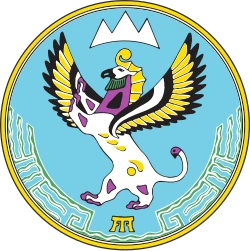
Coat of arms

The flag, in figures

Every fact about the flag, each with what it means.

Proportions
2:33 wide for every 2 high. 989 flags in the catalogue share it.
Properties
Normal flagFIAV symbol: the form of the flag.
Use
CivilFIAV symbol: who may fly the flag.
Adopted
19922 July 1992 · 34 years ago
Colours
  • Blue
  • White
Reference shades: the official one may vary slightly.
Coat of arms
YesIt carries the coat of arms on the cloth.

Take a closer look

  • Upper stripe

  • Second stripe

  • Third stripe

  • Lower stripe

  • Ratio

How it is described

The flag in the words of vexillology and heraldry.

Vexillological description

It is a rectangular field with a 2:3 ratio with four horizontal stripes, of light blue and white, of unequal widths.

Upper stripe
light blue, 67% of the height.
Second stripe
white, 4%.
Third stripe
white, 4%.
Lower stripe
light blue, 25%.
Ratio
2:3, changed several times since adoption.
What it carries

Each element and how many of the 1,390 flags in the catalogue carry it. In yellow, the rarest.

Its history in dates

Every date in its story, at a glance.

  1. 1992

    Chukuyev and approved on 3 May 1992, with a ratio of 1:2

  2. 1994

    What is strange came later: the ratio was changed to 2:3 on 29 June 1994

The full story

How it was born, how it has changed and what it means.

The flag of the Republic of Altai is a field of four horizontal stripes of light blue and white, with very unequal widths: 67, 4, 4 and 25 per cent. The two white stripes are almost a line; the colour is concentrated above and below.

How it came about

The flag was designed by the artist V. P. Chukuyev and approved on 3 May 1992, with a ratio of 1:2. The design established from the start the four stripes with their percentages of width.

What is strange came later: the ratio was changed to 2:3 on 29 June 1994, back to 1:2 on 24 April 2003, and returned to 2:3 on 11 March 2016. Those are four different ratios in twenty-four years.

How it has changed

The ratio has changed three times, and the design never. On 29 June 1994 it went from 1:2 to 2:3; on 24 April 2003 it went back to 1:2; on 11 March 2016 it returned to 2:3. The colours, the percentages of the stripes and the meaning have not been touched.

What it means

  • White

    eternity, the tendency to rebirth, love and the consent of the peoples within the republic. It takes up the two central stripes, 4% each.

  • Light blue

    cleanliness, the mountains, the rivers, the lakes and the sky. It takes up the upper stripe, 67%, and the lower one, 25%.

  • Upper stripe

    blue, 67% of the height.

  • Lower stripe

    blue, 25%.

Fun facts

  1. Two white stripes of four per cent

    The two white stripes measure 4% of the height each. They are almost a dividing line: the white separates two large areas of blue instead of being the dominant colour. It is the visual solution to stop a single field of colour weighing too much.

  2. Four ratios in twenty-four years

    From 1:2 in 1992 to 2:3 in 1994, back to 1:2 in 2003 and once more to 2:3 in 2016. Changing the ratio of a flag without touching the colours or the figures is an administrative adjustment, not a redesign: that is why the blazon of Altai survives intact.

  3. White as consensus between peoples

    The official definition of the white includes ‘the consent of the peoples within the republic’. It is not a religious or dynastic symbol: it is a political idea, that of an agreement between different peoples living in the same republic.

Location

How much have you learnt?

Test what you have read about the flag of Altai.

  1. 1. Which one is the flag of Altai?

  2. 2. What are the proportions (height:width) of the flag?

  3. 3. In which year was the current flag adopted?

Sources

Text based on the article “Bandera de la República de Altái” from the Spanish Wikipedia, published under the licence CC BY-SA 4.0.

Sources consulted:

Credits

Flag image: Comment – This license tag is also applicable to official documents, state symbols and signs of the Russian Soviet Federative Socialist Republic and the Union of Soviet Socialist Republics (union level[1]). Warning – This license tag is not applicable to drafts of official documents, proposed official symbols and signs, which can be copyrighted. Warning – This Russian official document, state symbol or sign (postage stamps, coins and banknotes mainly) may incorporate one or more works that can be copyrightable if separated from this document, symbol or sign. In such a case, this work is not an object of copyright if reused in its entirety but, at the same time, extracting specific portions from this work could constitute copyright infringement. For example, the denomination and country name must be preserved on postage stamps. ↑ Official documents, state symbols and signs of 14 other Soviet Republics are the subject of law of their legal successors. See respective license tags., Wikimedia Commons · Public domain.

More flags

Accessibility preferences

Accessibility statement

Quick profiles

Text and reading

Text size
Default
Line height
Default
Letter spacing
Default
Word spacing
Default

Colour

Motion and orientation

Cursor