Skip to content

Wiki Banderas
Open menu

Flag of Oslo

A saint with a millstone and three arrows on blue: the flag of Oslo carries the medieval seal of the city since 2000.

Flag of Oslo
Coat of arms

The flag, in figures

Every fact about the flag, each with what it means.

Proportions
8:1111 wide for every 8 high. 5 flags in the catalogue share it.
Properties
Normal flagFIAV symbol: the form of the flag.
Use
CivilFIAV symbol: who may fly the flag.
Adopted
2000January 2000 · 26 years ago
Colours
  • blue
  • yellow
  • red
  • white
Reference shades: the official one may vary slightly.
Coat of arms
YesIt carries the coat of arms on the cloth.
Origin
Medieval seal of Oslo
12345

Take a closer look

  1. The blue cloth

  2. 1

    Saint Hallvard

  3. 2

    The mural crown

  4. 3

    The three arrows

  5. 4

    The millstone

  6. 5

    The defeated warrior

How it is described

The flag in the words of vexillology and heraldry.

Vexillological description

It is a plain blue field (the cloth) with the emblem of the city, which is a round seal, placed slightly towards the flagpole. No rule fixes its ratio.

Field
blue, with no stripes or borders.
Seal
a circle with Saint Hallvard seated on a throne with lion heads. He holds a millstone in one hand and three arrows in the other. At his feet is a reclining woman and around, four golden stars.
Ring
it surrounds the seal with the Latin motto ‘Unanimiter et constanter’ and the name ‘Oslo’.
Mural crown
a golden crown in the shape of a wall above the seal.
Its history in dates

Every date in its story, at a glance.

  1. 1043

    Saint Hallvard: a young nobleman who, in 1043, tried to protect a woman accused of theft

  2. 1300

    The oldest seal of the city, from around 1300, already showed him on his throne

  3. 1924

    In 1924 the architect Børre Ulrichsen drew the colour version used today

  4. 2000

    In January 2000 the city council decided to replace it with the seal on a blue field

The full story

How it was born, how it has changed and what it means.

The flag of Oslo, the capital of Norway, is blue and carries in the centre the seal of the city: a saint seated on a throne, with a millstone and three arrows. It is a drawing from the Middle Ages. And it is a flag that, according to Norwegian law, should not exist.

How it came about

The saint is Hallvard, patron of Oslo. The oldest seal of the city, from around 1300, already showed him on his throne. In 1924 the architect Børre Ulrichsen drew the colour version used today.

That same year Oslo (then called Kristiania) celebrated its 300th anniversary with a flag of four blue and white stripes. It was never officially approved. In January 2000 the city council decided to replace it with the seal on a blue field, and the new flag began to fly in 2002.

How it has changed

Oslo has had two flags in a century.

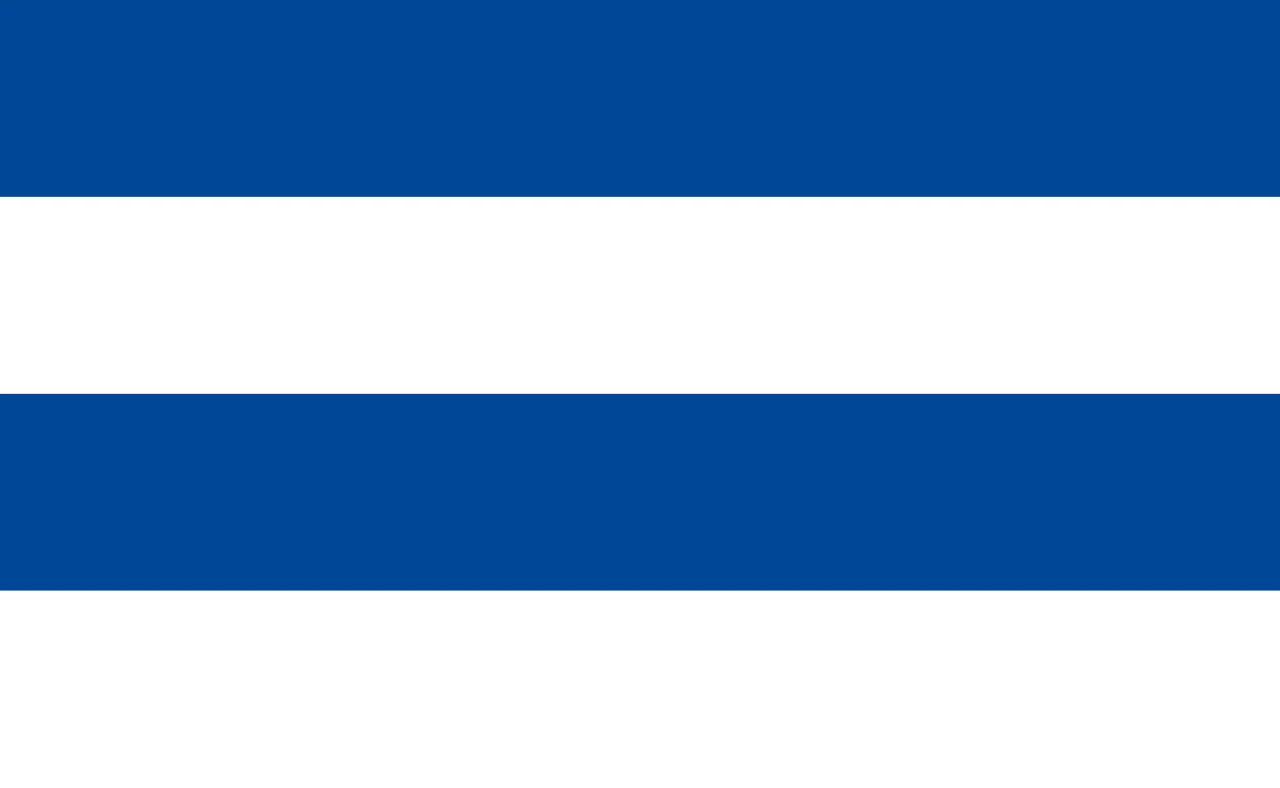
  1. Flag of Oslo from 1924: four horizontal stripes, blue, white, blue and white
    The City of Oslo · Public domain

    1924-2000

    Four blue and white stripes, created for the third centenary of the city.

  2. Current flag of Oslo: blue field with the seal of Saint Hallvard

    2000

    The seal of Saint Hallvard on blue. It was decided in January 2000 and was hoisted from 2002.

What it means

Almost the whole drawing tells the death of the saint, according to tradition.

  • Saint Hallvard

    a young nobleman who, in 1043, tried to protect a woman accused of theft. The accusers killed them both.

  • Three arrows

    the weapons with which he was killed.

  • Millstone

    they tied it to his neck to sink his body in a fjord, but the body floated up. That is how the crime was discovered.

  • Reclining woman

    the woman Hallvard tried to save, although in the medieval seal there was another figure (see ‘Fun facts’).

  • Motto

    ‘Unanimiter et constanter’, in Latin, ‘united and steadfast’.

Fun facts

  1. A flag outside the law

    Since 1933 a Norwegian law forbids municipalities from flying flags that the king has not approved, with fines or up to three months in prison. Oslo never asked for that approval for its flag.

  2. Too similar to Greece

    According to the vexillologist Jan Oskar Engene, one of the reasons for retiring the 1924 stripes was that the town hall thought they recalled the Greek flag, also blue and white.

  3. The woman was a warrior

    In the medieval seal, at the saint’s feet there was not a woman but an armed warrior, one of his killers defeated. The seal was so worn that later it was read as the woman of the legend.

  4. Trondheim chose the opposite path

    Trondheim, the other great historic city of Norway, also has an old and complicated coat of arms, but it accepted a simple flag under the official rules and the king approved it.

Location

Buy the flag

Buy the flag on AmazonAffiliate link: if you buy, Wiki Banderas receives a small commission.

How much have you learnt?

Test what you have read about the flag of Oslo.

  1. 1. Which one is the flag of Oslo?

  2. 2. Which of these elements appears on the flag?

  3. 3. In which year was the current flag adopted?

More flags

Accessibility preferences

Accessibility statement

Quick profiles

Text and reading

Text size
Default
Line height
Default
Letter spacing
Default
Word spacing
Default

Colour

Motion and orientation

Cursor