Skip to content

Wiki Banderas
Open menu

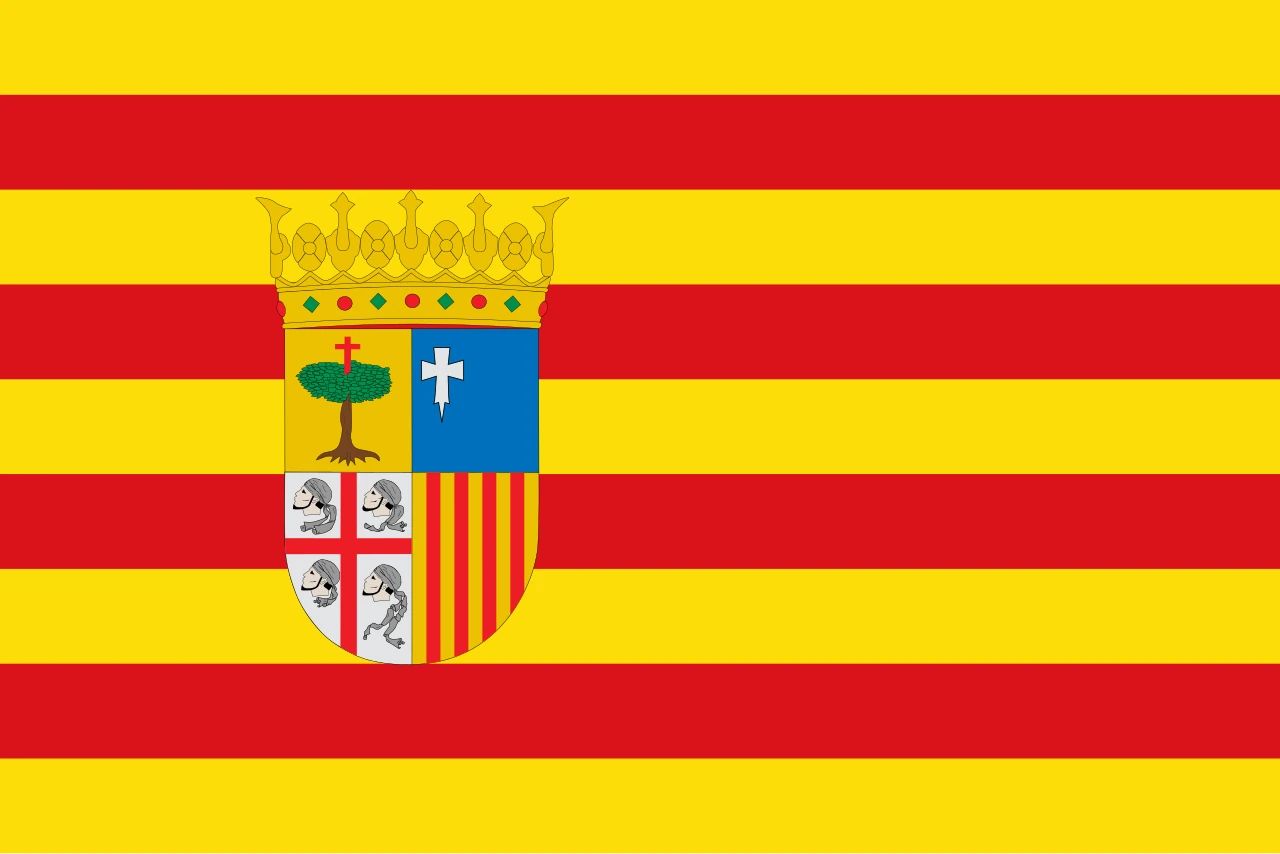
Flag of Aragon

Four red bars on a yellow field and a coat of arms shifted towards the mast: this is the flag of Aragon, heir to the emblem of its kings.

Flag of Aragon
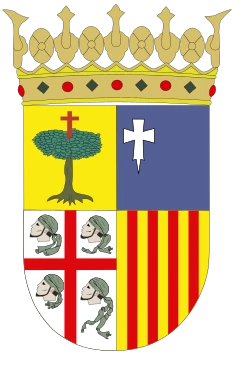
Coat of arms

The flag, in figures

Every fact about the flag, each with what it means.

Proportions
2:33 wide for every 2 high. 989 flags in the catalogue share it.
Properties
Normal flagFIAV symbol: the form of the flag.
Use
CivilFIAV symbol: who may fly the flag.
Adopted
198416 April 1984 · 42 years ago
Colours
  • yellow
  • red
Reference shades: the official one may vary slightly.
Coat of arms
YesIt carries the coat of arms on the cloth.
Origin
Señera Real
12

Take a closer look

  1. The nine stripes

  2. 1

    The coat of arms of Aragon

  3. 2

    The royal crown

How it is described

The flag in the words of vexillology and heraldry.

Vexillological description

It is the senyera of Aragon: a field with a 2:3 ratio and four horizontal red bars on a yellow ground, with the coat of arms shifted towards the flagpole (the pole it is hoisted on).

Stripes
nine horizontal bands of the same width: five yellow and four red; the red ones are the bars.
Coat of arms
it does not sit in the centre: its axis is half the width of the flag —the short measure— from the hoist (the edge of the mast).
No borders
only yellow and red across the whole field.
What it carries

Each element and how many of the 1,390 flags in the catalogue carry it. In yellow, the rarest.

The full story

How it was born, how it has changed and what it means.

The flag of Aragon is the senyera: a field with a 2:3 ratio and four horizontal red bars on a yellow ground, with the coat of arms shifted towards the flagpole.

How it came about

Aragon is an autonomous community of Spain, heir to a medieval kingdom. Its flag was adopted on 16 April 1984.

The design is the emblem of the kings of Aragon: the red bars on gold. The coat of arms, on the other hand, is not in the centre: it is shifted towards the flagpole.

How it has changed

It has never changed. It was adopted in 1984 and there are no documented later modifications.

What it means

  • Stripes

    nine horizontal bands of the same width, five yellow and four red. The red ones are the bars.

  • Coat of arms

    shifted towards the flagpole. Its axis is half the width of the flag from the hoist, the edge of the mast.

  • No borders

    only yellow and red across the whole field.
Fun facts

  1. Nine bands: five of gold and four of gules

    The field is not described as “four bars on a yellow ground” but as nine bands of equal width: five yellow and four red. It is the exact way of saying the same thing, and the one needed for the field to be reconstructed without error.

  2. The coat of arms is not in the centre

    The senyera is unique among the Spanish flags: its coat of arms is shifted towards the flagpole, not centred. Its axis is half the width of the flag from the hoist. The reason is historical: the shift reproduces how the coat of arms was placed on the medieval standard.

  3. From a kingdom to an autonomous community

    The red bars and the gold are the colours of the Crown of Aragon. What was a dynastic emblem —of the kings— became the flag of an autonomous community in 1984. It is a change of nature: from the house to the territory.

Location

How much have you learnt?

Test what you have read about the flag of Aragon.

  1. 1. Which one is the flag of Aragon?

  2. 2. Which of these elements appears on the flag?

  3. 3. What are the proportions (height:width) of the flag?

  4. 4. In which year was the current flag adopted?

Sources

Text based on the article “Bandera de Aragón” from the Spanish Wikipedia, published under the licence CC BY-SA 4.0.

Credits

Flag image: Autor desconocido, Wikimedia Commons · CC BY-SA 3.0.

More flags

Accessibility preferences

Accessibility statement

Quick profiles

Text and reading

Text size
Default
Line height
Default
Letter spacing
Default
Word spacing
Default

Colour

Motion and orientation

Cursor