Skip to content

Wiki Banderas
Open menu

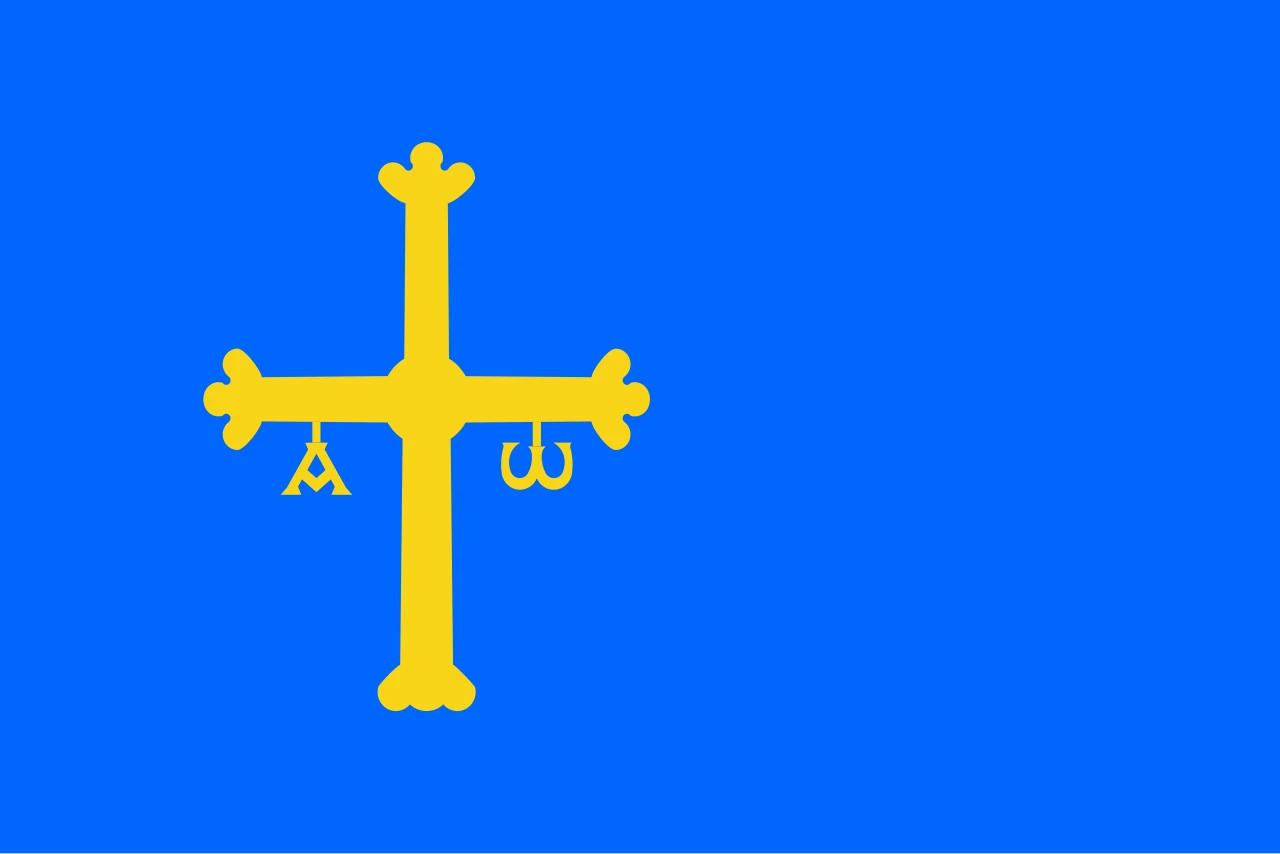
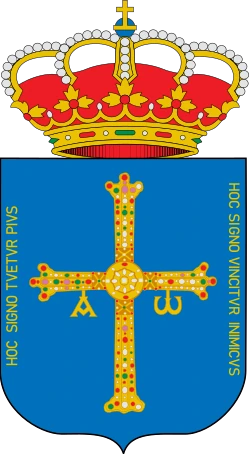
Flag of Asturias

A golden cross on a blue ground: the flag of Asturias reproduces the Cross of Victory, a royal jewel over a thousand years old that is kept in Oviedo.

Flag of Asturias
Coat of arms

The flag, in figures

Every fact about the flag, each with what it means.

Proportions
2:33 wide for every 2 high. 989 flags in the catalogue share it.
Properties
Normal flagFIAV symbol: the form of the flag.
Use
StateFIAV symbol: who may fly the flag.
Adopted
199019 December 1990 · 36 years ago
Colours
  • blue
  • yellow
Reference shades: the official one may vary slightly.
Coat of arms
YesIt carries the coat of arms on the cloth.
12

Take a closer look

  1. The blue field

  2. 1

    The Cross of Victory

  3. 2

    The alpha and omega letters

How it is described

The flag in the words of vexillology and heraldry.

Vexillological description

It is a rectangular field with a 2:3 ratio, blue, with a large yellow cross, the Cross of Victory, a little closer to the flagpole than to the centre. The flagpole is the side the flag is hooked to the mast on; the opposite side is called the fly side.

Field
blue and plain, with no stripes or divisions.
Cross
yellow, with a height of two thirds that of the field; its axis is at half the height of the field, counted from the flagpole.
Letters
from the arms hang the capital alpha and the small omega, in the same yellow.
What it carries

Each element and how many of the 1,390 flags in the catalogue carry it. In yellow, the rarest.

The full story

How it was born, how it has changed and what it means.

The flag of Asturias is a blue field with a large yellow cross, the Cross of Victory, a little closer to the flagpole than to the centre. From the arms of the cross hang the capital alpha and the small omega.

How it came about

Asturias is an autonomous community of Spain. Its flag was adopted on 19 December 1990.

The cross is not a design invented for the flag: it is the Cross of Victory, a royal jewel over a thousand years old that is kept in Oviedo. The flag reproduces the drawing of the relic.

How it has changed

It has never changed. It was adopted in 1990 and there are no documented later modifications.

What it means

  • Blue

    the background of the field, plain and with no stripes.

  • Yellow cross

    with a height of two thirds that of the field. Its axis is at half the height of the field, counted from the flagpole, and it sits a little closer to the flagpole than to the centre.

  • Letters

    from the arms hang the capital alpha and the small omega, in the same yellow.
Fun facts

  1. A relic turned into a flag

    The Cross of Victory is a royal jewel over a thousand years old, kept in Oviedo. The flag does not interpret it: it reproduces its drawing. The letters hanging from the arms are those of the relic, the alpha and the omega.

  2. The cross is shifted towards the flagpole

    The axis of the cross is at half the height of the field, but the cross itself is a little closer to the flagpole than to the centre. It is a detail that comes from the drawing of the jewel: the flag keeps the position of the relic.

  3. The letters hang from the arms

    The capital alpha and the small omega are not written on the field: they hang from the two vertical arms of the cross. It is the way of drawing a relic that is worn on the chest.

Location

How much have you learnt?

Test what you have read about the flag of Asturias.

  1. 1. Which one is the flag of Asturias?

  2. 2. Which of these elements appears on the flag?

  3. 3. What are the proportions (height:width) of the flag?

  4. 4. In which year was the current flag adopted?

Sources

Text based on the article “Bandera de Asturias” from the Spanish Wikipedia, published under the licence CC BY-SA 4.0.

Sources consulted:

Credits

Flag image: Banderas, Wikimedia Commons · Public domain.

More flags

Accessibility preferences

Accessibility statement

Quick profiles

Text and reading

Text size
Default
Line height
Default
Letter spacing
Default
Word spacing
Default

Colour

Motion and orientation

Cursor