Every fact about the flag, each with what it means.
Proportions
1:22 wide for every 1 high. 49 flags in the catalogue share it.
Properties
Normal flagFIAV symbol: the form of the flag.
Use
Civil, naval and stateFIAV symbol: who may fly the flag.
Adopted
19088 December 1908 · 118 years ago
Colours
Red
White
Blue
Reference shades: the official one may vary slightly.
Coat of arms
YesIt carries the coat of arms on the cloth.
Take a closer look
The blue cloth
1
The Union Jack
2
The Federation Star
3
The Southern Cross
How it is described
The flag in the words of vexillology and heraldry.
Vexillological description
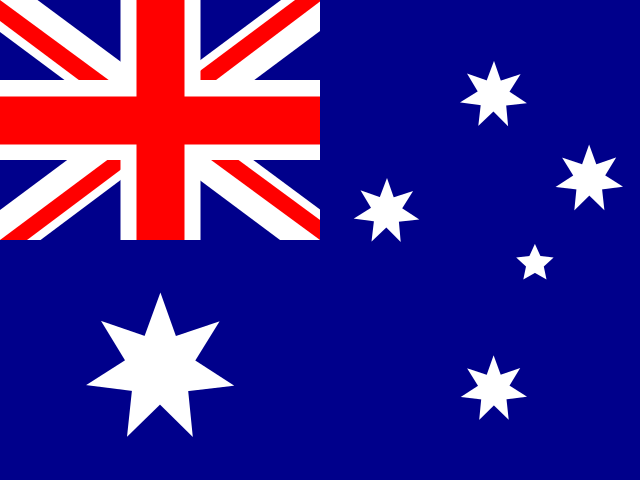
It is a blue field with a 1:2 ratio with the British flag in one corner, a large white star and five more forming the Southern Cross.
Canton
the rectangle at the upper corner next to the flagpole is the Union Jack, and it takes up a quarter of the field.
Federation Star
below the canton, a white seven-pointed star, the largest of the set.
Southern Cross
across the whole free half of the field, five white stars —four of seven points and one, very small, of five— placed like the real stars of the constellation.
Official colours
Pantone 280 blue, 185 red and white; the blue is the one of the ensign of British government ships.
What it carries
Each element and how many of the 1,390 flags in the catalogue carry it. In yellow, the rarest.
As early as 1823 and 1824 the captains John Nicholson and John Bingle had already created…
1901
Until 1901 Australia was not a country but six separate British colonies
1953
It is today’s flag, which the 1953 Flags Act declared the national flag
1954
What has changed a lot more is its importance: until 1954 it was not officially the national flag
1996
Since 1996 that day is National Flag Day
The full story
How it was born, how it has changed and what it means.
The flag of Australia is blue, with the flag of the United Kingdom in the upper corner next to the flagpole and six white stars. Five draw the Southern Cross, a constellation visible above all from the southern hemisphere. The sixth, larger one, is the Federation Star. At first sight it looks a lot like New Zealand’s, and that is no coincidence: both were born from the flags of British ships.
How it came about
Until 1901 Australia was not a country but six separate British colonies. As early as 1823 and 1824 the captains John Nicholson and John Bingle had already created an unofficial flag: a red cross on a white field, with four stars and the British flag in the corner.
On 1 January 1901 the six colonies united in a federation and the new government called a competition to choose a flag. 32,823 entries came in. The judges took six days to decide and chose five almost identical designs, so the five authors shared the prize. The winning flag flew for the first time on 3 September 1901 in Melbourne. Since 1996 that day is National Flag Day.
How it has changed
The touches have been small and all of them arrived in the first years. What has changed a lot more is its importance: until 1954 it was not officially the national flag, and for decades many Australians still saw the British one as theirs.
1823-1824
The colonial flag of Nicholson and Bingle. It was never official.
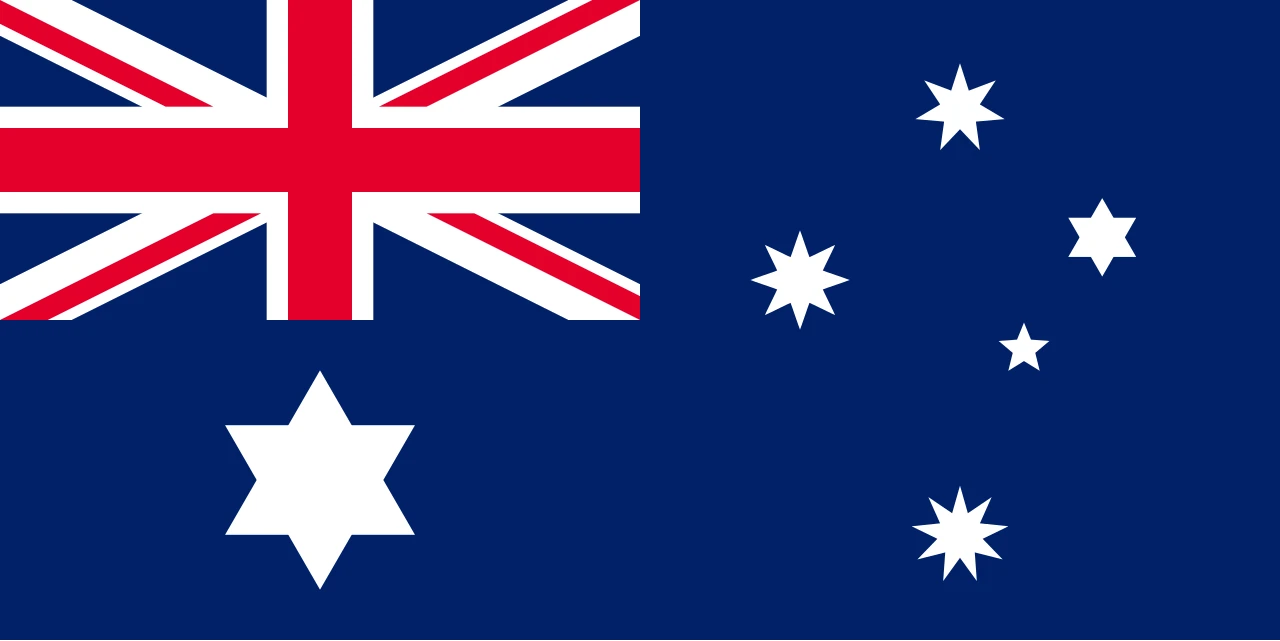
The design from the competition. Each star of the Southern Cross had a different number of points, from five to nine, according to what shone in the sky.
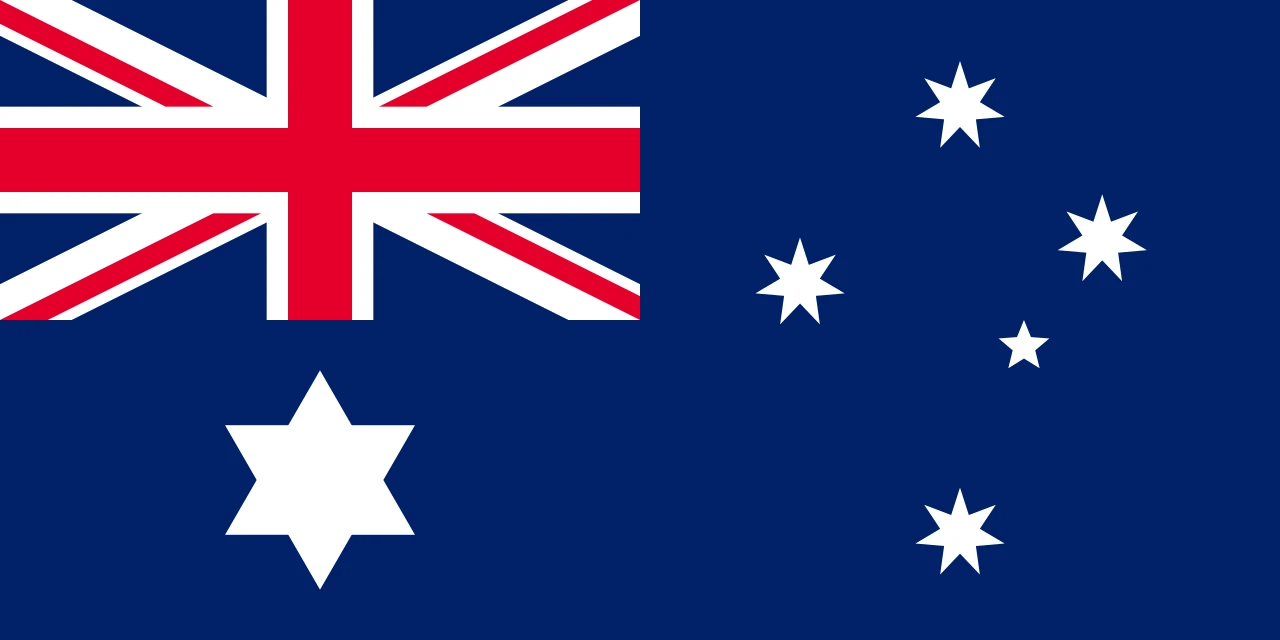
King Edward VII approves an easier version to sew: four seven-pointed stars and a small five-pointed one.
1908
The Federation Star goes from six points to seven. It is today’s flag, which the 1953 Flags Act declared the national flag.
What it means
Every element tells a part of the country’s history:
United Kingdom flag
Australia’s past as a British colony and its ties with the United Kingdom.
Federation Star
six points for the six states and a seventh for the territories.
Southern Cross
Australia’s position in the southern hemisphere.
Blue
the field colour of the flags of British government ships, which is where the design comes from.
Fun facts
One of its authors was 14 years old
Among the five winners of the 1901 competition was Ivor Evans, a schoolboy from Melbourne. Another of the prizewinners, William Stevens, was a ship’s officer from Auckland, New Zealand.
Confused in its own parliament
On 3 September 2026, on the 125th anniversary of the flag, the Australian Parliament put up 44 flags to celebrate it. Two of them were, by mistake, from New Zealand.
Buy the flag
Buy the flag on AmazonAffiliate link: if you buy, Wiki Banderas receives a small commission.
Country facts
Where it is and what borders it.
Capital
Canberra
Area
7,692,024 km²
Country
Commonwealth of Australia
Continent
Oceania
Subregion
Australia and New Zealand
Independent state
Yes
UN member
Yes
ISO code
AUS · AU
How much have you learnt?
Test what you have read about the flag of Australia.