Skip to content

Wiki Banderas
Open menu

Flag of Basel-City

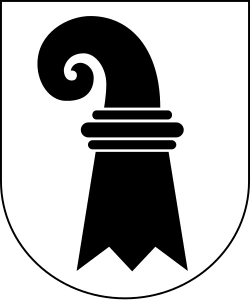
A very stylised black crozier, with the hook towards the flagpole, on a white field: the symbol of the prince-bishop who ruled Basel for centuries.

Flag of Basel-City
Coat of arms

The flag, in figures

Every fact about the flag, each with what it means.

Proportions
1:11 wide for every 1 high. 29 flags in the catalogue share it.
Properties
Normal flagFIAV symbol: the form of the flag.
Use
CivilFIAV symbol: who may fly the flag.
Colours
  • White
  • Black
Reference shades: the official one may vary slightly.
Coat of arms
YesIt carries the coat of arms on the cloth.
123

Take a closer look

  1. The white cloth

  2. 1

    The crook

  3. 2

    The bands of the crosier

  4. 3

    The base of the crosier

How it is described

The flag in the words of vexillology and heraldry.

Vexillological description

It is a square field —the cloth of the flag —with a 1:1 ratio, white, with a black crozier in the centre: a crozier is the hooked staff of a bishop.

Field
white and with no divisions.
Crozier
black and centred; the hook, or crook, looks towards the flagpole (the pole it hangs from).
Base
the lower end opens into three points.
No coat of arms
the crozier is drawn directly onto the cloth.
What it carries

Each element and how many of the 1,390 flags in the catalogue carry it. In yellow, the rarest.

Its history in dates

Every date in its story, at a glance.

  1. 1249

    The crozier of the city already had its stylised shape in 1249

  2. 1501

    It joined the Confederation in 1501

The full story

How it was born, how it has changed and what it means.

Basel-City is a city-state with one of the simplest flags in Switzerland: a black crozier on a white field, with the curve facing the flagpole.

How it came about

Basel was ruled for centuries by a prince-bishop, whose diocese, founded according to tradition in the year 346, was the most important in the Upper Rhine. The crozier of the city already had its stylised shape in 1249; it was red, and according to Flags of the World it became black around 1356, when the city bought its freedoms from the bishop. It joined the Confederation in 1501.

How it has changed

It has not changed since the late Middle Ages, and no modern rule fixed the design: it is still the banner of the medieval shield.

What it means

  • Crozier

    the bishop’s crook; since early Christianity it means guidance, authority and correction.

  • Curve towards the flagpole

    in the city it faces the mast; Basel-Country, its former subject, draws it the other way round.

  • Three-pointed tip

    the royal iron with which shepherds drove the staff into the ground.

Fun facts

  1. A crozier sewn onto silk

    The oldest surviving flag of Basel is Italian silk printed with pomegranates; the black crozier is sewn on top of it.

  2. Red and then black

    The crook was red at first: the change to black is associated with the liberation from the bishop in 1356, although no document fixes the date.

  3. The griffin, brother of the basilisk

    Besides the famous basilisk, the griffin is the heraldic animal of Basel: it appears in sixteenth-century stained glass holding the shield.

Location

How much have you learnt?

Test what you have read about the flag of Basel-City.

  1. 1. Which one is the flag of Basel-City?

  2. 2. Which of these elements appears on the flag?

  3. 3. What are the proportions (height:width) of the flag?

Sources

Sources consulted:

Credits

Flag image: Edi Hauri, Wikimedia Commons · Public domain.

More flags

Accessibility preferences

Accessibility statement

Quick profiles

Text and reading

Text size
Default
Line height
Default
Letter spacing
Default
Word spacing
Default

Colour

Motion and orientation

Cursor