Every fact about the flag, each with what it means.
Proportions
2:33 wide for every 2 high. 989 flags in the catalogue share it.
Properties
Normal flagFIAV symbol: the form of the flag.
Use
CivilFIAV symbol: who may fly the flag.
Adopted
19966 August 1996 · 30 years ago
Colours
red
white
green
Reference shades: the official one may vary slightly.
Coat of arms
YesIt carries the coat of arms on the cloth.
Take a closer look
The three stripes
1
The coat of arms
2
The royal crown
How it is described
The flag in the words of vexillology and heraldry.
Vexillological description
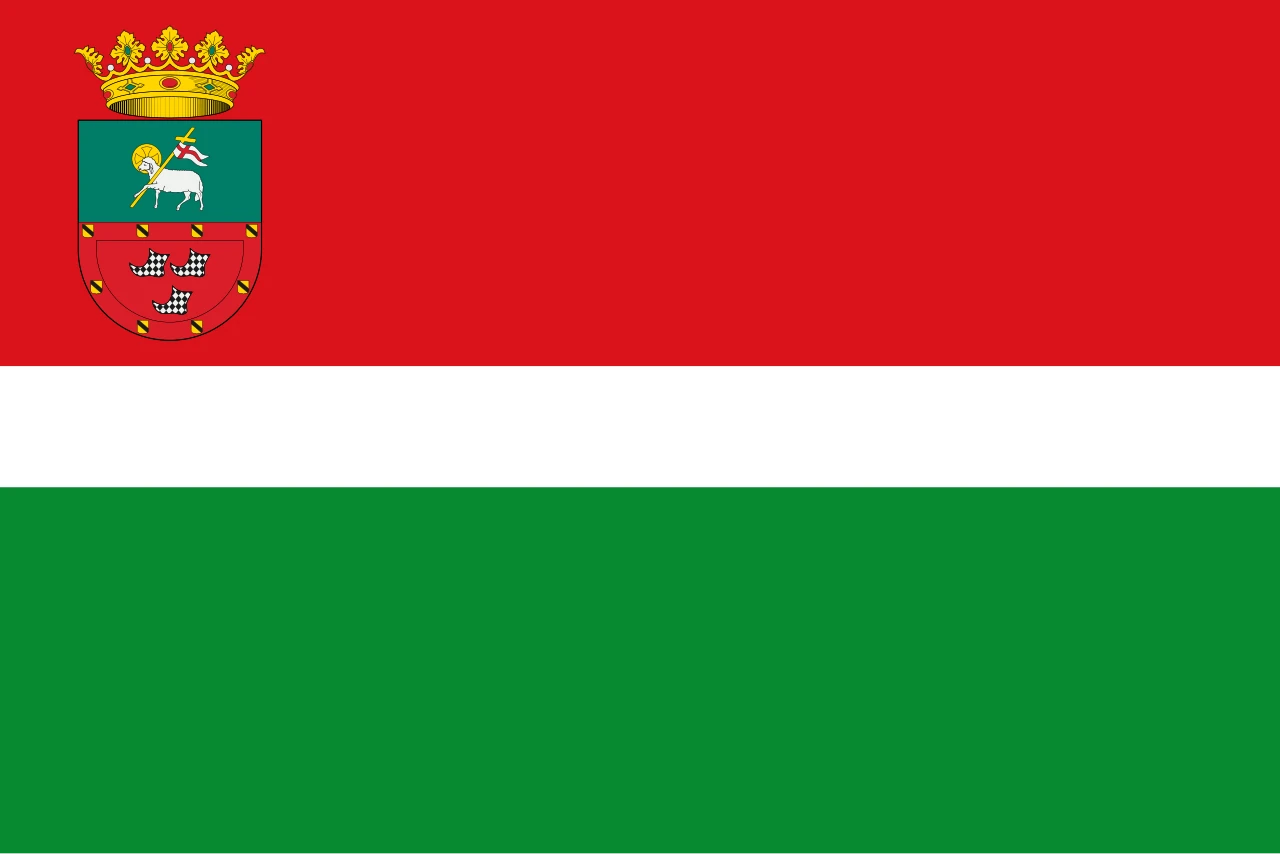
It is a rectangular field with a 2:3 ratio with three horizontal stripes: red on top at three sevenths of the height, white in the centre at a seventh, and green below at three sevenths. In the upper canton, by the flagpole, is the coat of arms of the municipality.
Upper stripe
red, three sevenths of the height.
Middle stripe
white, a seventh.
Lower stripe
green, three sevenths.
Coat of arms
in the upper canton, by the flagpole (the mast side), with an open royal crown on top.infoothers: 'Colores: rojo, blanco, verde'
What it carries
Each element and how many of the 1,390 flags in the catalogue carry it. In yellow, the rarest.
Its coat of arms was approved by resolution of 10 January 1995
1996
It has not changed: it is the flag approved in 1996
The full story
How it was born, how it has changed and what it means.
The flag of Bugarra has three horizontal stripes —red, white and green —and the coat of arms of the municipality in the upper corner, by the mast. What makes it rare is not the colours but the measurements: the white stripe is much narrower than the other two, and the rule states it with a precision of one part in seven.
How it came about
Bugarra is a municipality in the comarca of the Serranos, in the interior of Valencia. Its coat of arms was approved by resolution of 10 January 1995, published in DOGV number 2,456, and its flag a year and a half later: by resolution of 6 August 1996, published in DOGV number 2,854, of 23 October.
The official description is among the most precise ever made of a Valencian municipal flag: “Flag with a ratio of 2:3. Three horizontal stripes, the upper one red, the middle one white and the lower one green. The width of the upper and lower stripes shall be equal to three seventh parts of the total width of the flag and the middle one shall equal to the remaining seventh part. The municipal coat of arms shall be placed by the flagpole in the upper canton”.
Note two details: the stripes are not equal —the two at the ends take up three parts in seven each and the middle one only one —and the coat of arms does not go in the centre, but at the top by the mast.
How it has changed
It has not changed: it is the flag approved in 1996.
What it means
Red stripe
the upper stripe, the tallest, three parts in seven.
White stripe
the middle one, the narrowest, one part in seven.
Green stripe
the lower one, as tall as the red one.
Coat of arms
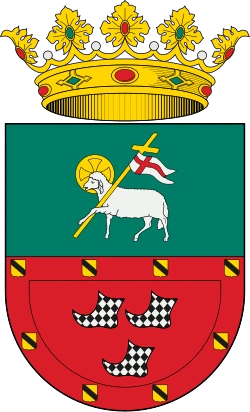
in the upper canton, by the flagpole. It bears the Lamb of God, three shoemakers and an open royal crown.
Fun facts
The lamb with the banner
The coat of arms of Bugarra bears at the top a white lamb with a golden halo and a red banner with a cross. It is the Lamb of God, the symbol of Saint John the Baptist, who is the patron of the village. Below go the three shoemakers: the canting arms of the Sabata family.
Three shoes on a coat of arms
The three sabatillas of the second quarter are the canting arms of the Sabata of Calatayud, barons of Pedralba and lords of Bugarra. Bugarra belonged to Pedralba until 1902, and the village keeps the shoe of those lords as a reminder.
The stripes are not equal
The rule measures the flag in seven parts: three for the red stripe, three for the green and one for the white. Few municipal flags say how their stripes measure, and almost none gets as far as doing it in sevenths.
The coat of arms at the top, not in the centre
Most flags with a coat of arms put it in the centre. Bugarra places it in the upper canton, by the flagpole, and says so expressly in the resolution. It is the traditional arrangement of war flags, where the coat of arms sits close to the pole.
Canting arms like those of Bonastre
Canting arms are the ones that draw the name of the lord or of the place: the shoes of the Sabata, the star of Bonastre, which in Catalan was bon astre. It is a heraldic play on words, and in the Valencian Country it repeats in many municipalities.
How much have you learnt?
Test what you have read about the flag of Bugarra.