Skip to content

Wiki Banderas
Open menu

Flag of Cabeceiras de Basto

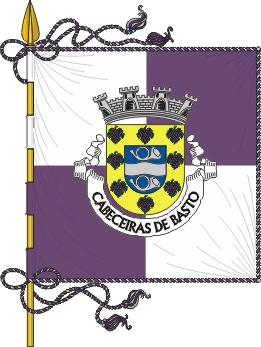
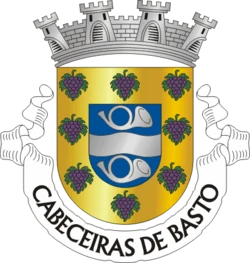
Four white and purple quarters with a coat of arms that plays with the name: a wavy fess, the River Basto, between hunting horns.

Flag of Cabeceiras de Basto
Coat of arms

The flag, in figures

Every fact about the flag, each with what it means.

Proportions
3:44 wide for every 3 high. 22 flags in the catalogue share it.
Properties
Normal flagFIAV symbol: the form of the flag.
Use
CivilFIAV symbol: who may fly the flag.
Adopted
198719 March 1987 · 39 years ago
Colours
  • white
  • purple
Reference shades: the official one may vary slightly.
Coat of arms
YesIt carries the coat of arms on the cloth.

Take a closer look

  • Quarters

  • Coat of arms

  • Field

How it is described

The flag in the words of vexillology and heraldry.

Vexillological description

It is a rectangular field divided into four quarters, that is, four equal rectangles, in white and purple, with the coat of arms of the town in the centre.

Quarters
two white and two purple, alternating like a two-colour chessboard.
Coat of arms
in the centre, on a blue ground; it bears two hunting horns, a wavy fess (a band with waves) and eight bunches of grapes on a golden bordure.
Field (the cloth)
only white and purple, with no outer border.
What it carries

Each element and how many of the 1,390 flags in the catalogue carry it. In yellow, the rarest.

The full story

How it was born, how it has changed and what it means.

The flag of Cabeceiras de Basto has four quarters, that is, four rectangles, in white and purple, with the coat of arms in the centre. “Cabeceiras” means the sources of a river, and the coat of arms says so with a wavy fess.

How it came about

According to Flags of the World, the flag and the coat of arms were published in the Diário da República on 19 March 1987. It is a very late date: most municipal flags in northern Portugal were approved in the thirties and forties. Since Cabeceiras is a town, the ground is in quarters and not in eight gironnies.

How it has changed

No earlier version is known. Its neighbour Celorico de Basto, with which it shares the river, did have an earlier proposal that was not approved.

What it means

  • White and purple

    the colours of the quarters. The sources consulted do not explain them.

  • Wavy fess of silver

    the River Basto. The name of the town means “cabeceiras do Basto”, the sources of the Basto.

  • Two hunting horns

    we did not find their meaning.

  • Eight bunches of purple grapes

    probably the vineyards of the area, according to Flags of the World.

Fun facts

  1. The coat of arms says the name of the village

    A coat of arms that represents the name of the place with a drawing is called canting arms. Here the wavy fess is the River Basto.

  2. A flag of 1987

    Flags of the World considers that a very late date for a Portuguese municipality. Celorico de Basto, its neighbour, has had its flag since 1948.

Location

How much have you learnt?

Test what you have read about the flag of Cabeceiras de Basto.

  1. 1. Which one is the flag of Cabeceiras de Basto?

  2. 2. Which of these elements appears on the flag?

  3. 3. In which year was the current flag adopted?

Sources

Sources consulted:

Credits

Flag image: Sérgio Horta, Wikimedia Commons · CC BY-SA 3.0.

More flags

Accessibility preferences

Accessibility statement

Quick profiles

Text and reading

Text size
Default
Line height
Default
Letter spacing
Default
Word spacing
Default

Colour

Motion and orientation

Cursor