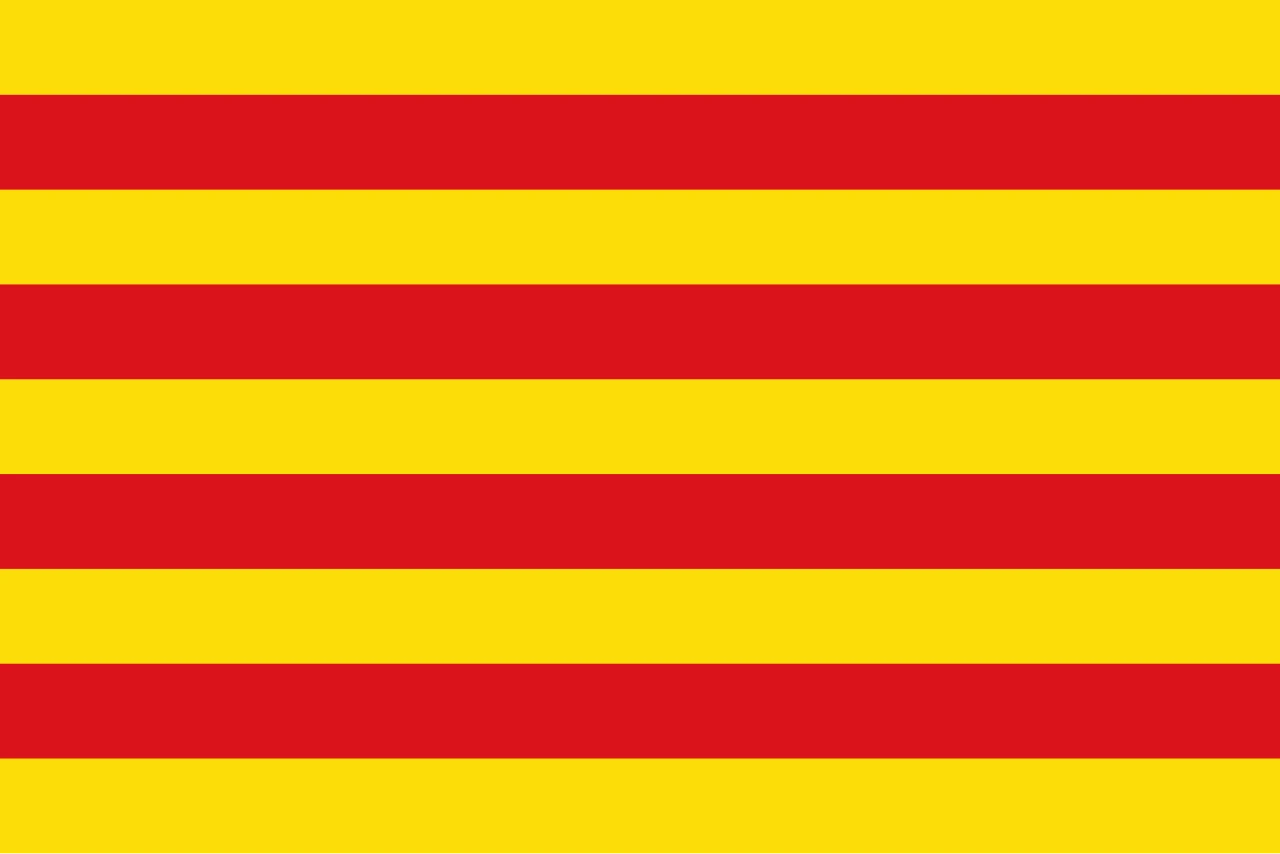
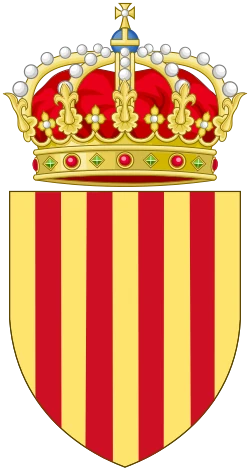
Four red bars on a yellow ground: the Catalan senyera is the old emblem of the counts of Barcelona and kings of Aragon, with no coat of arms or ornaments.
Every fact about the flag, each with what it means.
Proportions
2:33 wide for every 2 high. 989 flags in the catalogue share it.
Properties
Normal flagFIAV symbol: the form of the flag.
Use
CivilFIAV symbol: who may fly the flag.
Adopted
193325 May 1933 · 93 years ago
Colours
yellow
red
Reference shades: the official one may vary slightly.
Coat of arms
YesIt carries the coat of arms on the cloth.
Origin
Señera Real
Take a closer look
Stripes
Yellow
Red
Field
How it is described
The flag in the words of vexillology and heraldry.
Vexillological description
It is a rectangular field with a 2:3 ratio and nine horizontal stripes of the same width, five yellow and four red, alternating. It carries no coat of arms or any other figure.
Stripes (bands)
nine, equal, from top to bottom.
Yellow
five stripes, including the first and the last.
Red
the four stripes left between the yellow ones.
Field (the cloth)
no coat of arms, no text and no borders.
What it carries
Each element and how many of the 1,390 flags in the catalogue carry it. In yellow, the rarest.
The oldest surviving image is on a wax seal of 1150 of the count Ramón Berenguer IV
1933
It was first made official in 1933, with the Interior Statute of Catalonia
1979
After the Franco dictatorship, the Statute of Autonomy of 1979 recovered it
The full story
How it was born, how it has changed and what it means.
The flag of Catalonia, called the senyera, has nine horizontal stripes: five yellow and four red. It carries no coat of arms or any other drawing. It is one of the oldest flags in Europe still in use, and from it also come those of Aragon, the Valencian Community and the Balearic Islands.
How it came about
In the Middle Ages the red and yellow bars were the family emblem of the counts of Barcelona, who from the twelfth century were also kings of Aragon. The oldest surviving image is on a wax seal of 1150 of the count Ramón Berenguer IV, where a knight appears with the barred coat of arms.
At first only the king could use the emblem, as a sign of his power. Over time it passed to nobles, cities and guilds, and ended up identifying the territories he ruled. From the nineteenth century, with the revival of Catalan culture, it became the great symbol of Catalonia.
It was first made official in 1933, with the Interior Statute of Catalonia. After the Franco dictatorship, the Statute of Autonomy of 1979 recovered it, and that of 2006 kept it.
How it has changed
The design of four red bars on yellow has been the same for centuries. The laws have only refined its measurements and the exact shade of the colours.
What it means
The law gives no meaning to the colours. Its value is historical:
Yellow and red
the colours of the emblem of the House of Barcelona and of the kings of the Crown of Aragon.
Four bars
the number that was fixed over time; in the Middle Ages the number of bars varied.
Fun facts
Four fingers stained with blood
According to a legend, the Frankish emperor passed four fingers stained with the blood of Count Wifredo the Old over his golden shield. It is an invented story: the historian Pere Antoni Beuter wrote it in the sixteenth century, seven centuries later.
A seal nearly 900 years old
The wax seal of Ramón Berenguer IV, of 1150, is the oldest known representation of the bars.
The estelada is not official
The estelada, with a blue triangle and a white star, was designed around 1918 by Vicenç Albert Ballester, inspired by the flags of Cuba and Puerto Rico. Independence supporters use it, but the official flag is only the senyera.
Location
How much have you learnt?
Test what you have read about the flag of Catalonia.