Every fact about the flag, each with what it means.
Proportions
2:33 wide for every 2 high. 989 flags in the catalogue share it.
Properties
Normal flagFIAV symbol: the form of the flag.
Use
CivilFIAV symbol: who may fly the flag.
Adopted
198429 May 1984 · 42 years ago
Colours
white
blue
Reference shades: the official one may vary slightly.
Coat of arms
YesIt carries the coat of arms on the cloth.
Take a closer look
The diagonal band
1
The coat of arms
2
The royal crown
3
The seven crosses
How it is described
The flag in the words of vexillology and heraldry.
Vexillological description
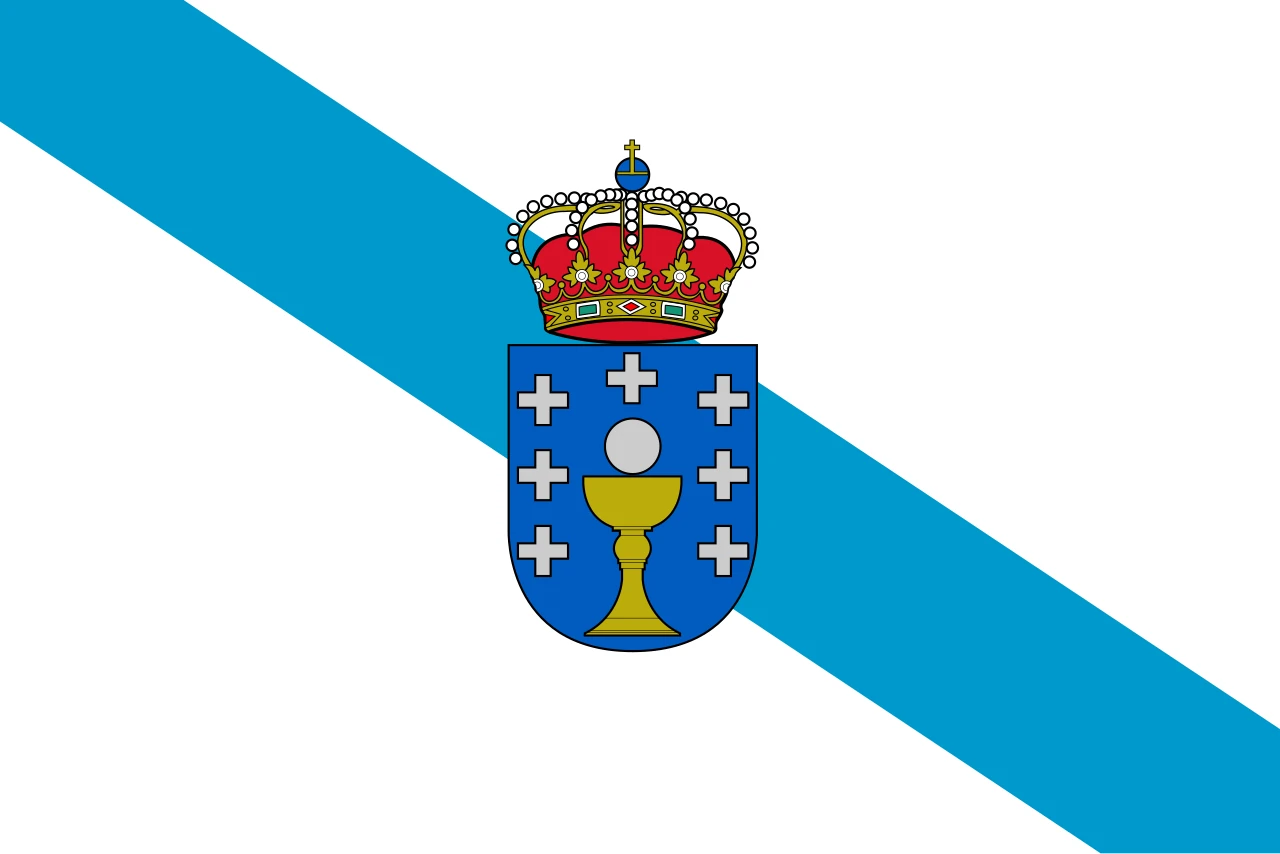
It is a rectangular field with a 2:3 ratio, white, crossed diagonally by a blue band. The official version also bears the coat of arms in the centre, on top of the band.
Field
a 2:3 rectangle, white.
Band
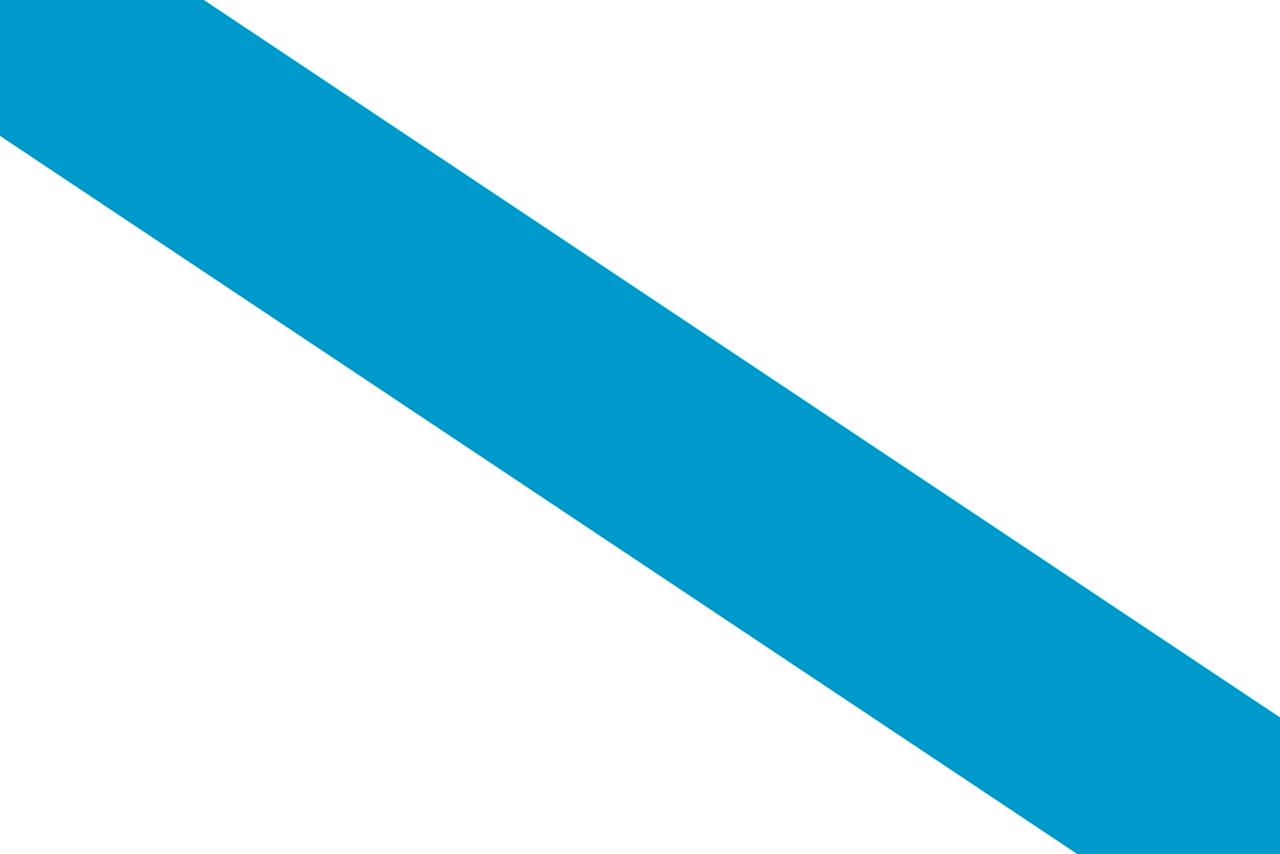
a blue stripe from left to right; the law fixes its width at a quarter of the height of the field.
Diagonal
it starts at the upper corner by the flagpole (the pole) and goes down to the lower corner of the fly side (the opposite edge).
Coat of arms
centred over the band, only in the official version.
What it carries
Each element and how many of the 1,390 flags in the catalogue carry it. In yellow, the rarest.
More recent studies think it was the other way round: the Galicianists, the movement that defended…
1981
The Statute of Autonomy of 1981 made it official
The full story
How it was born, how it has changed and what it means.
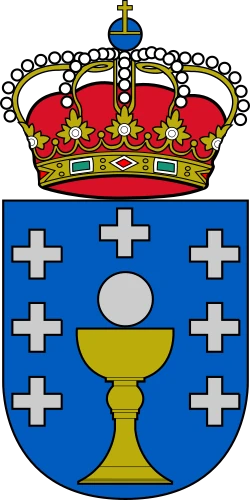
The flag of Galicia is white and a blue band runs across it from the upper corner by the mast to the lower corner on the other side. The official version also bears the coat of arms, with a golden chalice on a blue ground. The version without the coat of arms, the one most people use, is called the civil flag.
How it came about
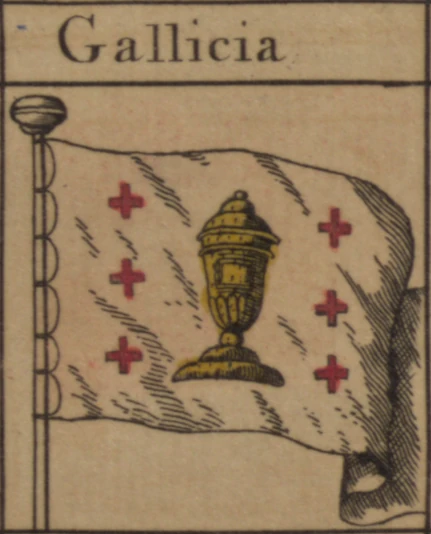
For centuries the symbol of Galicia was a chalice, a sacred cup. In the eighteenth and nineteenth centuries, European books of flags drew the naval flag of Galicia as a white field with the chalice and several red crosses.
The white and blue flag appeared in the late nineteenth century. For a long time it was said to come from the registration flag of the ships of A Coruña, which emigrants saw when boarding for America and ended up adopting as that of all Galicia. More recent studies think it was the other way round: the Galicianists, the movement that defended the Galician language and culture, were already using it before 1891.
The Statute of Autonomy of 1981 made it official, and a law of 1984 regulated the version with the coat of arms.
How it has changed
The blue band has not changed since the nineteenth century, but before that Galicia was represented with other designs.
The white flag with the blue band appears, which the Galicianists and the emigrants turn into a symbol of Galicia.
1984
A law regulates the official version, with the chalice coat of arms in the centre.
What it means
The law does not explain the colours, but there is a story behind each element:
White and blue
the colours of the old registration flag of A Coruña and, according to other studies, of the first Galicianists.
Chalice
the symbol of the Kingdom of Galicia since the Middle Ages, linked to the religious importance of Santiago de Compostela.
Seven crosses
they are usually read as the seven provinces of the old Kingdom of Galicia.
Fun facts
Blame on the Russian navy
The registration flag of A Coruña was a blue saltire on white. In 1891 one arm was removed because it was confused with the war flag of the Russian Navy, leaving a single diagonal band.
At the funeral of Rosalía de Castro
In May 1891 the remains of the poet Rosalía de Castro were moved to Santiago. According to several studies, a white flag with a blue band was already seen there, weeks before the change of the A Coruña registration flag.
A king with three cups
In an English book of coats of arms of around 1282, the arms of the king of Galicia appear with three golden chalices on blue. It is one of the oldest pieces of evidence for the chalice as a Galician symbol.
Location
How much have you learnt?
Test what you have read about the flag of Galicia.