Every fact about the flag, each with what it means.
Proportions
2:33 wide for every 2 high. 989 flags in the catalogue share it.
Properties
Normal flagFIAV symbol: the form of the flag.
Use
CivilFIAV symbol: who may fly the flag.
Adopted
18216 October 1821 · 205 years ago
Colours
yellow
blue
red
Reference shades: the official one may vary slightly.
Origin
Flag of Venezuela of 1811
Designer
Francisco de Miranda (the colours)
Out of use since
1830
Take a closer look
The three stripes
1
The national coat of arms
2
The cornucopias
How it is described
The flag in the words of vexillology and heraldry.
Vexillological description
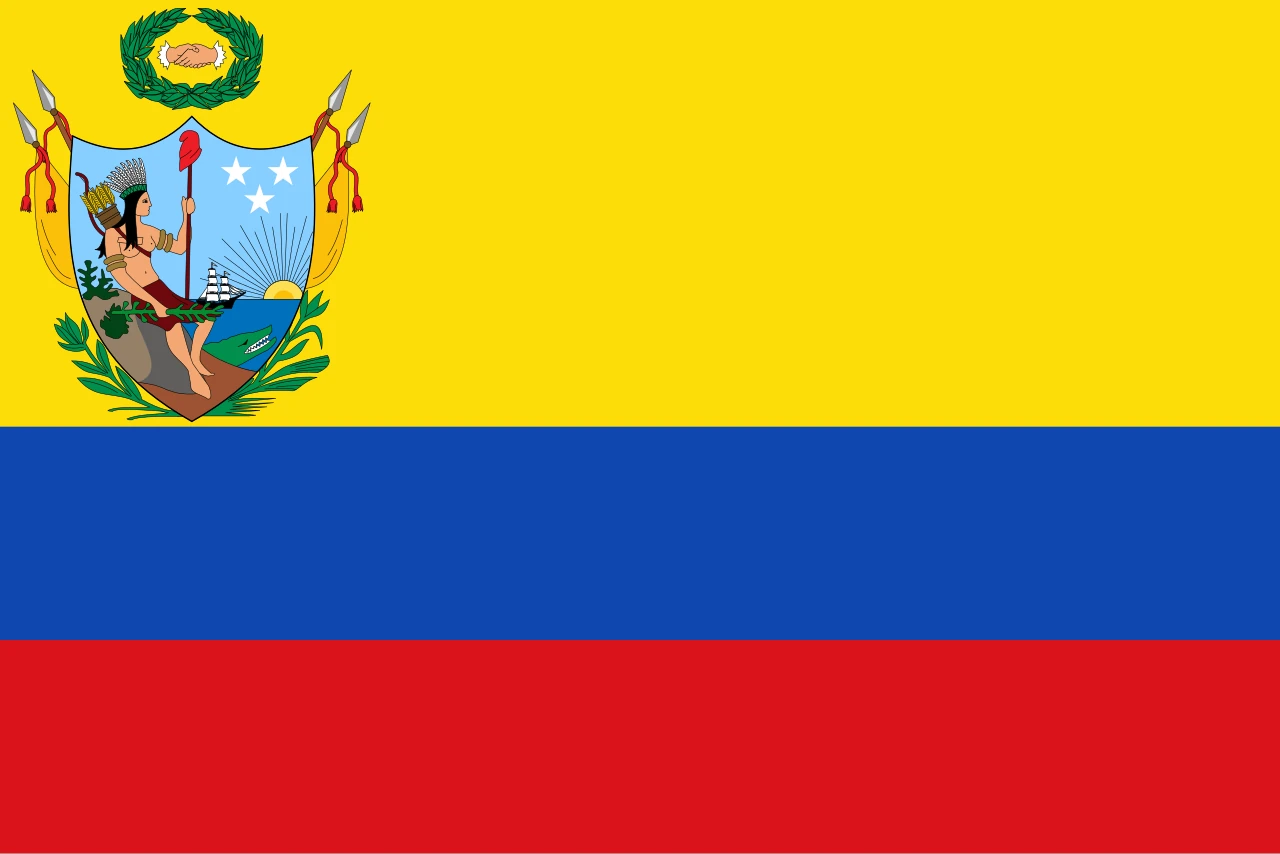
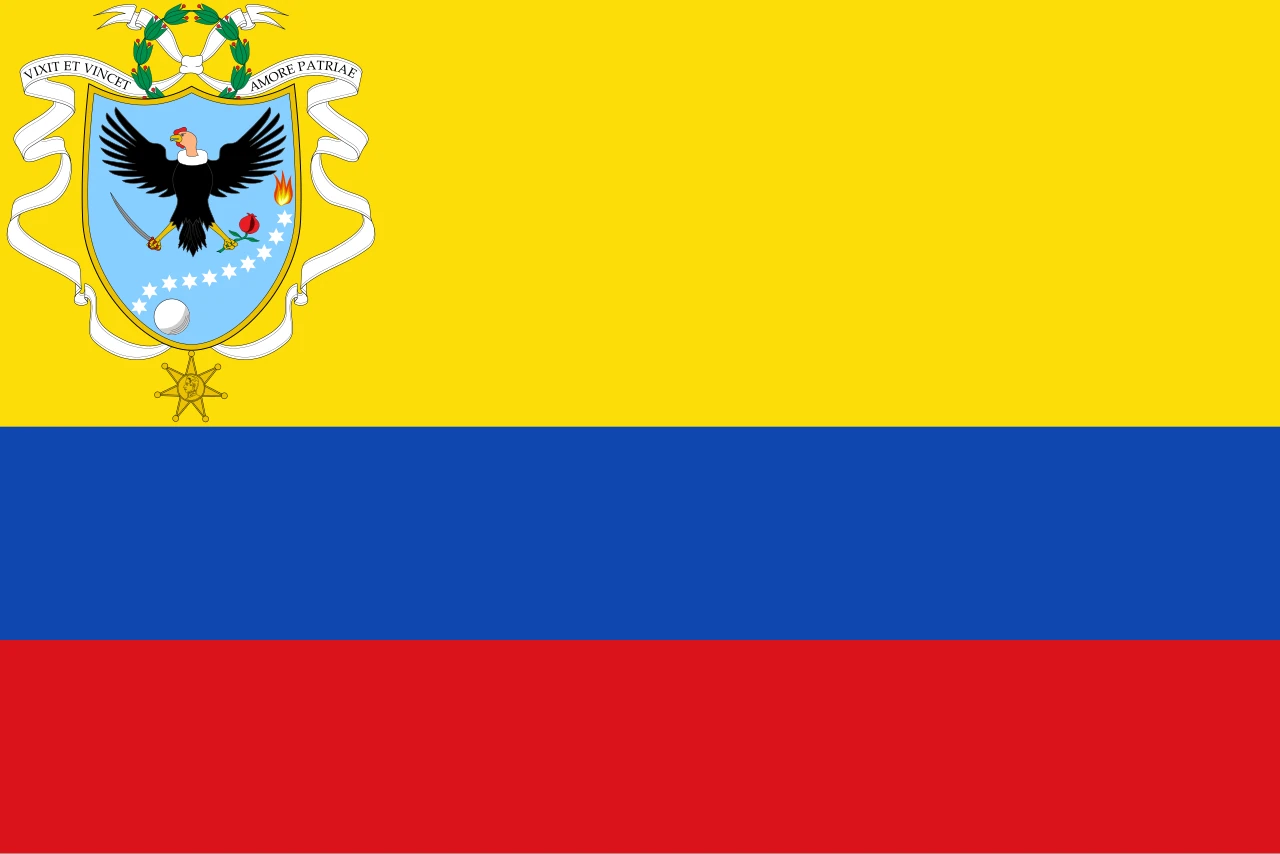
It is a rectangular field with a 2:3 ratio with three equal horizontal stripes: yellow on top, blue in the middle and red below.
Coat of arms
in the centre, over the three stripes. Two cornucopias (horns of plenty) full of fruit and flowers surround a bundle of spears crossed by a halberd, with a bow and arrows crossed, all tied with a tricolour ribbon.
Oval
white, it surrounds the coat of arms and carries the inscription ‘República de Colombia’ and a small star below.
Laurel
two green branches embrace the oval.
What it carries
Each element and how many of the 1,390 flags in the catalogue carry it. In yellow, the rarest.
In 1811 Venezuela adopted that tricolour as its national flag
1819
Gran Colombia was a huge country that existed between 1819 and 1830
1822
After joining Guayaquil in 1822 a new coat of arms appeared
1830
The countries born in 1830 went on using the coat of arms of 1821
The full story
How it was born, how it has changed and what it means.
Gran Colombia was a huge country that existed between 1819 and 1830. It joined what are today Colombia, Venezuela, Ecuador and Panama. Its yellow, blue and red flag disappeared with it, but its colours still fly in three of those countries.
How it came about
The colours were thought up by Francisco de Miranda, a Venezuelan soldier who fought against Spanish rule. In 1806 he first hoisted a yellow, blue and red flag on his ship, during a failed landing in Venezuela. In 1811 Venezuela adopted that tricolour as its national flag.
Simón Bolívar carried it on his campaigns. When the Congress of Angostura created the Republic of Colombia, on 17 December 1819, it decided to use the Venezuelan flag until another was approved. Historians call that country ‘Gran Colombia’ so as not to confuse it with today’s Colombia.
How it has changed
In eleven years the tricolour did not change, but the coat of arms did, three times.
Francisco de Paula Santander puts the coat of arms of Cundinamarca, with a black bird with spread wings, because the Venezuelan one was hardly known in Bogotá.
1821-1830
The Congress of Cúcuta approves the first coat of arms of the whole country, with cornucopias and spears, and places it in the centre.
Other flags and proposals
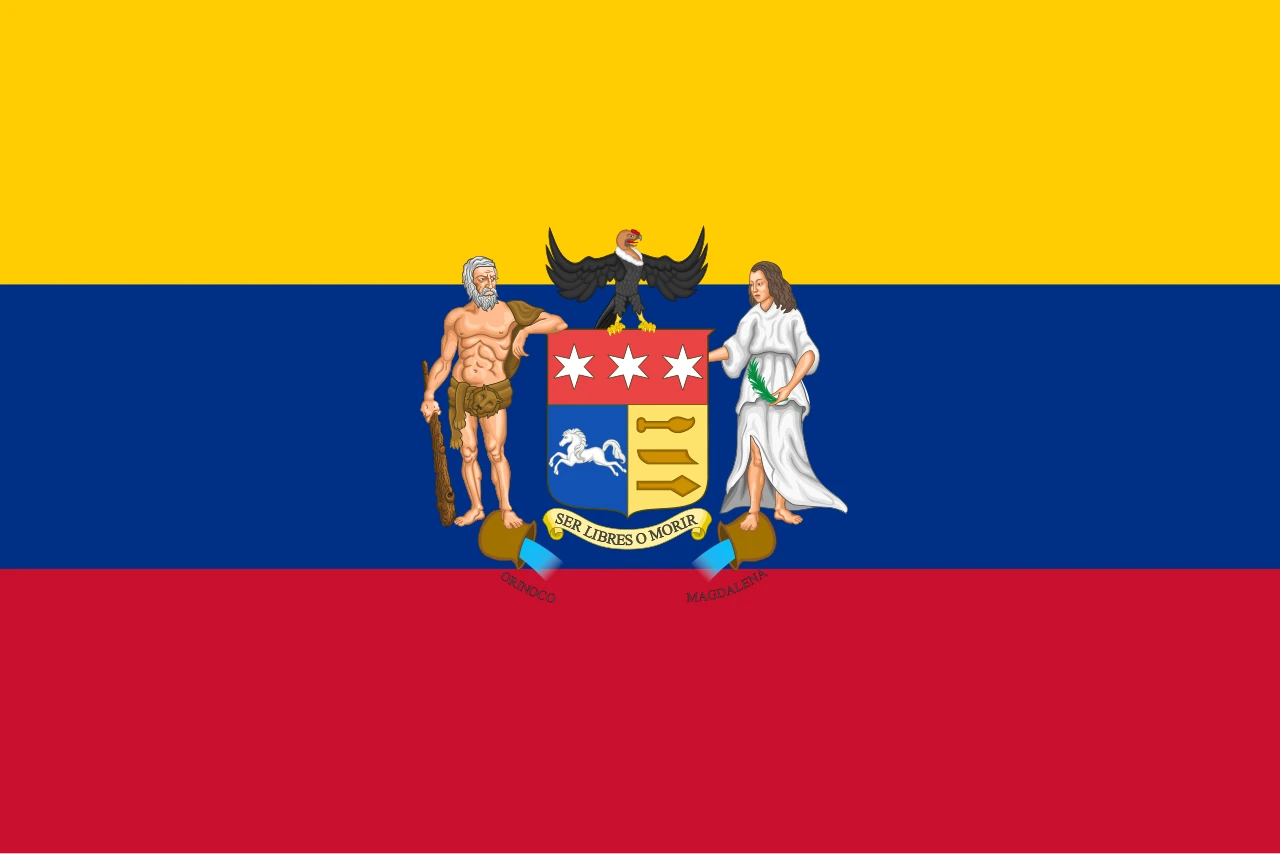
After joining Guayaquil in 1822 a new coat of arms appeared, but no law approved it.
Three stars for the three great departments, a horse for liberty and the motto ‘To be free or to die’. The countries born in 1830 went on using the coat of arms of 1821, a sign that this one never became official.
What it means
No law explained the colours. The most cited reading is attributed to Miranda: America separated from bloody Spain by the sea.
Yellow
America, the rich and young land.
Blue
the ocean that separates it from Europe.
Red
Spain and the blood of the war.
Cornucopias
the abundance of fruits of the cold, temperate and warm lands.
Tied bundle of spears
the union, which gives strength.
Fun facts
A mother flag for three countries
When Gran Colombia broke up in 1830, Colombia, Venezuela and Ecuador kept the yellow, the blue and the red. That is why their current flags are so similar.
Nobody fixed the width of the stripes
No decree gave exact measurements or tones, so every workshop sewed its own: there are flags with three equal stripes and others with the yellow one twice as wide.
A lighter blue than today’s
Until 1834 the blue was usually light blue. The dark blue of the current flags came later.
The colours of an empress, according to legend
One story says Miranda chose the yellow, blue and red after the hair, eyes and lips of Catherine II of Russia. Another says the writer Goethe suggested them. Neither has proof.
Location
Buy the flag
Buy the flag on AmazonAffiliate link: if you buy, Wiki Banderas receives a small commission.
How much have you learnt?
Test what you have read about the flag of Gran Colombia.