Skip to content

Wiki Banderas
Open menu

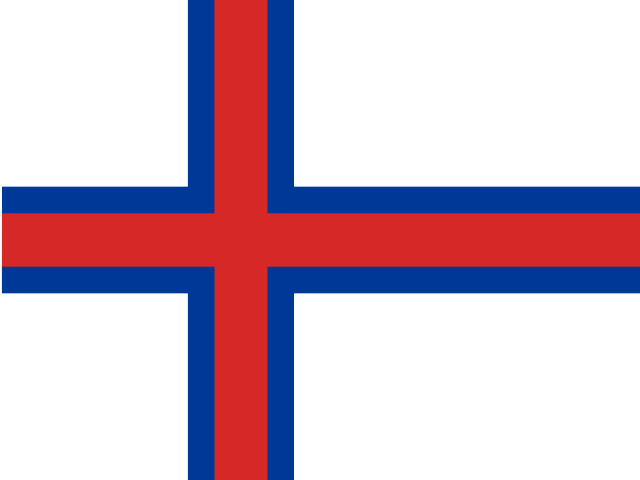
Flag of the Faroe Islands

A red cross with a blue border on white, created by some students in 1919 and recognised by the British in the middle of a world war.

Flag of the Faroe Islands
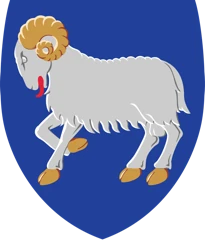
Coat of arms

The flag, in figures

Every fact about the flag, each with what it means.

Proportions
5:77 wide for every 5 high. 6 flags in the catalogue share it.
Properties
Normal flagFIAV symbol: the form of the flag.
Use
Civil, state and military, on land and at seaFIAV symbol: who may fly the flag.
Adopted
194025 April 1940 · 86 years ago
Colours
  • blue
  • red
  • white
Reference shades: the official one may vary slightly.
Coat of arms
YesIt carries the coat of arms on the cloth.
12

Take a closer look

  1. The white field

  2. 1

    The red cross

  3. 2

    The blue border

How it is described

The flag in the words of vexillology and heraldry.

Vexillological description

It is a white rectangular field with a red cross outlined in blue, shifted towards the flagpole.

Field (the cloth of the flag)
white, with no divisions.
Cross
red, with a blue line bordering it on all four sides.
Size
the cross reaches all four edges of the field.
Coat of arms
it carries no other drawing.

What it carries

Each element and how many of the 1,390 flags in the catalogue carry it. In yellow, the rarest.

Its history in dates

Every date in its story, at a glance.

  1. 1919

    It was designed in 1919 by some Faroese students living in Copenhagen

  2. 1940

    1940: Germany occupies Denmark and the United Kingdom occupies the Faroes

  3. 1948

    1948: the islands’ Home Rule Act recognises it as the official flag

  4. 1959

    1959 and 1998: the shade of the blue changes

The full story

How it was born, how it has changed and what it means.

The flag of the Faroe Islands is white, with a red cross surrounded by a blue border. The Faroese call it Merkið, which means “the banner”. These islands of the North Atlantic belong to the Kingdom of Denmark, but they govern themselves in almost everything, and they have their own flag.

How it came about

It was designed in 1919 by some Faroese students living in Copenhagen, among them Jens Oliver Lisberg. They wanted a symbol of their own for their land. They chose the same scheme as their Scandinavian neighbours: a cross whose vertical arm is closer to the flagpole than to the edge, so that the horizontal arm is long on one side and short on the other. On 22 June 1919 it was hoisted for the first time in Fámjin, a village on the island of Suðuroy.

How it has changed

The design has been the same since 1919; only the shade of the blue has changed. For twenty years it was a popular flag with no official recognition. The Second World War changed everything:

  • 1940

    Germany occupies Denmark and the United Kingdom occupies the Faroes. On 25 April, the British authorise Faroese vessels to sail under the Merkið to tell them apart from the Danes.

  • 1948

    the islands’ Home Rule Act recognises it as the official flag.

  • 1959 and 1998

    the shade of the blue changes, first to a lighter one and then, once again, to a dark one.

What it means

No rule sets its meaning, but the usual explanation is this:

  • White

    the clear sky and the foam of the waves breaking against the coast.

  • Red and blue

    colours of the traditional Faroese dress, which match those of Norway and Iceland.

  • Nordic cross

    belonging to the Scandinavian world.

Fun facts

  1. The original, in a church

    The first flag, the one hoisted in 1919, has been kept since 1955 in the church of Fámjin.

  2. A day for it

    25 April is Flaggdagur, Flag Day, in memory of the British recognition of 1940.

  3. A war made it official

    It was not the Danish government who gave it its first official use, but the British troops occupying the islands.

  4. With a tail, but no permission

    In the islands a version finished with a swallowtail is sometimes seen, but it is not authorised.

Country facts

Where it is and what borders it.

Capital
Tórshavn
Area
1,393 km²
Country
Faroe Islands
Continent
Europe
Subregion
Northern Europe
Independent state
No
UN member
No
ISO code
FRO · FO

How much have you learnt?

Test what you have read about the flag of Faroe Islands.

  1. 1. Which one is the flag of Faroe Islands?

  2. 2. Which of these elements appears on the flag?

  3. 3. In which year was the current flag adopted?

Sources

Text based on the article “Bandera de las Islas Feroe” from the Spanish Wikipedia, published under the licence CC BY-SA 4.0.

Sources consulted:

Credits

Flag image: It was made by User:IceKarma (Jeffrey Connell), who released it to the public domain., Wikimedia Commons · Public domain.

More flags

Accessibility preferences

Accessibility statement

Quick profiles

Text and reading

Text size
Default
Line height
Default
Letter spacing
Default
Word spacing
Default

Colour

Motion and orientation

Cursor