Every fact about the flag, each with what it means.
Proportions
75:101101 wide for every 75 high. 1 flags in the catalogue share it.
Properties
Normal flagFIAV symbol: the form of the flag.
Use
Civil - Not officialFIAV symbol: who may fly the flag.
Adopted
198615 August 1986 · 40 years ago
Colours
red
green
yellow
blue
Reference shades: the official one may vary slightly.
Origin
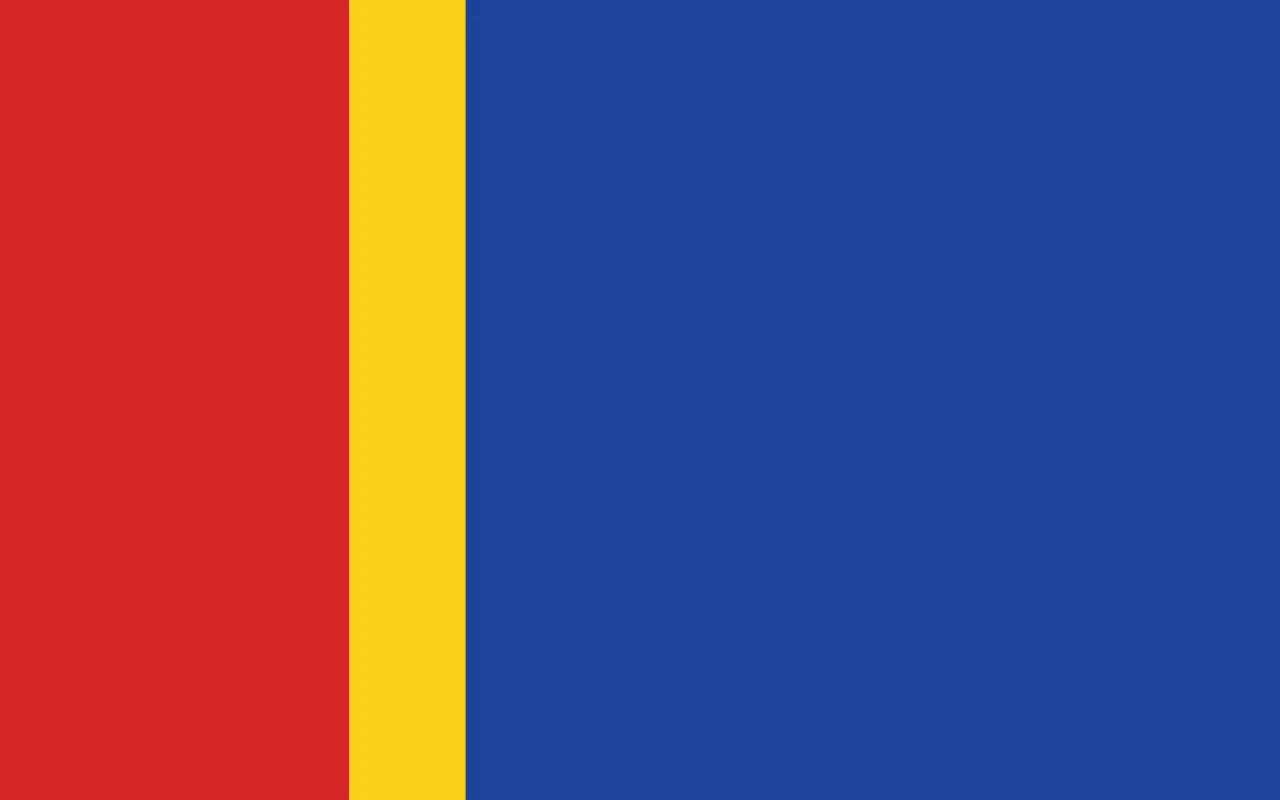
Unofficial Sami flag (Marit Stueng, 1962)
Designer
Astrid Båhl
Take a closer look
The four vertical stripes
1
The blue half of the circle
2
The red half of the circle
How it is described
The flag in the words of vexillology and heraldry.
Vexillological description
It is a rectangular field with a 75:101 ratio (150 by 202 cm, according to the Sami Council) with four vertical stripes and a circle.
Stripes
from the flagpole to the fly side, red, green, yellow and blue. The red one measures 64.5 cm; the green and yellow, 14 cm each; the blue, 109.5 cm.
Circle
a thick ring centred over the green and yellow stripes, closer to the flagpole. The half on the flagpole side is blue and the other half red, so that each crescent contrasts with the background behind it.
What it carries
Each element and how many of the 1,390 flags in the catalogue carry it. In yellow, the rarest.
The first Sami flag was drawn in 1962 by the politician Marit Stueng
1977
In 1977 the artist Synnøve Persen painted a similar design during the protests against…
1986
The 13th Nordic Sami Conference, meeting in Åre (Sweden), approved it unanimously on 15 August 1986
The full story
How it was born, how it has changed and what it means.
The Sami flag represents a people, not a country. The Sami, formerly called Lapps, live in the north of Norway, Sweden and Finland and on the Russian Kola peninsula, a land they call Sápmi. Their flag brings together the colours of their traditional garments and a circle that is at once sun and moon.
How it came about
The first Sami flag was drawn in 1962 by the politician Marit Stueng, from Karasjok (Norway), with the blue, red and yellow of the gákti, the Sami garment. In 1977 the artist Synnøve Persen painted a similar design during the protests against a dam on the Alta river, and it became the symbol of that struggle.
Years later the newspaper Sámi Áigi called a competition that received more than seventy entries. Astrid Båhl’s won, a Sami artist from the coast of Skibotn. The 13th Nordic Sami Conference, meeting in Åre (Sweden), approved it unanimously on 15 August 1986.
How it has changed
Båhl kept the base of the previous flag and added the green and the circle.
Unofficial flag of three colours, with red next to the flagpole and blue taking up more than half.
1986
The green, much used in the garments of the south, and the circle of sun and moon are added.
What it means
Red, green, yellow and blue
the colours of the gákti. Since 1986 they are known as the Sami national colours.
Red half of the circle
the sun.
Blue half of the circle
the moon.
The whole circle
a symbol that appears on many Sami shaman drums, and in a poem that calls the Sami ‘sons of the sun’.
Fun facts
On the drums it was only red
On the shaman drums the sun symbol was painted only in red, with a dye from the alder, a sacred tree. The flag splits it into two colours to add the moon.
Sons and daughters of the sun
The circle was chosen thinking of a poem that the shepherd Anders Fjellner collected in the mid-19th century from a joik, the traditional Sami chant. It tells that the Sami descend from a son of the Sun, and the Sami anthem repeats the idea.
Compulsory in Norwegian town halls
Since 2003 it has official status in Norway, the country with the most Sami, and all municipalities must fly it on 6 February, Sami National Day.
Its birthday is twice
15 August, the day it was approved, is also the anniversary of the birth of Isak Saba, author of the lyrics of the Sami anthem. That is why it is one of the days it is flown.
A painting in the National Museum
Synnøve Persen’s works with her 1977 flag proposal entered the National Museum of Norway in 2018.
Location
Buy the flag
Buy the flag on AmazonAffiliate link: if you buy, Wiki Banderas receives a small commission.
How much have you learnt?
Test what you have read about the flag of Sami.
Sources
Text based on the article “Sámi flag” from the Spanish Wikipedia, published under the licence CC BY-SA 4.0.