Skip to content

Wiki Banderas
Open menu

Flag of Zug

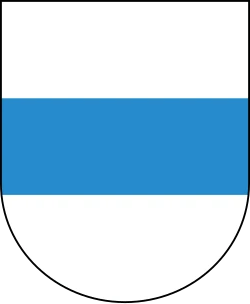
A blue band on a white ground: the seal of the community of Zug dates from 1319 and the design resembles the Habsburg arms with the colours changed.

Flag of Zug
Coat of arms

The flag, in figures

Every fact about the flag, each with what it means.

Proportions
1:11 wide for every 1 high. 29 flags in the catalogue share it.
Properties
Normal flagFIAV symbol: the form of the flag.
Use
CivilFIAV symbol: who may fly the flag.
Colours
  • White
  • Blue
Reference shades: the official one may vary slightly.
Coat of arms
YesIt carries the coat of arms on the cloth.

Take a closer look

  • Field

  • Band

  • Colours

How it is described

The flag in the words of vexillology and heraldry.

Vexillological description

It is a square field, of a 1:1 ratio, white, with a horizontal blue band in the centre. A band is a stripe of colour.

Field
white and square (1:1), with no coat of arms or figures.
Band
blue and horizontal; it leaves the same height of white above as below and runs from one side to the other.
Colours
only two, the white of the ground and the blue of the band.
What it carries

Each element and how many of the 1,390 flags in the catalogue carry it. In yellow, the rarest.

Its history in dates

Every date in its story, at a glance.

  1. 1315

    Zug changed sides, not flags: founded by Austria, it fought against the confederates at Morgarten…

  2. 1319

    VNIVERSITATIS DE ZVGE, is of 1319

The full story

How it was born, how it has changed and what it means.

The flag of Zug is a horizontal blue band in the centre of a white field. Nothing else: with no animals or towers, it is among the barest of the cantonal flags, and its simplicity covers a dynastic origin.

How it came about

Zug was a town founded by the dukes of Austria, and its arms come from noble hands, not from communal fantasy. The most accepted explanation: they were granted by Rudolf of Habsburg by inverting his own, which were a white band on red; in Zug it became a blue band on white, with the blue perhaps taken from the counts of Lenzburg, the first lords of the place. The first written record of the community’s seal, S. VNIVERSITATIS DE ZVGE, is of 1319; since then the design has not moved.

How it has changed

Zug changed sides, not flags: founded by Austria, it fought against the confederates at Morgarten (1315) and ended up joining them when it was surrounded, with its admission officially dated to 1352.

What it means

  • Blue band

    in heraldry the horizontal stripe is sometimes read as a military belt or a ribbon of honour.

  • White and blue

    a mixture of the Habsburg and Lenzburg arms, according to the most sustained explanation; no document confirms it entirely.

Fun facts

  1. The enemy founded it and it became a friend

    Zug, a town of the dukes of Austria, fought against the confederates at the battle of Morgarten; when the Duke abandoned them and it was surrounded, it opened its gates and joined the winning side.

  2. An entry with a false date

    Zug’s admission to the Confederation was formalised in the Peace of Thorberg in 1368, but in 1414 the paperwork was redone and backdated to 1352, giving it more antiquity than it had.

  3. The standard that became booty

    In the Toggenburg War of 1712 the Protestant cantons captured Zug’s standard; its image survives in old photographs and in sharpshooters’ chronicles.

Localisation

How much have you learnt?

Test what you have read about the flag of Zug.

  1. 1. Which one is the flag of Zug?

  2. 2. What are the proportions (height:width) of the flag?

Sources

Sources consulted:

Credits

Flag image: Autor desconocido, Wikimedia Commons · Public domain.

More flags

Accessibility preferences

Accessibility statement

Quick profiles

Text and reading

Text size
Default
Line height
Default
Letter spacing
Default
Word spacing
Default

Colour

Motion and orientation

Cursor