Every fact about the flag, each with what it means.
Proportions
2:33 wide for every 2 high. 989 flags in the catalogue share it.
Properties
Normal flagFIAV symbol: the form of the flag.
Use
CivilFIAV symbol: who may fly the flag.
Colours
yellow
red
green
white
grey
Reference shades: the official one may vary slightly.
Coat of arms
YesIt carries the coat of arms on the cloth.
Take a closer look
The nine stripes
1
The four bars
2
The municipal coat of arms
3
The royal crown
How it is described
The flag in the words of vexillology and heraldry.
Vexillological description
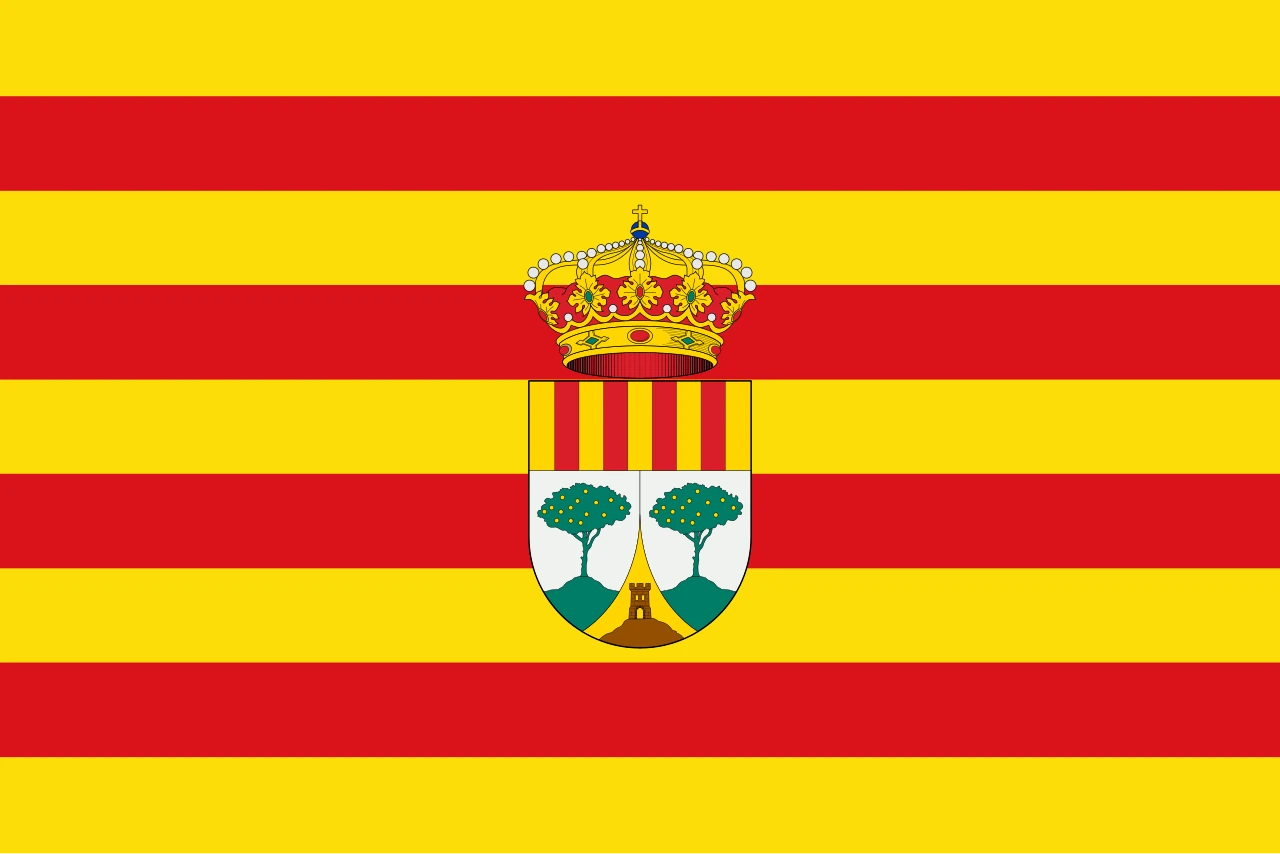
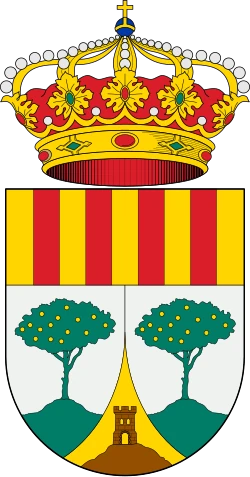
It is a rectangular field with a 2:3 ratio, yellow, with four horizontal red stripes that divide it into nine equal parts. In the centre, on top, the coat of arms of the municipality: Or with four red pales above, two green fruit trees with golden fruit at the sides and a stone castle on a rock below. All crowned by a Spanish royal crown.
Field
yellow with four horizontal red stripes; the nine divisions have the same width.
Coat of arms
in the centre, elliptical in shape and divided: four red pales on gold above, two green trees with golden fruit on the flanks and a stone castle at the point.
Crown
the Spanish royal crown, closed and with a cross, above the coat of arms.infoothers: 'Colores: amarillo, rojo'
What it carries
Each element and how many of the 1,390 flags in the catalogue carry it. In yellow, the rarest.
How it was born, how it has changed and what it means.
The flag of Busot is the Valencian senyera —four red stripes on yellow —with the coat of arms of the town in the centre and, above it, a closed Spanish royal crown. What is unusual is how the stripes are distributed: the rule asks that the field be divided into exactly nine equal parts, four red and five yellow.
How it came about
Busot is a municipality in the Alacantí. Its symbols were made in the eighties and nineties, when the town council decided it lacked a coat of arms and a flag. The Real Academia de la Historia approved both projects —the coat of arms report and the flag report —at its session of 23 November 1990.
The coat of arms never made it into the Diario Oficial. The flag, on the other hand, exists and is used, even though its coat of arms is that unofficial one. The description reads: “The flag of Busot is made up of a yellow field with four horizontal red stripes, so that the nine divisions are of the same width, and it bears superimposed at the centre the coat of arms of the municipality topped with the Spanish royal crown”.
The coat of arms brings three things: the castle, which is the old castle of Busot; the fruit trees, which recall the agricultural economy of the village; and the four pales, which come from the fact that the population depended on the city of Alicante until the nineteenth century, which was a royal town and could use the arms of the old Kingdom of Valencia.
How it has changed
It has not changed: it is the 1990 design.
What it means
Yellow and red
the senyera, with the nine divisions of equal width.
Stone castle
at the point of the coat of arms, the old castle of Busot, on its crag.
Two fruit trees
at the sides, with golden fruit; they allude to the agriculture of the municipality.
Four red pales
above, the arms of Aragon, for the old dependence on Alicante.
Fun facts
Nine divisions, all equal
The flag of Busot does not say “four red bars on yellow” but something more precise: that the field is divided into nine parts of the same width. Four are red and five yellow. It is the traditional way of measuring the senyera, and very few municipal flags write it that way.
A flag with a coat of arms that does not officially exist
The Real Academia de la Historia gave its approval to the coat of arms of Busot in 1990, but it was never published in the Diario Oficial. The flag is used all the same and carries that unofficial coat of arms on top: it is a municipal flag with a coat of arms half way to official status.
The four pales come from Alicante
The four red pales on the coat of arms are not there on account of Aragon in general: they explain that Busot was a district of the city of Alicante until the nineteenth century, and that Alicante, as a royal town, was allowed to use the arms of the Kingdom of Valencia. The same explanation holds for the four bars of the flag.
A Spanish crown, not a Valencian one
Most Valencian municipal flags carry the coat of arms with the open royal crown. Busot crowns it with the closed Spanish royal crown with a cross, exactly as it appears in the coat of arms of Spain. It is a detail of the Crown, not of the king.
How much have you learnt?
Test what you have read about the flag of Busot.
Sources
Sources consulted:
Real Academia de la Historia: informe sobre la bandera de Busot (Boletín de la RAH, 23-11-1990)
Viquipèdia: Símbols de Busot
Generalitat Valenciana (2003), citada en la Viquipèdia