Every fact about the flag, each with what it means.
Proportions
1:22 wide for every 1 high. 49 flags in the catalogue share it.
Properties
Normal flagFIAV symbol: the form of the flag.
Use
Civil, state and militaryFIAV symbol: who may fly the flag.
Adopted
190621 April 1906 · 120 years ago
Colours
Blue
White
Red
Reference shades: the official one may vary slightly.
Coat of arms
YesIt carries the coat of arms on the cloth.
Nickname
Flag of the Lone Star
Designer
Miguel Teurbe Tolón, from an idea of Narciso López
Take a closer look
The five stripes
1
The red triangle
2
The white star
How it is described
The flag in the words of vexillology and heraldry.
Vexillological description
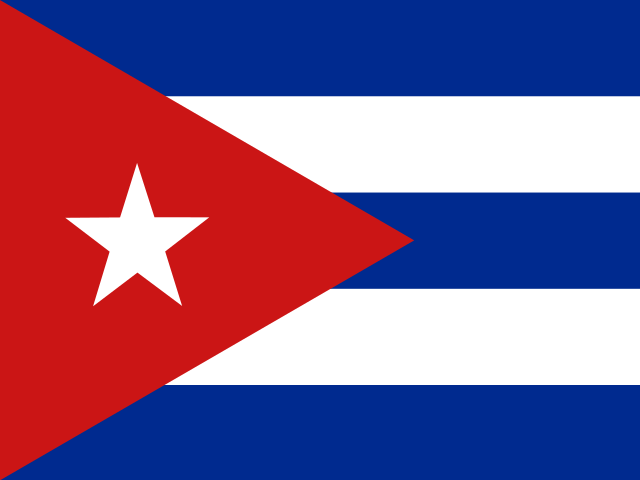
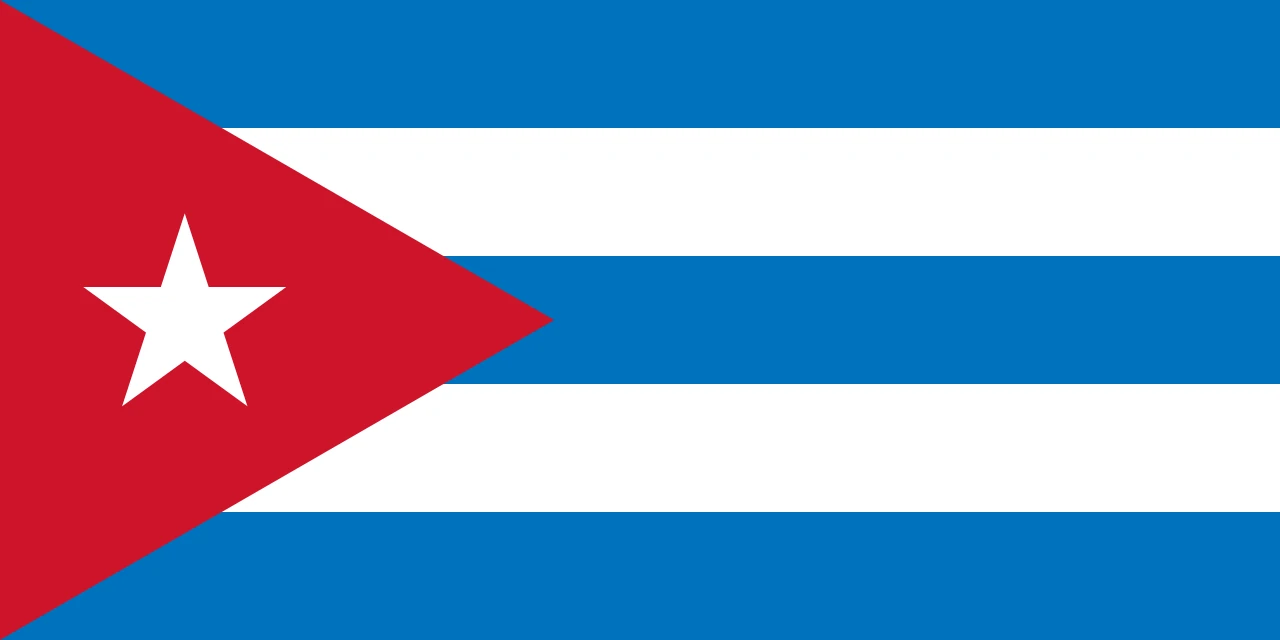
It is a rectangular field —the field is the cloth of the flag— with a 1:2 ratio, twice as long as it is high, with five horizontal stripes (three blue and two white) and, next to the flagpole, a red triangle with a white star in the centre.
Stripes (a stripe is a band of colour)
five, of the same thickness, alternating blue and white.
Triangle
red, with its vertical side on the flagpole and its point towards the fly (the free edge).
Star
white and five-pointed, in the centre of the triangle, with one point facing up.
No coat of arms
it carries no coat of arms or other figure.
What it carries
Each element and how many of the 1,390 flags in the catalogue carry it. In yellow, the rarest.
In 1849 a group of Cuban exiles was preparing an expedition in New York to free the island
1850
On 19 May 1850 his expedition landed at Cárdenas and the flag was raised there for the first time
1851
The adventure failed and López was executed in Havana in 1851
1869
In 1869 the Assembly of Guáimaro chooses López’s as the flag of free Cuba
1902
Cuba has been independent since 1902
The full story
How it was born, how it has changed and what it means.
The flag of Cuba has five horizontal stripes, three blue and two white, and a red triangle next to the flagpole with a white star. Because of that star it is known as ‘the lone star’. It is older than the country itself: it was created half a century before Cuba became independent.
How it came about
In the mid-19th century Cuba was a colony of Spain. In 1849 a group of Cuban exiles was preparing an expedition in New York to free the island. Its leader was Narciso López, a soldier born in Caracas. López explained his idea for a flag to the poet Miguel Teurbe Tolón, who drew it, and Teurbe Tolón’s wife, Emilia, sewed the first one.
The clearest inspiration was the flag of the United States, with its stripes and its star. It was no coincidence: López wanted to separate Cuba from Spain and then join it to the United States as one more state. On 19 May 1850 his expedition landed at Cárdenas and the flag was raised there for the first time. The adventure failed and López was executed in Havana in 1851, but his flag survived.
How it has changed
The design is the same as in 1849. What changed was the tone of the blue and, for a while, it had a rival.
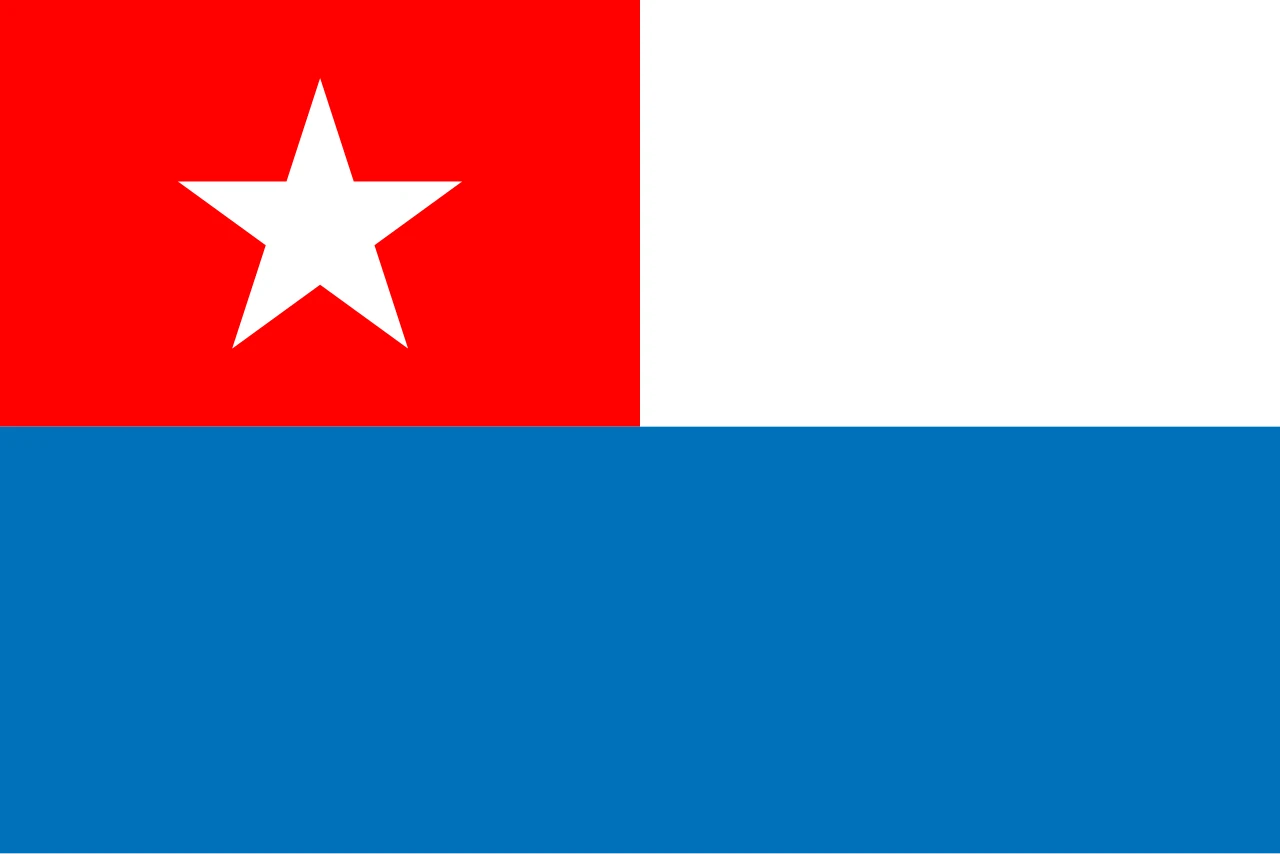
Carlos Manuel de Céspedes starts the war of independence with another flag, the one of La Demajagua. In 1869 the Assembly of Guáimaro chooses López’s as the flag of free Cuba.
1906
Cuba has been independent since 1902. A decree fixes the measurements of the flag and darkens the blue, which stays like that to this day.
What it means
The most accepted explanation of each element is this:
Three blue stripes
the three departments Cuba was divided into in 1849: west, centre and east.
Two white stripes
the purity of the ideas of the independence supporters.
Red triangle
the blood shed for freedom. Its three-equal-sides shape is a Masonic symbol of liberty, equality and fraternity; many independence leaders were Masons.
White star
a new and free state. For López, it was the star that Cuba would add to the flag of the United States.
Fun facts
A flag seen in the sky
According to a much-repeated legend, López saw the design at dawn: red clouds formed a triangle, the planet Venus shone and two white clouds divided the blue sky. No document confirms it.
The losing flag presides over Parliament
In 1869 the deputies of Guáimaro did not want to forget Céspedes’s flag. They agreed to hang it in the hall where they met, and since then the two flags preside together over the sessions of the Cuban Parliament.
Sister of the Puerto Rican one
In 1895 the independence supporters of Puerto Rico, who were organised alongside the Cubans in New York, adopted the same design with the colours of the triangle and the stripes swapped.
Buy the flag
Buy the flag on AmazonAffiliate link: if you buy, Wiki Banderas receives a small commission.
Buy the flag on AmazonAffiliate link: if you buy, Wiki Banderas receives a small commission.
Country facts
Where it is and what borders it.
Capital
Havana
Area
109,884 km²
Country
Republic of Cuba
Continent
North America
Subregion
Caribbean
Independent state
Yes
UN member
Yes
ISO code
CUB · CU
How much have you learnt?
Test what you have read about the flag of Cuba.
Sources
Text based on the article “Bandera de Cuba” from the Spanish Wikipedia, published under the licence CC BY-SA 4.0.