Skip to content

Wiki Banderas
Open menu

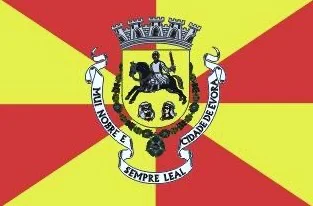
Flag of Évora

Eight red and yellow gironnies with Giraldo Sem Pavor on horseback: the flag of Évora was published in 1990 and replaced a red and blue one.

Flag of Évora
Coat of arms

The flag, in figures

Every fact about the flag, each with what it means.

Proportions
2:33 wide for every 2 high. 989 flags in the catalogue share it.
Properties
Normal flagFIAV symbol: the form of the flag.
Use
CivilFIAV symbol: who may fly the flag.
Adopted
199012 October 1990 · 36 years ago
Colours
  • red
  • yellow
  • black
  • silver
Reference shades: the official one may vary slightly.
Coat of arms
YesIt carries the coat of arms on the cloth.
123

Take a closer look

  1. The gyronny cloth

  2. 1

    The coat of arms

  3. 2

    The mural crown

  4. 3

    The scroll with the motto

How it is described

The flag in the words of vexillology and heraldry.

Vexillological description

It is a rectangular field with a 2:3 ratio divided into eight gironnies that alternate red and yellow. The coat of arms of the city occupies exactly the centre and can be seen whole.

Field
a 2:3 rectangle, the cloth that is raised on the flagpole (the vertical pole).
Gironnies
eight equal triangles that start at the centre and reach the edges.
Coat of arms
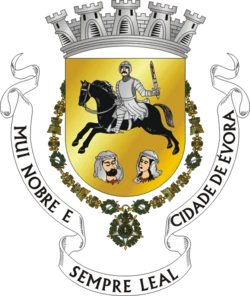
centred, on a golden ground, with a knight on horseback and a stone crown above.
Flagpole and fly side
the fly side is the free edge; the figure sits at the same distance from both.
What it carries

Each element and how many of the 1,390 flags in the catalogue carry it. In yellow, the rarest.

Its history in dates

Every date in its story, at a glance.

  1. 1165

    According to tradition, in 1165 the knight Giraldo Sem Pavor (“Giraldo the Fearless”) entered…

  2. 1930

    It followed the rule of 1930 for cities, like that of Lisbon

  3. 1931

    It was probably adopted in 1931, but the official publication has not been found

  4. 1987

    The town council had decided to change its symbols in 1987

  5. 1990

    The current flag was published in the Diário da República (III Série) on 12 October 1990

The full story

How it was born, how it has changed and what it means.

The flag of Évora has eight red and yellow gironnies, with a knight on horseback on the coat of arms in the centre. It is one of the Portuguese city flags with the best documented history: it has had at least three versions.

How it came about

The current flag was published in the Diário da República (III Série) on 12 October 1990. The town council had decided to change its symbols in 1987. A heraldist advised them red and gold, or black and gold. The council chose red and yellow, according to Flags of the World, because the red was already on the previous flag.

The coat of arms tells a story of the Reconquista. According to tradition, in 1165 the knight Giraldo Sem Pavor (“Giraldo the Fearless”) entered the city after killing the Muslim guard of a gate and his daughter. The two severed heads are at the horse’s feet.

How it has changed

Évora had two different symbols before. This is how they changed:

  1. 17th century

    A red silk standard with a knight raising his sword and the head of a decapitated Muslim. It bore a phrase in Latin: «PERPETVM LAVDIS DAT MONVMENTA TIBI», that is, “the continuity of praise gives you monuments”.

  2. 1931-1990

    A flag of eight red and blue gironnies. It was probably adopted in 1931, but the official publication has not been found. It followed the rule of 1930 for cities, like that of Lisbon.

  3. Current banner of Évora: red and yellow gironnies with the knight Giraldo on the coat of arms
    Mevora · CC BY-SA 4.0

    1990

    Current official flag. The blue is swapped for the yellow, but it keeps the red and the knight of the old standard.

What it means

  • Red and yellow

    the red comes from the previous flag; the yellow is the gold of heraldry.

  • Knight on horseback

    Giraldo Sem Pavor, with a sword stained with blood.

  • Two severed heads

    those of the Muslim guard and his daughter, according to tradition.

  • Mural crown of five towers

    it marks that it is a city.

  • Collar of the Order of the Tower and the Sword

    a decoration.

Fun facts

  1. Saramago told the deed of Giraldo

    According to Flags of the World, Nobel laureate José Saramago wrote that, after the city was taken by the Portuguese, Évora never fell again into Muslim hands.

  2. A standard with a Latin encomium

    The seventeenth-century standard bore the phrase PERPETVM LAVDIS DAT MONVMENTA TIBI. Over time it deteriorated and the head of the woman that appeared in one corner disappeared.

Location

How much have you learnt?

Test what you have read about the flag of Évora.

  1. 1. Which one is the flag of Évora?

  2. 2. Which of these elements appears on the flag?

  3. 3. What are the proportions (height:width) of the flag?

  4. 4. In which year was the current flag adopted?

More flags

Accessibility preferences

Accessibility statement

Quick profiles

Text and reading

Text size
Default
Line height
Default
Letter spacing
Default
Word spacing
Default

Colour

Motion and orientation

Cursor