Skip to content

Wiki Banderas
Open menu

Flag of Oporto

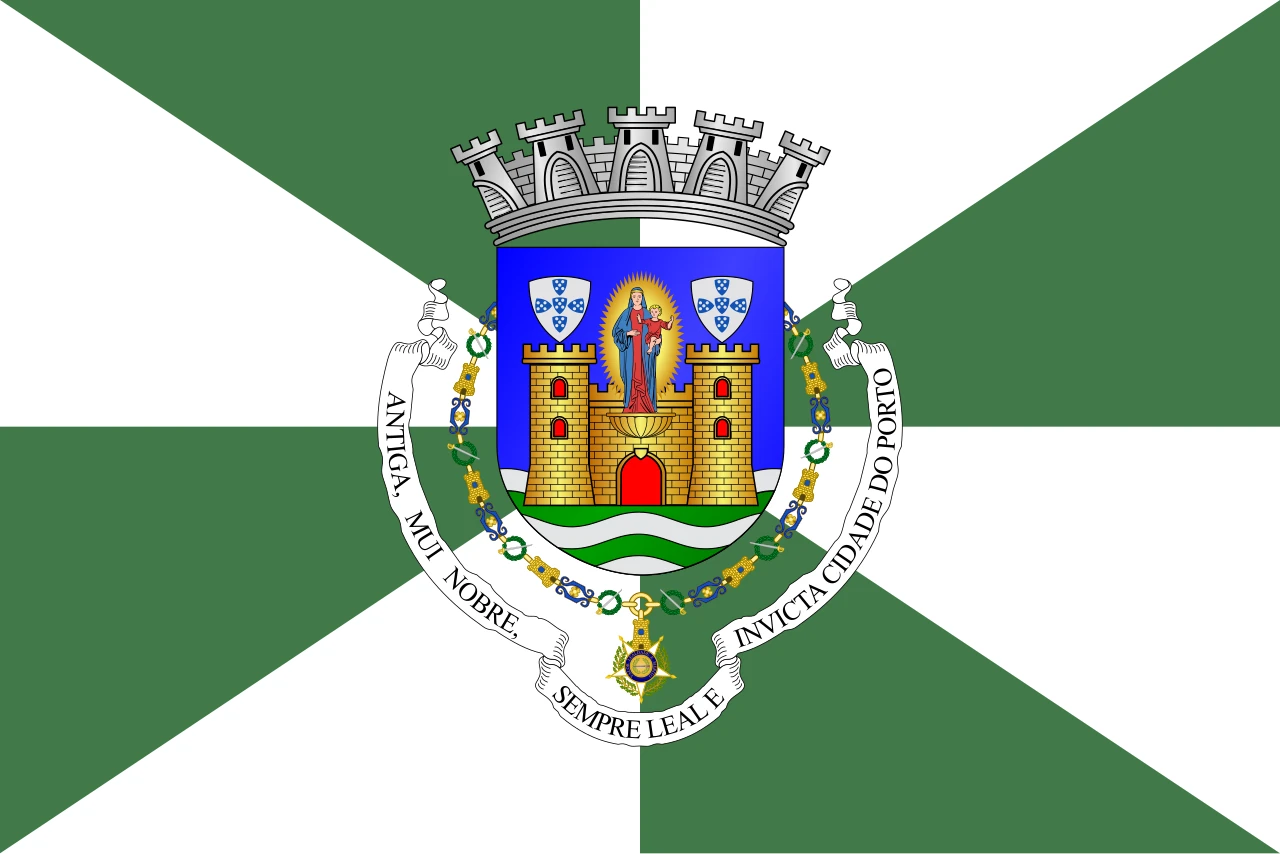
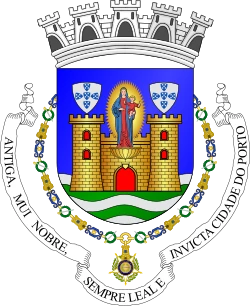
Eight green and white triangles with the castle and Our Lady of the city in the centre: the flag of Oporto has been official since the portaria of April 1940.

Flag of Oporto
Coat of arms

The flag, in figures

Every fact about the flag, each with what it means.

Proportions
2:33 wide for every 2 high. 989 flags in the catalogue share it.
Properties
Normal flagFIAV symbol: the form of the flag.
Use
CivilFIAV symbol: who may fly the flag.
Adopted
194025 April 1940 · 86 years ago
Colours
  • green
  • white
  • gold
  • blue
  • red
Reference shades: the official one may vary slightly.
Coat of arms
YesIt carries the coat of arms on the cloth.
123

Take a closer look

  1. The gyronny cloth

  2. 1

    The mural crown

  3. 2

    The coat of arms

  4. 3

    The Virgin with the Child

How it is described

The flag in the words of vexillology and heraldry.

Vexillological description

It is a rectangular field —the cloth of the flag —with a 2:3 ratio. The field is divided into eight gironnies, eight triangles that start at the centre and reach the edges: four green and four white, alternating. In the centre, over them, goes the arms of the city.

Field
green and white, with no borders or stripes.
Gironnies
eight triangles from the centre to the edge, alternating green and white.
Coat of arms
that of the city, in the centre, with a castle, Our Lady with the Child and a band with the motto.
What it carries

Each element and how many of the 1,390 flags in the catalogue carry it. In yellow, the rarest.

Its history in dates

Every date in its story, at a glance.

  1. 1354

    The symbols of the city go back to a grant of 1354

  2. 1935

    It was withdrawn between 1935 and 1940

  3. 1940

    A portaria, an order of the ministry, approved it on 25 April 1940 along with the coat of arms…

The full story

How it was born, how it has changed and what it means.

The flag of Oporto (Porto, in Portuguese) has eight triangles, four green and four white, with the arms of the city in the centre. On those arms there are a castle and the image of Our Lady with the Child. The symbols of the city go back to a grant of 1354.

How it came about

The current flag is from the twentieth century. A portaria, an order of the ministry, approved it on 25 April 1940 along with the coat of arms and the seal. It was the system Portugal created in the thirties: each municipality, a flag with its coat of arms in the centre and a ground that indicates its category. Oporto, being a city, carries the one of eight triangles.

How it has changed

No official flag earlier than 1940 is known. What changed was the coat of arms in the centre.

  1. 1354

    Shield of the city’s seal: two towers, Our Lady of Vendôme over a gate between two angels and a band reading “Sig Civitatis Virginis”, “seal of the city of the Virgin”. There is still no flag.

  2. 1837-1935

    Quartered coat of arms with the arms of Portugal and those of Oporto, a red escutcheon with a golden heart and a green dragon with the word “Invicta”. It was withdrawn between 1935 and 1940.

  3. Current flag of Oporto, with green and white triangles and the arms of the city

    1940

    The medieval coat of arms is recovered, without the quartering, and the green and white flag is fixed, which remains in force.

What it means

  • Green and white

    the colours of the waves of the coat of arms. The cords and tassels are silver and green.

  • Golden castle

    the walled city, with the gate open.

  • Our Lady with the Child

    Our Lady of Vendôme, above the gate.

  • Two escutcheons

    the ancient arms of Portugal, as on the flag of Portugal.

  • Motto

    “Antiga, mui nobre, sempre leal e invicta cidade do Porto”.

Fun facts

  1. The old coat of arms lives on in football

    The emblem of FC Porto uses the quartered coat of arms of 1837, the one the city stopped using officially.

  2. Porto gave Portugal its name

    Porto means “port”. The name of Portugal comes from its medieval name, Portus Cale. The “O” of Oporto is the Portuguese article and is not part of the name.

  3. Invicta comes from a siege

    The nickname recalls the siege of 1832 to 1833, when the city resisted absolutist troops.

Localisation

How much have you learnt?

Test what you have read about the flag of Oporto.

  1. 1. Which one is the flag of Oporto?

  2. 2. Which of these elements appears on the flag?

  3. 3. What are the proportions (height:width) of the flag?

  4. 4. In which year was the current flag adopted?

Sources

Sources consulted:

Credits

Flag image: Crest_of_Porto.png: Brgesto derivative work: Brgesto, Wikimedia Commons · Public domain.

More flags

Accessibility preferences

Accessibility statement

Quick profiles

Text and reading

Text size
Default
Line height
Default
Letter spacing
Default
Word spacing
Default

Colour

Motion and orientation

Cursor