Skip to content

Wiki Banderas
Open menu

Flag of Azores

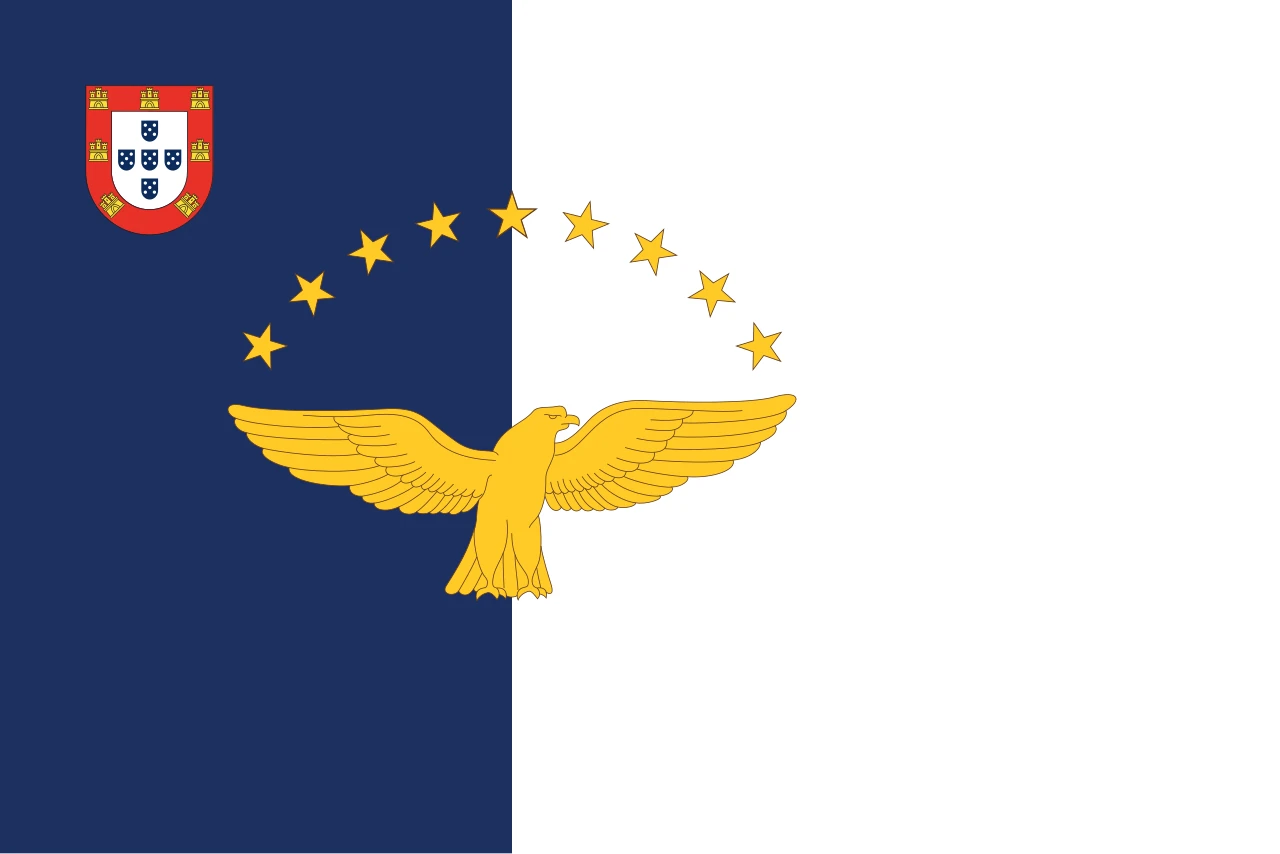
Blue and white, with a golden bird and nine stars, one per island: the flag of the Azores autonomy has been official since 10 April 1979.

Flag of Azores

The flag, in figures

Every fact about the flag, each with what it means.

Proportions
2:33 wide for every 2 high. 989 flags in the catalogue share it.
Properties
Normal flagFIAV symbol: the form of the flag.
Use
Civil and stateFIAV symbol: who may fly the flag.
Adopted
197910 April 1979 · 47 years ago
Colours
  • blue
  • white
  • yellow
  • red
  • black
Reference shades: the official one may vary slightly.
1234

Take a closer look

  1. The two stripes

  2. 1

    The blue stripe

  3. 2

    The goshawk

  4. 3

    The stars

  5. 4

    The national coat of arms

How it is described

The flag in the words of vexillology and heraldry.

Vexillological description

It is a field with a 2:3 ratio divided into two vertical stripes: a narrower blue one by the flagpole, and a wider white one towards the fly side. Over them are a yellow bird of prey, the goshawk, and nine stars; in the upper corner of the flagpole is the coat of arms of Portugal.

Stripes
the blue one, narrow, at the flagpole; the white one, wide, over the rest. A stripe is a band of colour.
Canton
the upper corner by the flagpole is called the canton; the coat of arms of Portugal goes there.
Goshawk
a yellow bird with spread wings, over the two stripes.
Stars
nine five-pointed ones, in an arc, one per island.
Colours
blue, white and yellow.

What it carries

Each element and how many of the 1,390 flags in the catalogue carry it. In yellow, the rarest.

The full story

How it was born, how it has changed and what it means.

The flag of the Azores is a field divided into two vertical stripes: a narrow blue one by the flagpole and a wider white one. Over them, a yellow bird with spread wings and nine stars.

How it came about

The Azores are a Portuguese archipelago in the Atlantic. The flag of the autonomy has been official since 10 April 1979.

The bird is a goshawk, the falcon of the island of Terceira, from which the archipelago takes its name. And the nine stars are one per island: the archipelago has nine inhabited islands, and the flag counts them.

How it has changed

It has never changed. It was approved in 1979 and there are no documented later modifications.

What it means

  • Blue stripe

    narrow, by the flagpole.

  • White stripe

    wide, towards the fly side.

  • Goshawk

    a yellow bird with spread wings, over the two stripes.

  • Nine stars

    five-pointed, in an arc. One per island.

  • Canton

    in the upper corner by the flagpole is the coat of arms of Portugal.

Fun facts

  1. Nine stars, nine islands

    The archipelago has nine inhabited islands and the flag has nine stars, one for each. It is a count, not a decoration: the flag enumerates the territory it represents.

  2. The coat of arms of Portugal in the canton

    In the upper corner against the flagpole, the canton, is the coat of arms of Portugal. It is a feature of the flags of the Portuguese regions: the national emblem occupies a fixed and recognisable place, and the region identifies itself over the rest of the field.

  3. The bird carries the name of the archipelago

    The goshawk is a falcon of the island of Terceira. From that bird, used in falconry, comes the name Azores. The flag puts it in yellow on blue and white so that it reads from a distance.

Location

How much have you learnt?

Test what you have read about the flag of Azores.

  1. 1. Which one is the flag of Azores?

  2. 2. Which of these elements appears on the flag?

  3. 3. What are the proportions (height:width) of the flag?

  4. 4. In which year was the current flag adopted?

More flags

Accessibility preferences

Accessibility statement

Quick profiles

Text and reading

Text size
Default
Line height
Default
Letter spacing
Default
Word spacing
Default

Colour

Motion and orientation

Cursor