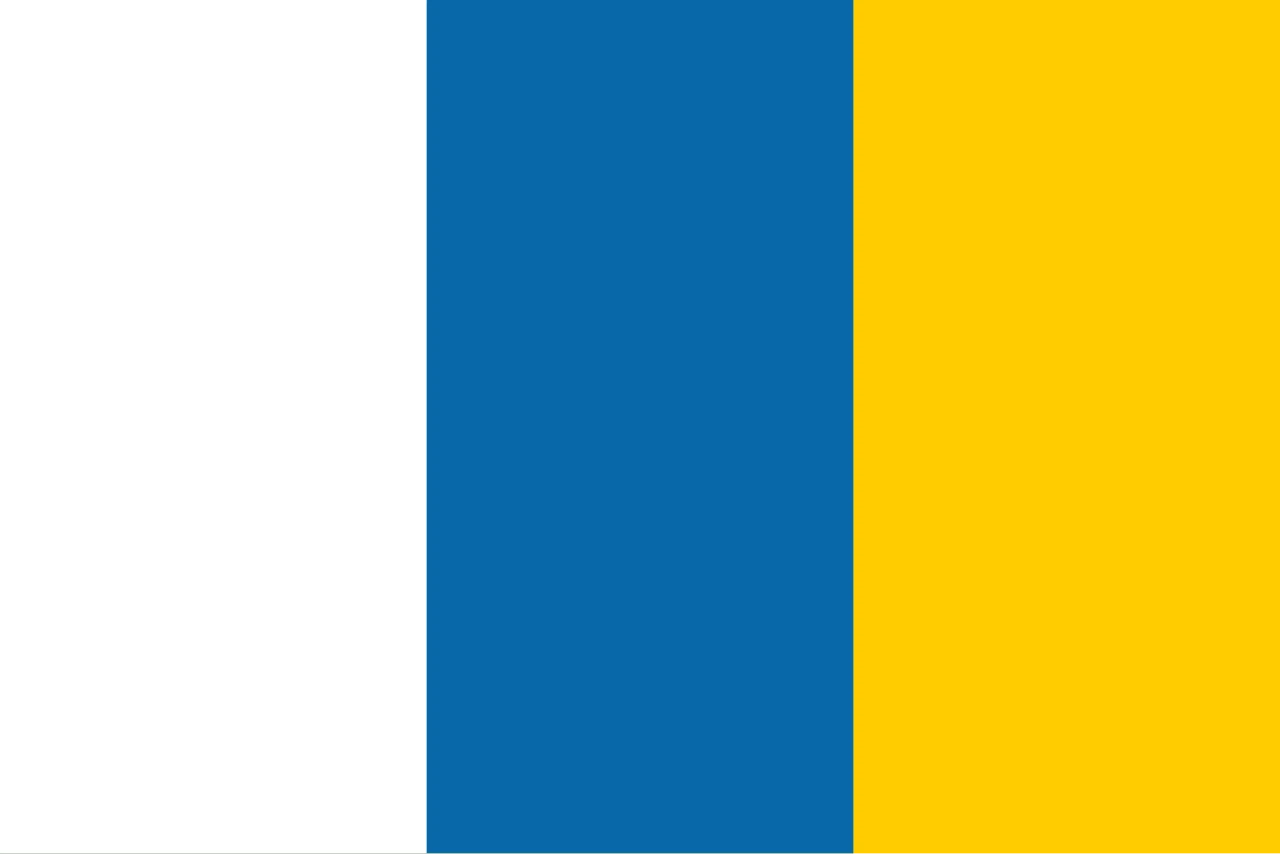
White, blue and yellow in vertical stripes: the flag of the Canary Islands joins the colours of Tenerife and Gran Canaria in the order they sit on the map.
Every fact about the flag, each with what it means.
Proportions
2:33 wide for every 2 high. 989 flags in the catalogue share it.
Properties
Normal flagFIAV symbol: the form of the flag.
Use
CivilFIAV symbol: who may fly the flag.
Adopted
198210 August 1982 · 44 years ago
Colours
white
blue
yellow
Reference shades: the official one may vary slightly.
Coat of arms
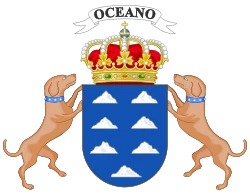
YesIt carries the coat of arms on the cloth.
Take a closer look
The three stripes
1
The white stripe
2
The yellow stripe
How it is described
The flag in the words of vexillology and heraldry.
Vexillological description
It is a rectangular field with a 2:3 ratio and three vertical stripes of the same width; the colours, starting from the flagpole (the pole it is hoisted on), are white, blue and yellow.
Stripes (bands)
three, of the same width, from left to right.
White
the first, by the flagpole.
Blue
the middle one.
Yellow
the last, by the fly side, the free edge.
What it carries
Each element and how many of the 1,390 flags in the catalogue carry it. In yellow, the rarest.
With democracy, the Statute of Autonomy of 1982 made it official
The full story
How it was born, how it has changed and what it means.
The flag of the Canary Islands has three vertical stripes of the same width: white, blue and yellow. It is simple, but it hides a map: its colours come from the flags of the two large islands and are placed from west to east, just as they are in the ocean.
How it came about
In the nineteenth century, Canary ships were identified by ensign flags, one for each “maritime province”. Tenerife’s was white and blue, and Gran Canaria’s blue and yellow. By the early twentieth century a Canarian flag was already in use in blue with seven white stars, one per island, which flew at the Ateneo of La Laguna.
The tricolour was born in 1961. A family from Gran Canaria linked to the Canarias Libre movement, which opposed Franco’s dictatorship, joined the colours of the two ensigns into vertical stripes. They handed them out at the feast of Our Lady of the Pine in Teror, and people adopted it at once as the flag of all the islands.
With democracy, the Statute of Autonomy of 1982 made it official, with the three stripes of equal width.
How it has changed
The design has not changed since 1982. On the 1961 flag the stripes were probably not equal: the blue one was a little wider.
What it means
The law does not explain the colours, but the traditional reading is geographical:
White
Tenerife, the province of the west, which goes on the left.
Yellow
Gran Canaria, the province of the east, which goes on the right.
Blue
the colour the two ensigns had in common, in the centre. It is also associated with the sea that surrounds the islands.
Fun facts
Three thousand paper flags
For the Teror festivities of 1961, María del Carmen Sarmiento and her sons Arturo and Jesús made about three thousand little flags with paper ribbons and handed them out to people.
The same colours in 1561
In 1561 a taffeta standard in white, blue and yellow with a red cross was delivered in Tenerife. Four centuries before the current flag its three colours already appeared, though purely by chance.
A flag with seven green stars
In the sixties, the MPAIAC independence movement added seven green stars, one per island, to the tricolour. That version is not official, but it is often seen at demonstrations.
A coat of arms with no law
There are Canarian flags with the coat of arms in the centre, but the Statute does not mention it. It appears only in the image manual of the Government of the Canary Islands.
Location
How much have you learnt?
Test what you have read about the flag of Canary Islands.