Skip to content

Wiki Banderas
Open menu

Flag of Zurich

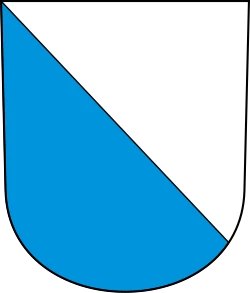
Blue and white divided diagonally: a flag documented in 1220, among the oldest in use, which for centuries bore a red streamer of which no trace now remains.

Flag of Zurich
Coat of arms

The flag, in figures

Every fact about the flag, each with what it means.

Proportions
1:11 wide for every 1 high. 29 flags in the catalogue share it.
Properties
Normal flagFIAV symbol: the form of the flag.
Use
CivilFIAV symbol: who may fly the flag.
Colours
  • Blue
  • White
Reference shades: the official one may vary slightly.
Coat of arms
YesIt carries the coat of arms on the cloth.

Take a closer look

  • Field

  • Division

  • Colours

  • Colours

How it is described

The flag in the words of vexillology and heraldry.

Vexillological description

It is a square field, of a 1:1 ratio, divided into two equal triangles by a diagonal: the blue lies by the flagpole (the pole it is hoisted from) and the white above and towards the fly (the free edge).

Field
square (1:1), with no coat of arms or any other figure.
Division
the diagonal runs from the upper corner of the hoist to the lower corner of the fly and leaves two triangles of the same size.
Colours
the blue triangle occupies the whole hoist side and the lower part; the white, the upper part and the fly side.
Colours
the blue triangle occupies the whole hoist side and the lower part; the white, the upper part and the fly side.


What it carries

Each element and how many of the 1,390 flags in the catalogue carry it. In yellow, the rarest.

Its history in dates

Every date in its story, at a glance.

  1. 1218

    The city of Zurich gained imperial freedom in 1218

  2. 1220

    It is documented in 1220: together with Schaffhausen

  3. 1273

    what was lost is the schwenkel, added in 1273 according to the most accepted date, flown…

  4. 1351

    Being free meant defending itself alone, and the city’s flag flew in battle at the head…

The full story

How it was born, how it has changed and what it means.

The flag of Zurich divides the field on the diagonal, blue at the top and by the flagpole and white below. It is documented in 1220: together with Schaffhausen, it is the oldest cantonal flag still in use, and one of the oldest still-valid flags in Europe.

How it came about

The city of Zurich gained imperial freedom in 1218, sharing with Schaffhausen the position of oldest state of the Empire that would later form Switzerland, and with it the right to have a standard of its own: it is first mentioned the following year and the seal of the town council, with the same drawing, dates from 1225. Being free meant defending itself alone, and the city’s flag flew in battle at the head of the Confederation, which Zurich joined in 1351. For centuries, moreover, the main flag carried an ornament that is no longer seen: a schwenkel, a very long streamer fastened at the top of the staff.

How it has changed

The field has not changed; what was lost is the schwenkel, added in 1273 according to the most accepted date, flown for centuries alongside the flag and now absent from it. The diagonal cut is the same as in the thirteenth century.

What it means

  • Blue

    it has been said to be the lake, with the white of the snowy mountains; in the older tradition, rather the sky, and the white the water.

  • The diagonal

    it has been explained as a sign of justice, though without medieval documentation saying so.

Fun facts

  1. A streamer of honour or of shame

    The medieval world disagreed about the red schwenkel: some held it a great honour, others a mark of infamy, a sign of having lost a flag in battle. In 1477 the Duke of Lorraine took them away from the Swiss, believing he was washing their shame; they put them back on reaching home, offended.

  2. The SPQR of Zurich

    On the eighteenth-century cavalry standards the city had S.PQ.T. engraved: Senatus Populusque Turicensis, the senate and people of Zurich, imitating the Roman SPQR.

  3. An old flag instead of a new one

    Zurich received the standard gifted by the pope in 1512, but when the Reformation came it retired it and went back into combat with a hundred-year-old flag that had been kept since the Burgundian wars.

Localisation

How much have you learnt?

Test what you have read about the flag of Zurich.

  1. 1. Which one is the flag of Zurich?

  2. 2. What are the proportions (height:width) of the flag?

Sources

Sources consulted:

Credits

Flag image: Autor desconocido, Wikimedia Commons · Public domain.

More flags

Accessibility preferences

Accessibility statement

Quick profiles

Text and reading

Text size
Default
Line height
Default
Letter spacing
Default
Word spacing
Default

Colour

Motion and orientation

Cursor