Every fact about the flag, each with what it means.
Proportions
2:33 wide for every 2 high. 989 flags in the catalogue share it.
Properties
Normal flagFIAV symbol: the form of the flag.
Use
CivilFIAV symbol: who may fly the flag.
Colours
blue
white
red
Reference shades: the official one may vary slightly.
Coat of arms
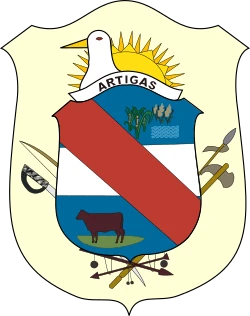
YesIt carries the coat of arms on the cloth.
Take a closer look
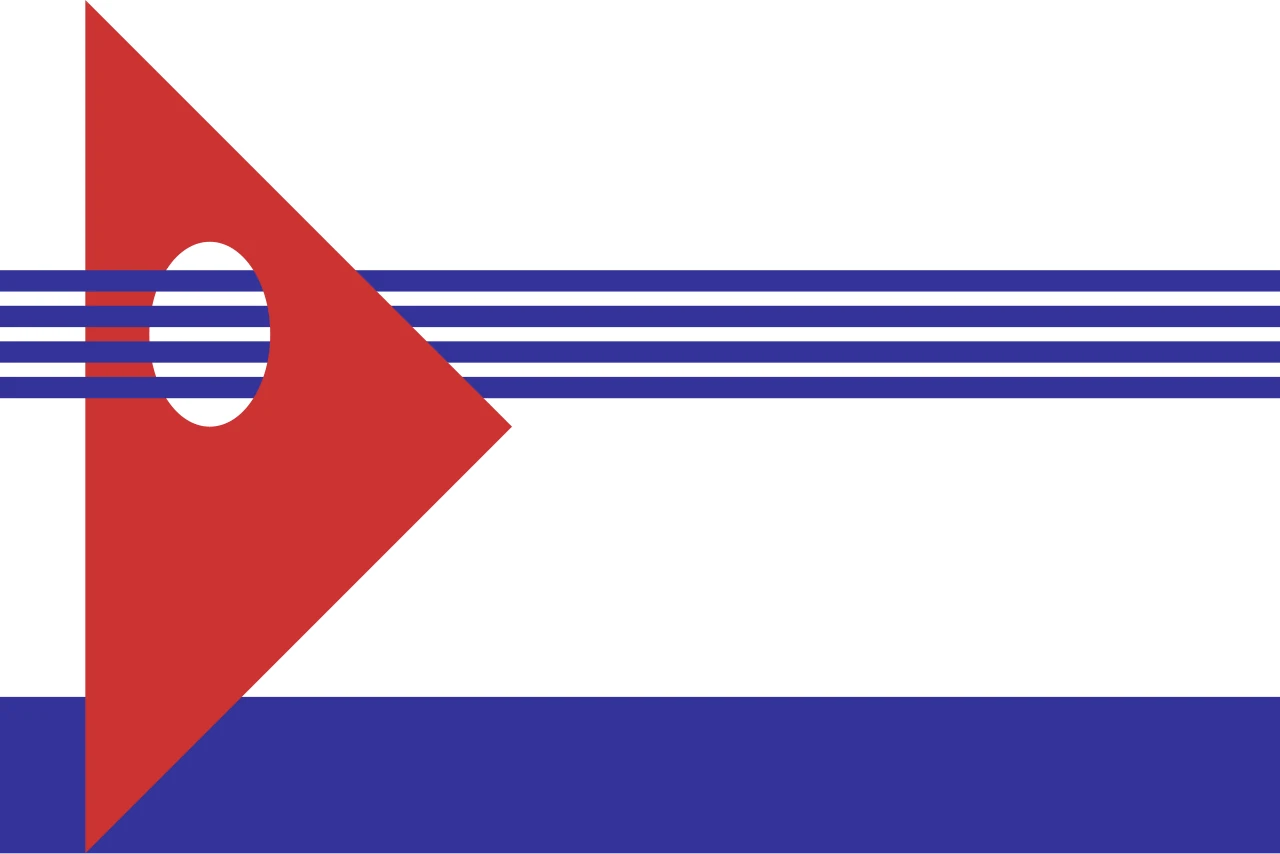
The white and blue field
1
The red triangle
2
The white oval
3
The four blue ribbons
4
The lower blue stripe
How it is described
The flag in the words of vexillology and heraldry.
Vexillological description
It is a rectangular white field with a blue stripe at the bottom and four thin blue lines in the central area. A red triangle, with its vertex pointing inwards, starts at the flagpole (the mast side) and reaches to the centre; inside it is a white oval.
Field
white, with a blue stripe at the bottom.
Lines
four thin horizontal blue lines across the middle of the field, which cross the triangle.
Triangle
red, at the flagpole, with its vertex pointing at the centre.
Oval
white, inside the triangle.
What it carries
Each element and how many of the 1,390 flags in the catalogue carry it. In yellow, the rarest.
How it was born, how it has changed and what it means.
The flag of the department of Artigas, in north-eastern Uruguay, is almost the flag of José Artigas retouched: it keeps the white, the blue and the red, but replaces the diagonal stripe with a red triangle and adds four blue lines. It was designed by the architect Hugo Ferreira Quirós, winner of a competition financed by the departmental government.
How it came about
Artigas is the gateway to Uruguay: it borders Brazil and Argentina. Its flag was designed taking as its starting point that of the national hero Artigas, with his white, his blue and his red, but substituting the diagonal red stripe for another equally symbolic and abstract figure.
The winner of the competition explained the rules that were followed. The flag is meant to be in motion, so it has to be easy to read and recognisable even when there is no wind; that is why the most important element, the red triangle with its oval, is against the flagpole, the mast side. And since in vexillology only primary and secondary colours are admitted, besides white and black, the palette was reduced to blue, red and white.
How it has changed
It has not changed: it is the design from the competition and there are no earlier versions documented.
What it means
White background
the integrity and purity of the inhabitants of the department, according to the author of the design.
Four blue lines
they allude to the national flag and to eastern nationality, inseparable from the collective memory of the people of Artigas.
Red triangle
the triple border, the rarest feature of the department: it is the only one that borders two countries at once. The red is the fire of intrepidness and the joy of joining hands with the neighbouring nations.
White oval
inside the triangle, it sums up the mineral wealth of the land, its precious stones.
Lower blue stripe
the water of the Artigas rivers and streams, which shape its landscape.
Fun facts
The only department with two borders
Besides the border with Brazil, Artigas is the only Uruguayan department that touches another country: Argentina. That is why its flag is almost a map of the department. The red triangle at the flagpole is precisely that triple border, and the white oval, the mineral wealth of the soil.
Designed to be recognisable without wind
The author explained that the flag was made with the movement of the air in mind. When there is no wind, the field hangs down and only what is next to the flagpole is seen well: that is why the triangle and the oval are against the mast, and the four blue lines cross the field so that they can be read even without air.
Only three colours, by the rule of vexillology
In vexillology the admitted colours are the primary ones, the secondary ones, white and black. The competition stuck to that list, and so the flag has neither green nor yellow, even though the landscape of Artigas is green and the sun very yellow.
An oval instead of the precious stones
In the original project, the white oval of the triangle represents the precious stones of the land. It is the most abstract figure on the flag: it draws neither a mine nor a gem, only an oval shape, and the competition chose it anyway.
How much have you learnt?
Test what you have read about the flag of Department of Artigas.