In 1889 the British Admiralty, which decided what flags ships could fly
1928
The island adopted it as its own flag between 1928 and 1932: the sources do not agree on the exact…
1968
In July 1968 the current model was fixed: the legs turn clockwise and one of them rests exactly…
The full story
How it was born, how it has changed and what it means.
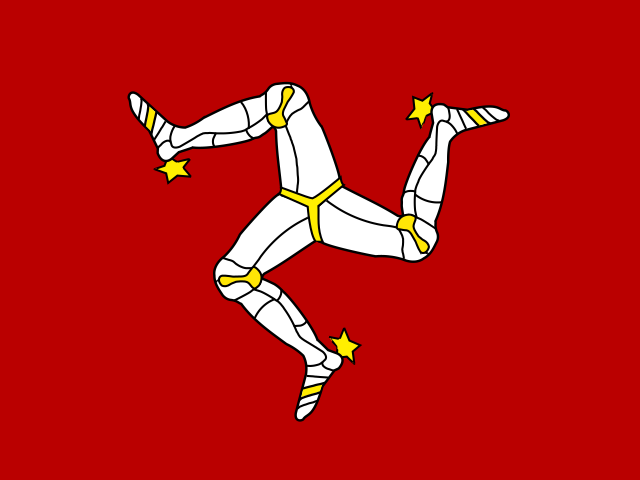
The flag of the Isle of Man is red and has in its centre a drawing you do not forget: three armoured legs, joined at the thighs, that seem to run in a circle. This symbol is called the triskele. The island is in the Irish Sea and depends on the British Crown, but is not part of the United Kingdom.
How it came about
The three legs are the emblem of the island since the 13th century. They appear shortly after 1265, when Man stops having kings of Norse origin and passes into the hands of Scotland. Nobody knows for certain where the drawing came from. Some historians link it to Sicily, which used a similar symbol at the time of the Normans.
The flag is that same emblem put onto a red field. By the mid-19th century the island’s merchant ships were already flying it without permission. In 1889 the British Admiralty, which decided what flags ships could fly, authorised it. The island adopted it as its own flag between 1928 and 1932: the sources do not agree on the exact date.
How it has changed
The design is the same from the start, but for centuries everyone drew the legs in their own way. Sometimes they ran to the right and sometimes to the left, and sometimes they rested on one leg and sometimes on two. In July 1968 the current model was fixed: the legs turn clockwise and one of them rests exactly at the bottom. Even so, old versions can still be seen on the island.
What it means
The flag has no official meaning. This is what is usually said about each element:
Red field
it is the colour of the island’s emblem.
Three legs
the triskele, from the Greek for ‘three legs’, is one of the oldest symbols known and is usually linked to the sun and movement. In Manx, the language of the island, they are called ny tree cassyn, ‘the three legs’.
Armour and golden spurs
those of a medieval knight.
Fun facts
However it falls, it stays standing
The motto that goes with the three legs, in Latin ‘Quocunque jeceris stabit’, means ‘wherever you throw it, it will stand’. It is read as the island’s ability to survive all its changes of owner.
A wizard turned into legs
A legend of the island tells that the wizard Manannán, lord of the sea, turned into three armoured legs and rolled down the mountain like a wheel of fire to drive out Saint Patrick. It is a popular tale, not history.
A cousin in Sicily
The flag of Sicily also carries three legs, but bare and with the head of Medusa in the centre.
Buy the flag
Buy the flag on AmazonAffiliate link: if you buy, Wiki Banderas receives a small commission.
Buy the flag on AmazonAffiliate link: if you buy, Wiki Banderas receives a small commission.
Country facts
Where it is and what borders it.
Capital
Douglas
Area
572 km²
Country
Isle of Man
Continent
Europe
Subregion
Northern Europe
Independent state
No
UN member
No
ISO code
IMN · IM
How much have you learnt?
Test what you have read about the flag of Isle of Man.