Every fact about the flag, each with what it means.
Proportions
2:33 wide for every 2 high. 989 flags in the catalogue share it.
Properties
Normal flagFIAV symbol: the form of the flag.
Use
CivilFIAV symbol: who may fly the flag.
Colours
green
yellow
white
Reference shades: the official one may vary slightly.
Coat of arms
YesIt carries the coat of arms on the cloth.
Take a closer look
The silver square
1
The green stripe
2
The yellow stripe
3
The coat of arms
How it is described
The flag in the words of vexillology and heraldry.
Vexillological description
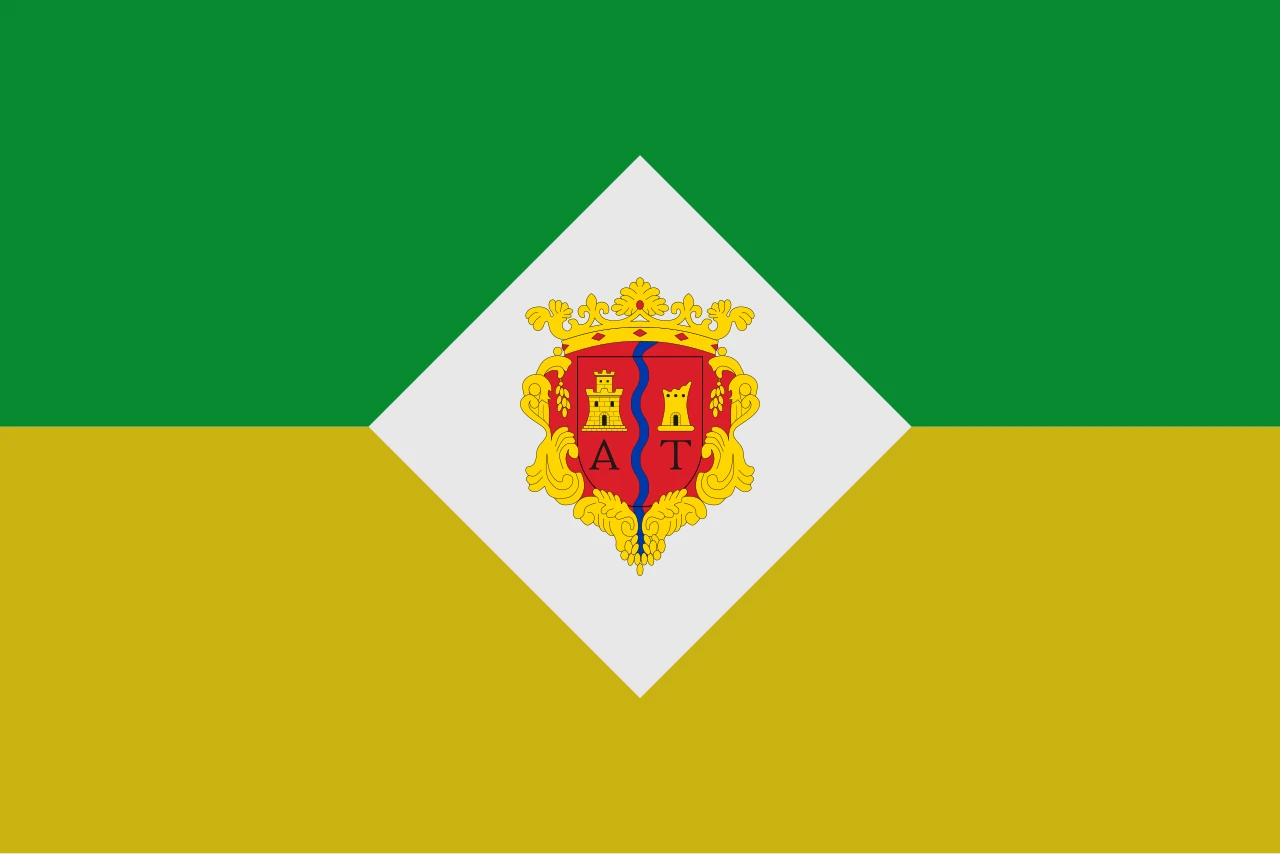
It is a rectangular field with a 2:3 ratio, divided into two equal horizontal stripes: green on top and yellow below. In the centre, between the two stripes, there is a white square resting on one corner (a point downwards) and, on top of it, the municipal coat of arms.
Field (the cloth)
two horizontal stripes of equal height.
Upper stripe
green.
Lower stripe
yellow.
Central figure
a white or pearl grey square resting on a point.
Coat of arms
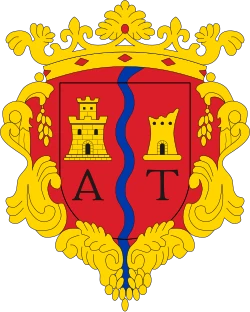
round in shape, with a wavy vertical blue band between two golden towers, on a red field. It takes up less than half the height of the field.
What it carries
Each element and how many of the 1,390 flags in the catalogue carry it. In yellow, the rarest.
The oldest surviving coat of arms is an 1876 seal of the Ayuntamiento Constitucional de Agost
2020
The blazon of the coat of arms was published in 2020
The full story
How it was born, how it has changed and what it means.
The flag of Agost is one of the few Valencian municipalities that relies on neither the senyera nor the colours of the Crown of Aragon. It is a design of its own: two stripes, green and yellow, with a white lozenge in the middle that serves as a pedestal for the coat of arms.
How it came about
Neither the coat of arms nor the flag of Agost were ever legalised by the Generalitat. Both are in de facto use: the council uses them, but there is no official resolution approving them. The blazon of the coat of arms was published in 2020, in a work on Valencian heraldry, and it describes a shield with a red field and a vertical wavy blue band between two golden towers, one of them half ruined, with the letters A and T at the sides. It is topped by an open crown with acanthus.
From that red field and those two towers there is a very likely reading: they would be the castle of Agost and the castellet of La Murta, the two walled enclosures in the town, separated by the bed of the rambla. The wavy blue band would be precisely that rambla.
How it has changed
It has never changed. The oldest surviving coat of arms is an 1876 seal of the Ayuntamiento Constitucional de Agost, kept in the Archivo Histórico Nacional, with emblems very similar to the current ones. The only striking difference is that on that seal the central wavy band looks more like a crozier.
What it means
The colours are read above all through the coat of arms:
Red
the field of the coat of arms, where the two towers stand.
Blue
the vertical wavy band, standing for the rambla that separates the two castles.
Gold
the colour of the towers, which the flag repeats in the lower stripe.
Green
the upper stripe of the flag.
White lozenge
a support on which the coat of arms is placed, so that it stands out against the two colours.
Fun facts
A flag nobody legalised
Neither the coat of arms nor the flag of Agost have been legalised by the Valencian Generalitat: they are banners in de facto use, the ones the council displays and nobody has corrected. It is rare, because most Valencian municipalities did go through the Consell Tècnic d’Heràldica.
Two castles and a river below
The coat of arms shows two golden towers and, between them, a wavy blue band. It is not an ornament: they are the two castles of the town and the rambla that runs between them, separated by the water.
An Iberian town with a medieval coat of arms
Agost was one of the most important Iberian settlements in the Alicante area, and in 2015 the council recovered its Iberian sphinxes for the museum. Even so, its coat of arms uses no Iberian figure at all: it draws crenellated towers and a crown, the language of the Middle Ages.
The seal of 1876 already had almost this coat of arms
The Archivo Histórico Nacional keeps a seal of the Ayuntamiento Constitucional de Agost with emblems nearly identical to the current ones. The only difference is that the central blue band looks there more like a crozier than a river.