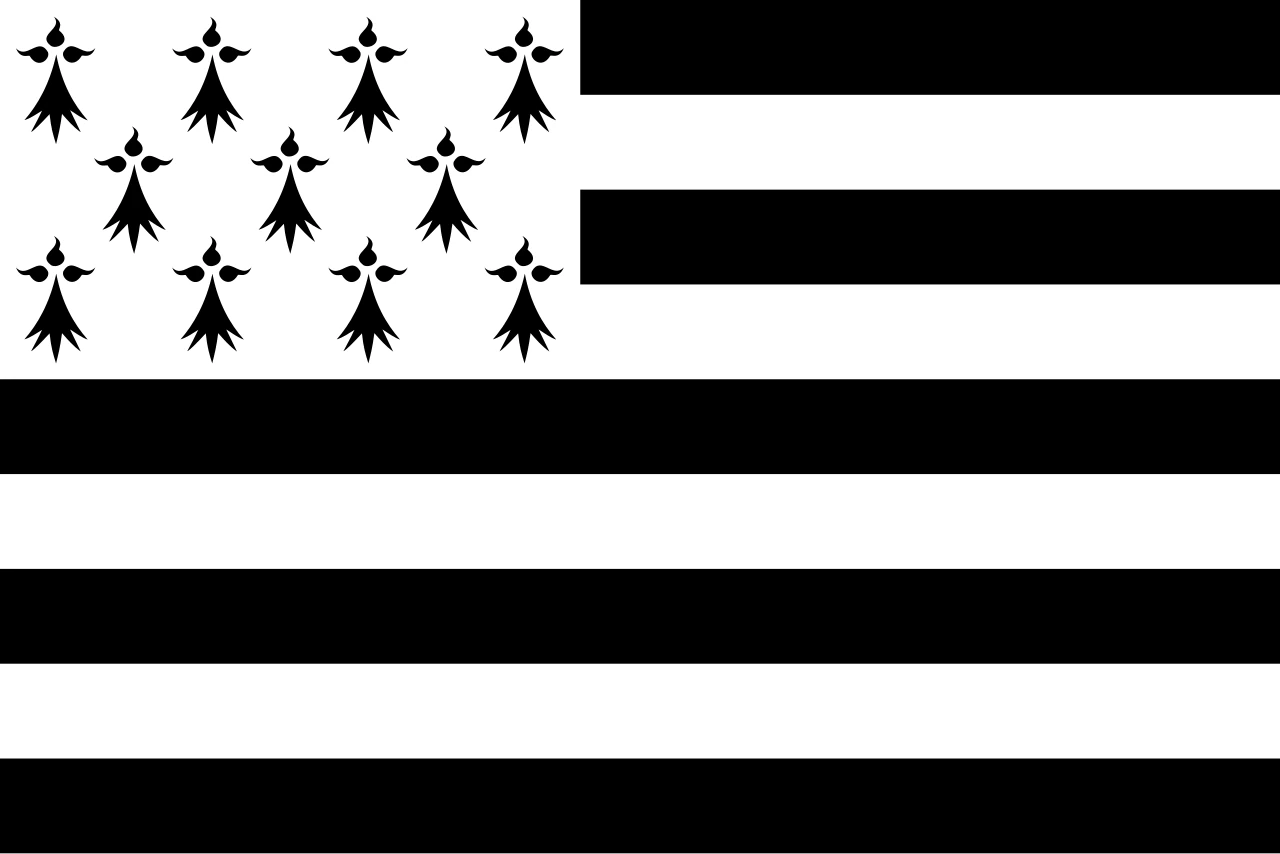
The Gwenn ha du, “white and black” in Breton, is the flag of Brittany: nine stripes and eleven ermine spots. It was designed in the twenties and the region adopted it in 1997.
Every fact about the flag, each with what it means.
Proportions
2:33 wide for every 2 high. 989 flags in the catalogue share it.
Properties
Normal flagFIAV symbol: the form of the flag.
Use
Civil and stateFIAV symbol: who may fly the flag.
Adopted
19231923 · 103 years ago
Colours
black
white
Reference shades: the official one may vary slightly.
Coat of arms
YesIt carries the coat of arms on the cloth.
Designer
Morvan Marchal
Take a closer look
Stripes
Canton
Ermine spots
Field
How it is described
The flag in the words of vexillology and heraldry.
Vexillological description
It is a rectangular field with a 2:3 ratio with nine horizontal black and white stripes and a canton, which is the rectangle of the upper corner by the flagpole, the pole it is hoisted on.
Stripes (bands)
five black and four white, alternating from top to bottom.
Canton
white, in the upper corner by the flagpole; it is the only area without stripes.
Ermine spots
eleven black figures inside the canton, arranged 4 + 3 + 4.
Field (the cloth)
only black and white, with no coat of arms.
What it carries
Each element and how many of the 1,390 flags in the catalogue carry it. In yellow, the rarest.
It was designed by the architect Morvan Marchal, from Vitré, between 1923 and 1925
1927
What changed was its status: the Breton Autonomist Party adopted it at a congress in Rosporden…
The full story
How it was born, how it has changed and what it means.
The Gwenn ha du, which in Breton means “white and black”, is the flag of Brittany. It has nine stripes, five black and four white, and in the upper left corner a white rectangle with eleven ermine spots. It looks ancient, but it is really barely a hundred years old.
How it came about
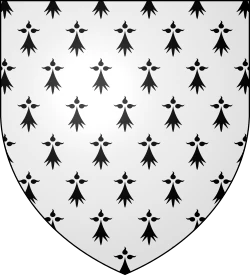
It was designed by the architect Morvan Marchal, from Vitré, between 1923 and 1925. He was part of the Breiz Atao (“Brittany forever”) movement, which defended Breton identity. He used medieval symbols (the white, the black and the ermine of the dukes of Brittany), but placed everything as on the flag of the United States: stripes and a rectangle in one corner. Some authors add the flag of Greece as an inspiration.
Before it, Brittany was associated with a black cross on a white ground, the Kroaz du, which according to tradition Breton troops carried in the Middle Ages. Today it is defended by those who prefer a more traditional flag.
How it has changed
The drawing has not changed since it was created. What changed was its status: the Breton Autonomist Party adopted it at a congress in Rosporden on 10 September 1927, and the regional council of Brittany approved it as the flag of the region on 30 June 1997.
What it means
Black stripes (5)
they represent the five territories of the east, where Gallo, the Romance language of the area, was traditionally spoken: Rennes, Nantes, Dol, Saint-Malo and Penthièvre.
White stripes (4)
they represent the four western territories, Breton-speaking: Léon, Trégor, Cornouaille and Vannes.
Ermine spots (11)
they are the ermine spots, the symbol of the old dukes of Brittany. Marchal gave them no number with meaning.
Black and white
they are the medieval heraldic colours of Brittany.
Fun facts
Eleven ermine spots, eleven letters?
Some independence supporters say the eleven ermine spots represent the eleven letters of “Breizh dieuh”, “Brittany free” in Breton. It is a later interpretation: Marchal did not fix that number.
A symbol rehabilitated in the sixties
During the Second World War some collaborationist Breton movements used it and its image was damaged. It began to recover in the sixties, above all after Rennes’ victory in the 1965 Cup Final.
The flag of every number plate
Today it appears on the number plates of Breton cars and is seen in stadiums, festivals and demonstrations.
Location
How much have you learnt?
Test what you have read about the flag of Brittany.