Skip to content

Wiki Banderas
Open menu

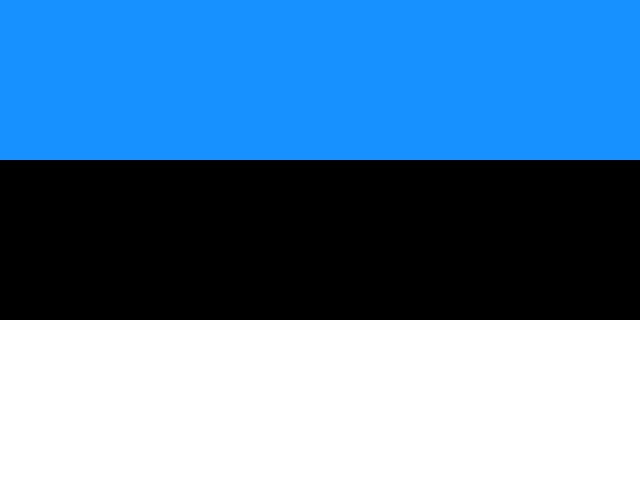
Flag of Estonia

Blue, black and white: the flag born in 1884 in a students’ association and which survived hidden through the Soviet occupation.

Flag of Estonia
Coat of arms

The flag, in figures

Every fact about the flag, each with what it means.

Proportions
7:1111 wide for every 7 high. 5 flags in the catalogue share it.
Properties
Normal flagFIAV symbol: the form of the flag.
Use
Civil, on land and at seaFIAV symbol: who may fly the flag.
Adopted
191821 November 1918 · 108 years ago
Colours
  • blue
  • black
  • white
Reference shades: the official one may vary slightly.
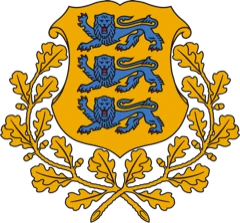
Coat of arms
YesIt carries the coat of arms on the cloth.
12

Take a closer look

  1. The three stripes

  2. 1

    The blue stripe

  3. 2

    The white stripe

How it is described

The flag in the words of vexillology and heraldry.

Vexillological description

It is a rectangular field with a 7:11 ratio and three equal horizontal stripes.

Stripes
from top to bottom, blue, black and white, of the same thickness.
Field
no coat of arms or figures.
Brief history
the blue was chosen in 1918 on independence from Russia; the Soviet flag banned it for half a century and it was raised again in 1990, shortly before independence.
What it carries

Each element and how many of the 1,390 flags in the catalogue carry it. In yellow, the rarest.

Its history in dates

Every date in its story, at a glance.

  1. 1884

    They consecrated it on 4 June 1884 in Otepää

  2. 1918

    1918: on declaring independence

  3. 1922

    A law confirms it in 1922

  4. 1940

    1940: the Soviet Union occupies Estonia and bans it

  5. 1988

    1988: in the middle of the wave of peaceful protests

  6. 1989

    24 February 1989: it replaces the Soviet flag at the top of the Pikk Hermann tower in Tallinn

  7. 1990

    1990: it becomes, officially, the flag of the country again

The full story

How it was born, how it has changed and what it means.

The flag of Estonia has three equal horizontal stripes: blue, black and white. In Estonian it is called sinimustvalge, which simply means “blue-black-white”. It is special for two reasons: very few national flags use black, and it was not created by a government but by a students’ association.

How it came about

In the nineteenth century Estonia was part of the Russian Empire, and the Estonians were beginning to defend their language and their culture. A group of university students from Tartu, the Estonian Students’ Society, chose these three colours for their standard. They consecrated it on 4 June 1884 in Otepää, a village in the south of the country. Over the years, that student flag became the one of the whole Estonian people.

How it has changed

The design has never changed; what changed was whether it could be used.

  • 1918

    on declaring independence, the provisional government adopts it as the national flag. A law confirms it in 1922.

  • 1940

    the Soviet Union occupies Estonia and bans it. Anyone displaying it could be punished.

  • 1988

    in the middle of the wave of peaceful protests, the local authorities allow it again.

  • 24 February 1989

    it replaces the Soviet flag at the top of the Pikk Hermann tower in Tallinn.

  • 1990

    it becomes, officially, the flag of the country again.

What it means

There is no meaning fixed by law, but the most widespread reading is this:

  • Blue

    the sky, the lakes and the sea, and also fidelity.

  • Black

    the soil, the black barns of the peasants and the difficult past of the Estonian people.

  • White

    the snow, the bark of birches and the wish for a better future.

Fun facts

  1. Buried under a chimney

    In 1940 the students swapped the original flag for a copy and hid the real one in the base of the chimney of a farm. They dug it up on 26 December 1991, in front of the cameras of Estonian television. Today it is on display in the National Museum of Estonia.

  2. Its own day

    4 June, the anniversary of that 1884 consecration, is Flag Day.

  3. To the rhythm of the sun

    At Pikk Hermann tower the flag is raised at sunrise, never before 7 am, and lowered at sunset.

Country facts

Where it is and what borders it.

Capital
Tallinn
Area
45,227 km²
Country
Republic of Estonia
Continent
Europe
Subregion
Northern Europe
Independent state
Yes
UN member
Yes
ISO code
EST · EE

2 neighbouring countries

How much have you learnt?

Test what you have read about the flag of Estonia.

  1. 1. Which one is the flag of Estonia?

  2. 2. In which year was the current flag adopted?

More flags

Accessibility preferences

Accessibility statement

Quick profiles

Text and reading

Text size
Default
Line height
Default
Letter spacing
Default
Word spacing
Default

Colour

Motion and orientation

Cursor