Every fact about the flag, each with what it means.
Proportions
2:33 wide for every 2 high. 989 flags in the catalogue share it.
Properties
Normal flagFIAV symbol: the form of the flag.
Use
Civil: land and sea, and stateFIAV symbol: who may fly the flag.
Adopted
198521 June 1985 · 41 years ago
Colours
White
Red
Reference shades: the official one may vary slightly.
Coat of arms
YesIt carries the coat of arms on the cloth.
Nickname
Erfalasorput (‘our flag’) and also known as Aappalaartoq (‘the red one’)
Origin
Flag of Denmark
Designer
Thue Christiansen
Take a closer look
The two stripes
1
The red half of the circle
2
The white half of the circle
How it is described
The flag in the words of vexillology and heraldry.
Vexillological description
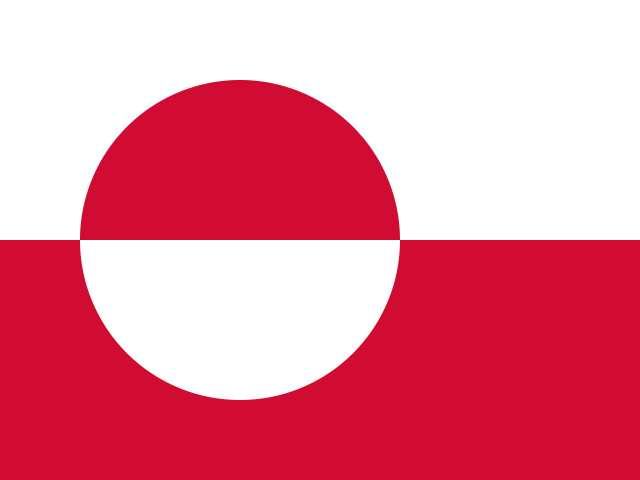
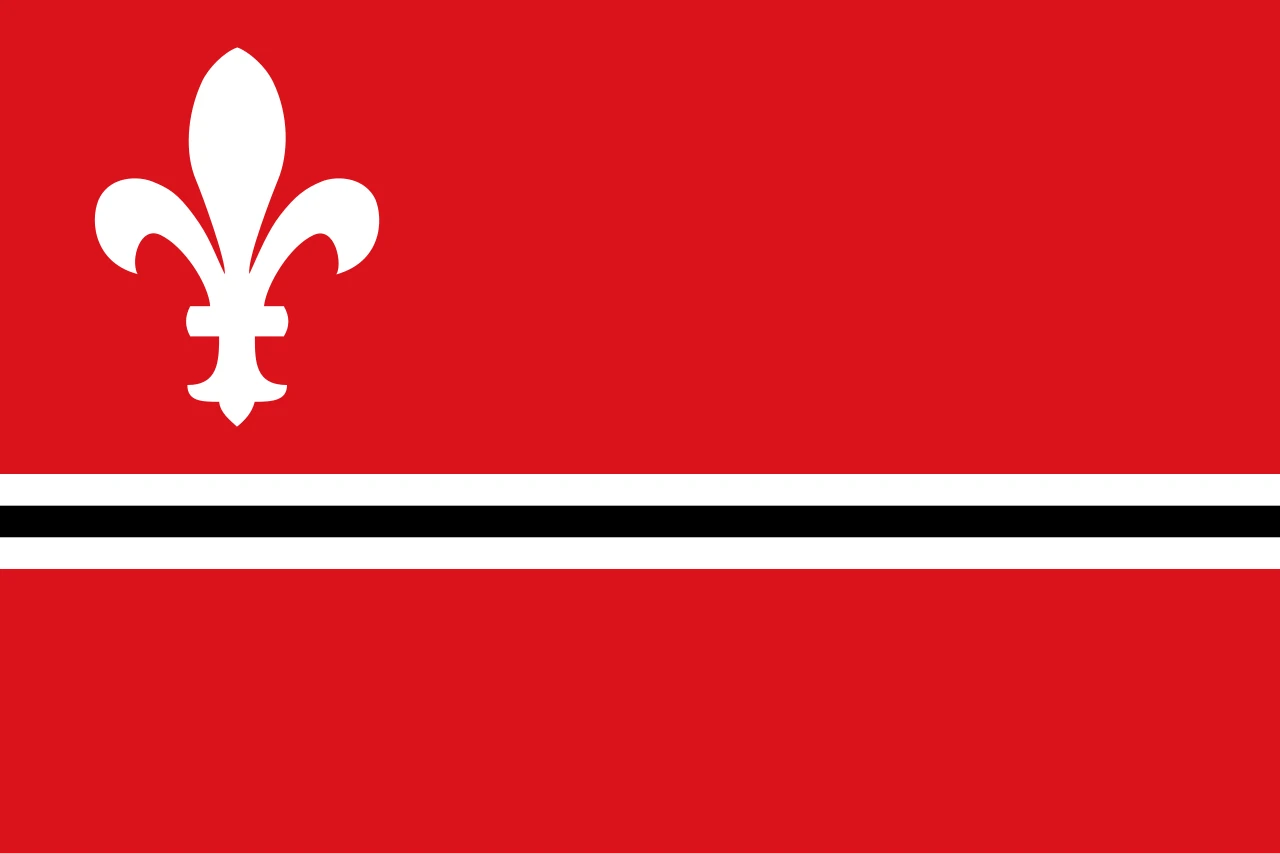
It is a rectangular field with a 2:3 ratio with two bands of equal height and a circle at mid height, shifted towards the flagpole (the pole it is hoisted on). The circle repeats the colours of the field the other way round.
Stripes
two equal horizontal bands, white on top and red below.
Circle
its radius is a third of the height of the field and its centre is closer to the flagpole than to the fly (the free edge).
Inverted colours
inside the circle the upper half is red and the lower one white.
No arms
it carries no arms, crosses or stars.
What it carries
Each element and how many of the 1,390 flags in the catalogue carry it. In yellow, the rarest.
The flag was hoisted for the first time on 21 June 1985
2026
What does change is who decides about it: its design is fixed by a Danish law of that year,…
The full story
How it was born, how it has changed and what it means.
The flag of Greenland has two horizontal stripes, white on top and red below, and a circle shifted towards the flagpole with the colours inverted. It recalls a setting sun over the frozen sea. It is the only flag among the Nordic countries and territories that does not carry the Scandinavian cross.
How it came about
Greenland is part of the Kingdom of Denmark and for centuries used the Danish flag, the Dannebrog. The idea of having one of its own came up in 1973, when five Greenlanders proposed a green, white and blue flag. The following year a newspaper published eleven proposals, almost all with a Scandinavian cross, and asked its readers. The Dannebrog won.
In 1979 Greenland obtained a self-government, which in 1980 called a competition. 555 designs came in, 293 of them from the island itself. As there was no agreement, more were asked of artists. In the end, the red and white design of the professor, artist and politician Thue Christiansen won by 14 votes to 11 against a green and white Scandinavian cross. The flag was hoisted for the first time on 21 June 1985, Greenland’s national day.
How it has changed
It has not changed since 1985. What does change is who decides about it: its design is fixed by a Danish law of that year, but in January 2026 the governments of Greenland and Denmark agreed to hand that power over to the Greenlandic government.
What it means
Christiansen himself explained his design like this:
White of the flag
the ice that covers most of the island.
Red of the flag
the ocean.
Red half of the circle
the sun, and also the fjords.
White half of the circle
icebergs and sea ice.
Red and white
the colours of the Danish flag, which recall Greenland’s place in the Kingdom of Denmark.
In Greenlandic it is called Erfalasorput, ‘our flag’. It is also called Aappalaartoq, ‘the red one’, the same nickname given to the Dannebrog.
Fun facts
No cross, and it won by a hair
Many Greenlanders wanted a Scandinavian cross like that of their neighbours. The flag with the circle won by only three votes, and for a while there were people who did not accept it.
A rowing club got there first
A rowing club from the Aarhus area, in Denmark, had used a pennant with the same design since 1970. When Greenland adopted its flag, both sides agreed to keep their symbols.
An inherited nickname
Christiansen explained that, since it had the same colours as the Danish one, the new flag could go on being called Aappalaartoq, ‘the red one’. That probably helped it win.
Country facts
Where it is and what borders it.
Capital
Nuuk
Area
2,166,086 km²
Country
Greenland
Continent
North America
Subregion
North America
Independent state
No
UN member
No
ISO code
GRL · GL
How much have you learnt?
Test what you have read about the flag of Greenland.