Skip to content

Wiki Banderas
Open menu

Flag of Ireland

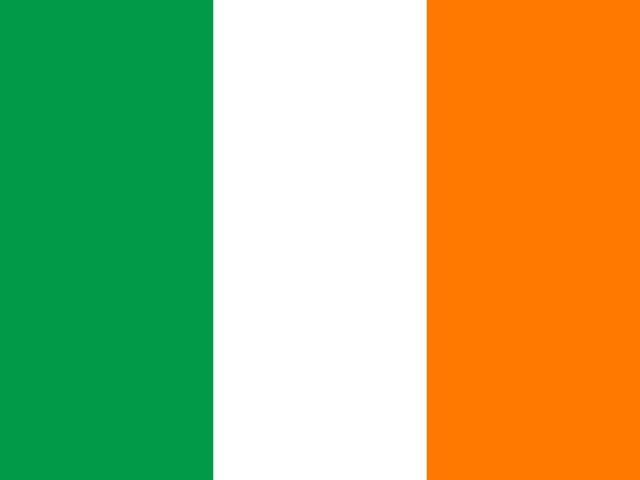
Three vertical stripes in green, white and orange, born in 1848 with one idea: peace between the two great traditions of the island.

Flag of Ireland
Coat of arms

The flag, in figures

Every fact about the flag, each with what it means.

Proportions
1:22 wide for every 1 high. 49 flags in the catalogue share it.
Properties
Normal flagFIAV symbol: the form of the flag.
Use
Civil, state and military, on land and at seaFIAV symbol: who may fly the flag.
Adopted
193729 December 1937 · 89 years ago
Colours
  • green
  • white
  • orange
Reference shades: the official one may vary slightly.
Coat of arms
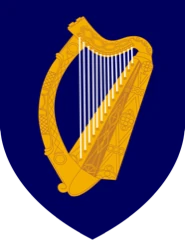
YesIt carries the coat of arms on the cloth.
123

Take a closer look

  1. The three stripes

  2. 1

    The green stripe

  3. 2

    The white stripe

  4. 3

    The orange stripe

How it is described

The flag in the words of vexillology and heraldry.

Vexillological description

It is a rectangular field with a 1:2 ratio and three equal vertical stripes.

Stripes
green next to the flagpole, white in the middle and orange at the end, of the same width.
Field
no coat of arms or figures.
Detail
no law describes the flag: the order of the stripes was fixed by official custom and the orange is often mistaken for yellow.
What it carries

Each element and how many of the 1,390 flags in the catalogue carry it. In yellow, the rarest.

Its history in dates

Every date in its story, at a glance.

  1. 1848

    In 1848 Europe was living through a wave of revolutions

  2. 1916

    It became very well known in 1916

  3. 1922

    From 1922 the new Irish Free State used it, though with no law defining it

  4. 1937

    The Constitution that came into force on 29 December 1937 finally declared it the national flag

The full story

How it was born, how it has changed and what it means.

The flag of Ireland has three vertical stripes of the same size: green, white and orange. In Ireland it is simply known as “the tricolour”. Its design tells a simple idea: two different traditions living together in peace.

How it came about

In 1848 Europe was living through a wave of revolutions. Thomas Francis Meagher, a young leader of the Young Ireland movement, travelled to Paris and came back with a tricolour inspired by the French flag. In March of that year he showed it in public for the first time in Waterford, his hometown. A little later, in Dublin, he explained the sense of the design: the white of the centre represented a lasting truce between the orange and the green.

How it has changed

The design has been the same since 1848, but it took almost a century to become official. It became very well known in 1916, when it flew over the General Post Office in Dublin during the Easter Rising. From 1922 the new Irish Free State used it, though with no law defining it. The Constitution that came into force on 29 December 1937 finally declared it the national flag.

What it means

The Constitution only says that it is green, white and orange. The Irish Government explains that it expresses the wish for unity between the different traditions of the island:

  • Green

    the Gaelic tradition, Catholic majority.

  • Orange

    the Protestant tradition, whose name comes from William of Orange, a seventeenth-century king.

  • White

    the peace and understanding between the two.

Fun facts

  1. Orange, not gold

    It is sometimes seen with a yellow or gold stripe. The Government asks that this be avoided, because it changes the meaning of the flag. Until 1923 it was not so clear, and in some places yellow was used.

  2. Made in France

    The first tricolour that Meagher brought back had been sewn by some French women who sympathised with the Irish cause.

  3. “No such flag exists”

    In 1848 a group of Irish people in Paris wanted to give a flag of Ireland to the French minister Lamartine. The British ambassador protested saying he knew of no Irish flag.

  4. The reversed twin

    The flag of Côte d’Ivoire has the same colours in the reverse order, orange, white and green, and is less elongated.

Country facts

Where it is and what borders it.

Capital
Dublin
Area
70,273 km²
Country
Ireland
Continent
Europe
Subregion
Northern Europe
Independent state
Yes
UN member
Yes
ISO code
IRL · IE

1 neighbouring countries

How much have you learnt?

Test what you have read about the flag of Ireland.

  1. 1. Which one is the flag of Ireland?

  2. 2. What are the proportions (height:width) of the flag?

  3. 3. In which year was the current flag adopted?

More flags

Accessibility preferences

Accessibility statement

Quick profiles

Text and reading

Text size
Default
Line height
Default
Letter spacing
Default
Word spacing
Default

Colour

Motion and orientation

Cursor