Skip to content

Wiki Banderas
Open menu

Flag of Korean Unification

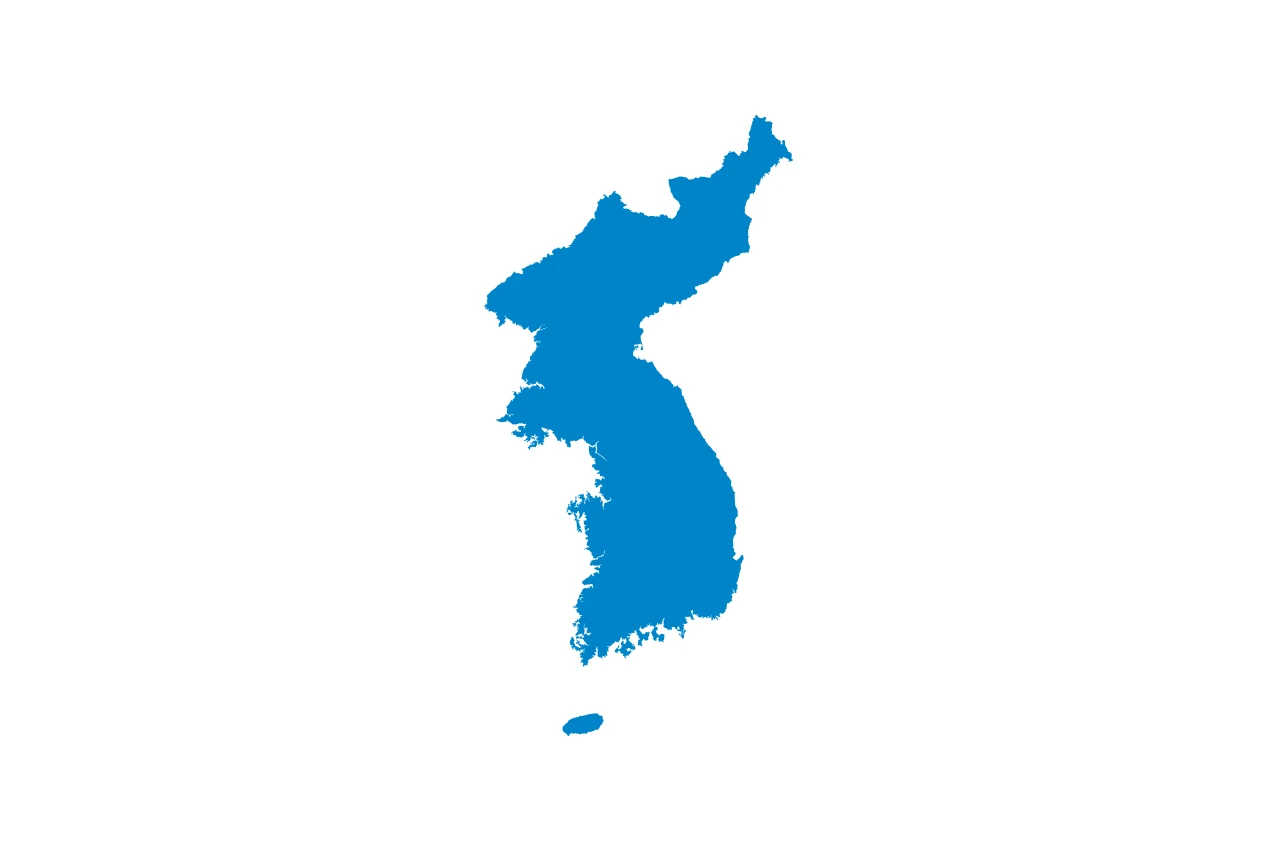
A blue map of the whole of Korea on white: the flag with which North and South march together at the big championships.

Flag of Korean Unification

The flag, in figures

Every fact about the flag, each with what it means.

Proportions
2:33 wide for every 2 high. 989 flags in the catalogue share it.
Properties
Normal flagFIAV symbol: the form of the flag.
Use
CivilFIAV symbol: who may fly the flag.
Adopted
19911991 · 35 years ago
Colours
  • white
  • sky blue
Reference shades: the official one may vary slightly.
Nickname
Flag of the Korean peninsula
12

Take a closer look

  1. The white cloth

  2. 1

    The Korean Peninsula

  3. 2

    Jeju Island

How it is described

The flag in the words of vexillology and heraldry.

Vexillological description

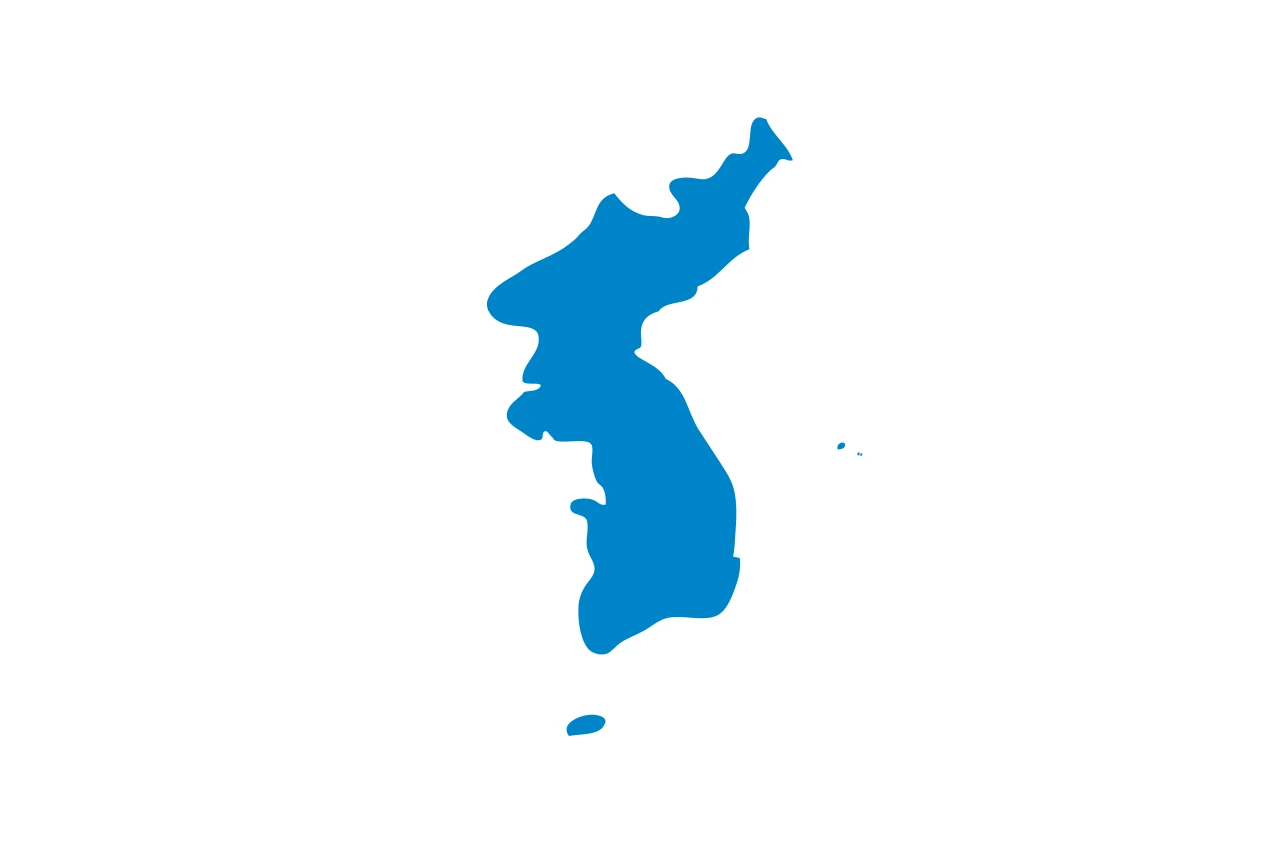
It is a rectangular field with a 2:3 ratio, white, with the silhouette of the Korean peninsula in the centre.

Field (the cloth)
white, plain.
Map
light blue. It draws the peninsula with a smoothed coast, no detail, and the northern border with China.
Islands
below, the island of Jeju, and on the right, a small dot for the island of Ulleungdo. Other islands are deliberately left out.
What it carries

Each element and how many of the 1,390 flags in the catalogue carry it. In yellow, the rarest.

Its history in dates

Every date in its story, at a glance.

  1. 1945

    Korea was split in two in 1945

  2. 1990

    In 1990, during the Asian Games in Beijing

  3. 1991

    Its official debut was in 1991

  4. 2000

    Afterwards the two delegations marched together behind it at the 2000 Sydney Olympics

  5. 2002

    Ulleungdo is added in 2002, and the Liancourt rocks in 2003

  6. 2018

    In 2018 the two eastern islands were removed, and in 2019 Ulleungdo came back

The full story

How it was born, how it has changed and what it means.

The Korean unification flag belongs to no country. It is a blue map of the whole peninsula on a white field, and it is used by North Korea and South Korea when they compete or march together. For many it is also a symbol of the wish to be one country again.

How it came about

Korea was split in two in 1945, at the end of the Second World War, and since 1948 there have been two states. Each competes with its own team.

In 1990, during the Asian Games in Beijing, the two governments agreed to form a joint team. Flying two flags at once was a problem, so a third, neutral one was thought of: the whole peninsula. That team never got together, but the flag was seen in the stands. Its official debut was in 1991, at the World Table Tennis Championships in Chiba (Japan), with the popular song ‘Arirang’ as the anthem. Afterwards the two delegations marched together behind it at the 2000 Sydney Olympics, Athens 2004 and Pyeongchang 2018.

How it has changed

The base drawing has not changed, but the islands it carries have come and gone depending on politics.

  1. White flag with the Korean peninsula and the island of Jeju in blue
    Various · CC BY-SA 3.0

    1991-2002

    Only the peninsula and the island of Jeju.

  2. White flag with the Korean peninsula, Jeju, Ulleungdo and the Liancourt rocks
    Pk0001 · CC BY-SA 4.0

    2003-2018

    Ulleungdo is added in 2002, and the Liancourt rocks in 2003. Japan also claims those rocks.

  3. Current flag of Korean unification: peninsula, Jeju and Ulleungdo in blue on white

    2019

    In 2018 the two eastern islands were removed, and in 2019 Ulleungdo came back.

What it means

  • Map of the peninsula

    a single Korea, without the line that divides it today.

  • White

    the neutral background. Both Koreas say the map is a symbol, not an exact drawing.

Fun facts

  1. Debut with a victory over China

    At the 1991 World Table Tennis Championships, the unified women’s team won the final 3-2 against China. China had won eight titles in a row.

  2. A goal against Argentina in the 88th minute

    That same year, at the under-20 World Cup in Portugal, united Korea beat Argentina 1-0 in Lisbon. In the quarter-finals it lost 5-1 to Brazil.

  3. Some rocks at the centre of the controversy

    At the 2018 Winter Games the International Olympic Committee asked for the Liancourt rocks to be removed, because carrying them would be a political gesture. South Korea accepted.

  4. Two readings of the same flag

    According to the specialist Brian Reynolds Myers, in the South it is seen as a symbol of peace and coexistence, and in the North as the wish to unite Korea under its own government.

Location

Buy the flag

Buy the flag on AmazonAffiliate link: if you buy, Wiki Banderas receives a small commission.

How much have you learnt?

Test what you have read about the flag of Korean Unification.

  1. 1. Which one is the flag of Korean Unification?

  2. 2. Which of these elements appears on the flag?

  3. 3. What are the proportions (height:width) of the flag?

  4. 4. In which year was the current flag adopted?

Sources

Text based on the article “Korean Unification Flag” from the Spanish Wikipedia, published under the licence CC BY-SA 4.0.

Sources consulted:

Credits

Flag image: File:Unification flag of Korea (pre 2006).svg: Various derivative work: Valentim, Wikimedia Commons · CC BY-SA 3.0.

More flags

Accessibility preferences

Accessibility statement

Quick profiles

Text and reading

Text size
Default
Line height
Default
Letter spacing
Default
Word spacing
Default

Colour

Motion and orientation

Cursor