Skip to content

Wiki Banderas
Open menu

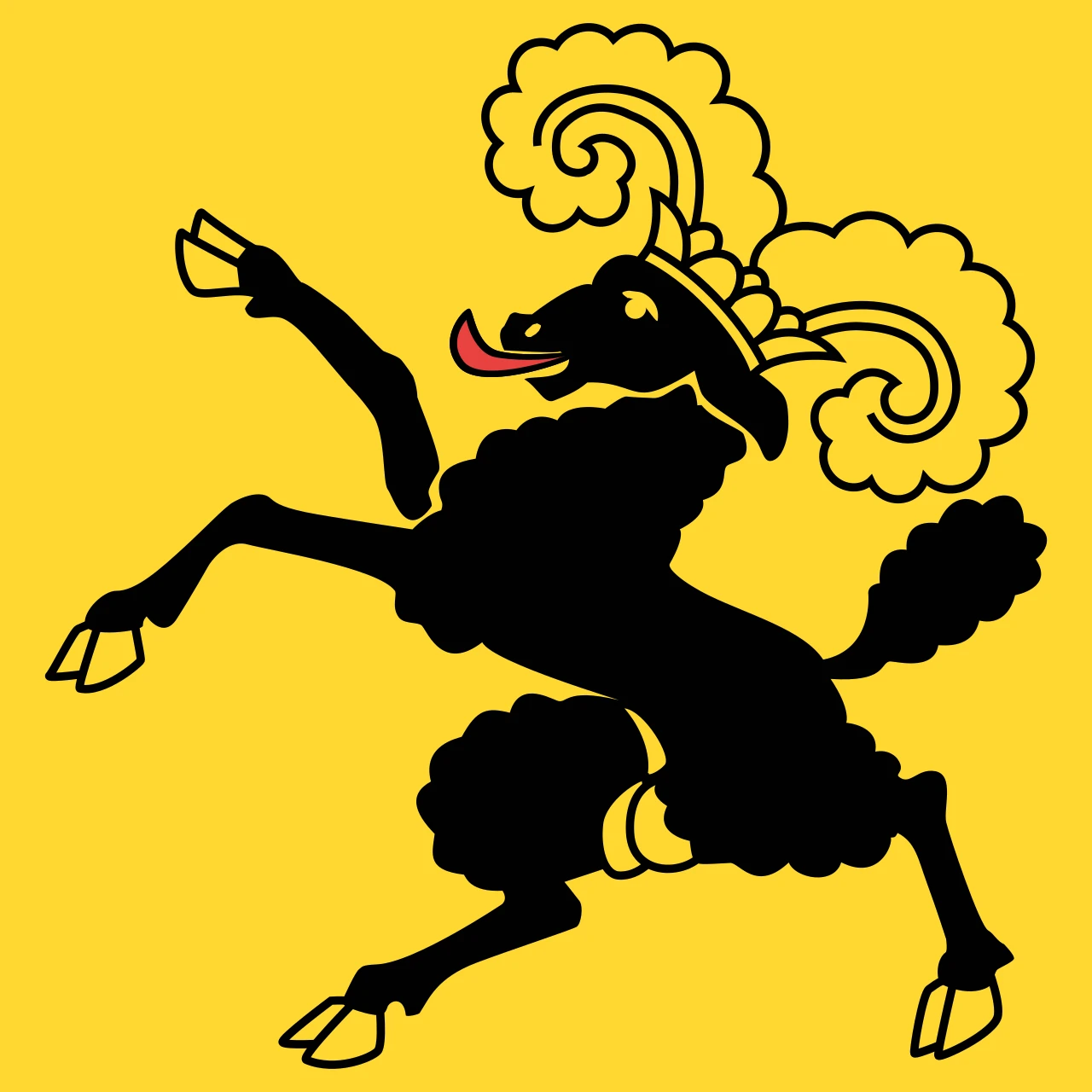
Flag of Schaffhausen

A black ram with horns, hooves and a golden crown leaps on a yellow ground: the canting arms of Schaffhausen since the twelfth century.

Flag of Schaffhausen

The flag, in figures

Every fact about the flag, each with what it means.

Proportions
1:11 wide for every 1 high. 29 flags in the catalogue share it.
Properties
Normal flagFIAV symbol: the form of the flag.
Use
CivilFIAV symbol: who may fly the flag.
Colours
  • Yellow
  • Black
Reference shades: the official one may vary slightly.

Take a closer look

  • Field

  • Ram

  • Crown and details

  • Colours

  • No shield

How it is described

The flag in the words of vexillology and heraldry.

Vexillological description

It is a rectangular field with a 2:3 ratio in yellow, with a black ram in the centre carrying a crown and a golden sex.

Field
yellow, plain, with no divisions.
Ram
black, in the centre, leaping towards the flagpole.
Crown and details
golden crown, horns, hooves and sex.
Colours
black and gold.
No shield
the animal is the whole charge; there are no stripes or borders of another colour.
What it carries

Each element and how many of the 1,390 flags in the catalogue carry it. In yellow, the rarest.

Its history in dates

Every date in its story, at a glance.

  1. 1180

    The first image of the ram appears on coins from around 1180: a ram on a roof

  2. 1218

    The city was free within the Empire from 1218 and its oldest seal is documented in 1253

  3. 1250

    By 1250 the coins already showed the ram leaping from a tower

  4. 1512

    Crown, horns, hooves and golden sex: a privilege granted by Pope Julius II in 1512

  5. 1940

    The ram changed posture: until the twentieth century it appeared supported on one hoof…

  6. 1948

    The crown and the red tongue, on the other hand, do have a date: they were made compulsory with…

The full story

How it was born, how it has changed and what it means.

The flag of Schaffhausen is a black ram leaping on a yellow ground, with horns, hooves and a golden crown and a red tongue. It is a canting emblem the city has used for eight hundred years.

How it came about

The first image of the ram appears on coins from around 1180: a ram on a roof, joining the two syllables of the popular name, Schaf (sheep) and Haus (house). By 1250 the coins already showed the ram leaping from a tower, and since then it almost always appears alone on the coat of arms. The city was free within the Empire from 1218 and its oldest seal is documented in 1253, but the standard that survives is the one carried to the Battle of Sempach in 1386, where the people of Lucerne captured it.

How it has changed

There is no dated order that redesigned the flag. The ram changed posture: until the twentieth century it appeared supported on one hoof (heraldically rampant) and in the 1940s the present leap became general, with both hind hooves on the ground. The crown and the red tongue, on the other hand, do have a date: they were made compulsory with the description in the 1948 federal armorial.

What it means

  • Ram

    a canting arms for the name of the city, although the etymology is disputed; specialists prefer an old word for reed or boat over the popular Schaf (sheep).

  • Gold and black

    the colours of the imperial standard, the black eagle on a golden ground.

  • Crown, horns, hooves and golden sex

    a privilege granted by Pope Julius II in 1512, an augmentation of arms that even the Protestant Reformation did not remove.

Fun facts

  1. The Sempach booty is still in Lucerne

    The standard captured at Sempach is kept in the Lucerne town hall; in 1867 Schaffhausen tried to buy it back and the sale was refused. What does exist is the copy Lucerne commissioned in 1490, when the original was already rotting.

  2. The most famous jewel is the most scandalous

    That the ram bears a golden penis is no modern joke: it appears in official heraldic descriptions since the papal augmentation of 1512.

  3. It joined late, and not by choice

    Schaffhausen only joined the Confederation in 1501, two months after Basel-Stadt; it had lived under Austrian rule between 1330 and 1415.

Localisation

How much have you learnt?

Test what you have read about the flag of Schaffhausen.

  1. 1. Which one is the flag of Schaffhausen?

  2. 2. Which of these elements appears on the flag?

  3. 3. What are the proportions (height:width) of the flag?

Sources

Sources consulted:

Credits

Flag image: Autor desconocido, Wikimedia Commons · Public domain.

More flags

Accessibility preferences

Accessibility statement

Quick profiles

Text and reading

Text size
Default
Line height
Default
Letter spacing
Default
Word spacing
Default

Colour

Motion and orientation

Cursor