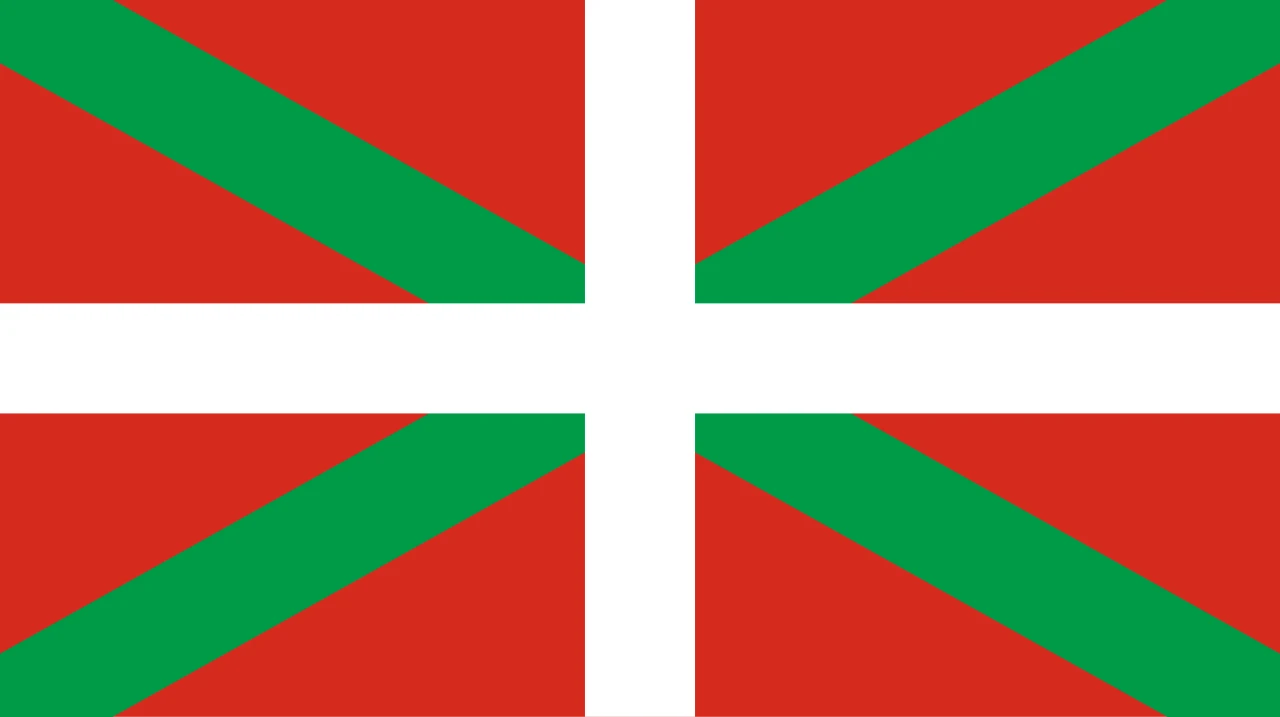
The ikurriña, with its white cross and its green saltire on a red ground, was created in 1894 by the Arana brothers and today is the official flag of the Basque Country.
Every fact about the flag, each with what it means.
Proportions
14:2525 wide for every 14 high. 1 flags in the catalogue share it.
Properties
Normal flagFIAV symbol: the form of the flag.
Use
CivilFIAV symbol: who may fly the flag.
Adopted
19361936 · 90 years ago
Colours
red
green
white
Reference shades: the official one may vary slightly.
Coat of arms
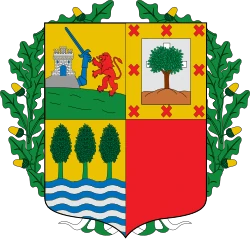
YesIt carries the coat of arms on the cloth.
Nickname
Ikurriña
Designer
Luis y Sabino Arana
Take a closer look
Field
Green saltire
White cross
How it is described
The flag in the words of vexillology and heraldry.
Vexillological description
It is a rectangular field with a 14:25 ratio (wider than it is high) in red. On it there are two overlapping crosses: a green saltire, that is, a diagonal from corner to corner, and on top of it a white one, straight, which reaches all four edges.
Field
red, with a 14:25 ratio.
Green saltire
the diagonal cross, from corner to corner.
White cross
vertical and horizontal, over the green one.
What it carries
Each element and how many of the 1,390 flags in the catalogue carry it. In yellow, the rarest.
The brothers Luis and Sabino Arana, founder of the Basque Nationalist Party, designed the flag…
1936
In 1936, with the Civil War already begun
1977
After Franco’s death it was tolerated in 1977 and
1979
In 1979 the law fixed its exact measurements
The full story
How it was born, how it has changed and what it means.
The ikurriña is the flag of the Basque Country. It is red and bears two overlapping crosses: a green one in the shape of a saltire and a white one, straight. The name comes from Basque: ikur means “symbol”. For decades it was banned, and so it became a symbol of freedom for many Basques.
How it came about
The brothers Luis and Sabino Arana, founder of the Basque Nationalist Party, designed the flag in 1894. It was hoisted for the first time on 14 July of that year, at the inauguration of a nationalist venue in Bilbao. At first it was only the flag of Biscay, and it was based on the coat of arms of that territory.
Little by little it came to represent the seven Basque lands on both sides of the Pyrenees. In 1936, with the Civil War already begun, the Basque Government declared it official. With Franco’s victory, it was banned for almost forty years.
After Franco’s death it was tolerated in 1977 and, with the Gernika Statute of Autonomy of 1979, it became official once more.
How it has changed
The flag has been the same since 1894. In 1979 the law fixed its exact measurements, with a green cross and a white one overlapping.
What it means
Arana explained the symbols in his writings in political and religious terms. This is the most widespread reading:
Red
the ground of the flag of Biscay, which gave rise to the ikurriña.
Green cross
the saltire of Saint Andrew, a diagonal cross, which comes from the coat of arms of Biscay.
White cross
according to Arana, religion, taken from his motto “God and the Ancient Law”.
Fun facts
An invented word
Sabino Arana created the name “ikurriña”. He formed it from ikur, “symbol” in Basque, and the word for cloth.
With an ikurriña on the football pitch
On 5 December 1976, the captains of Real Sociedad and Athletic, Kortabarria and Iribar, walked out onto the pitch at Atotxa with an ikurriña before the derby. It was one of the first times it was shown in public after Franco’s death.
A flag on the cathedral
On 18 July 1946, the former captain Joseba Elosegi placed a gigantic ikurriña on the lightning rod of the cathedral of the Good Shepherd, in San Sebastián, in the middle of the dictatorship.
How much have you learnt?
Test what you have read about the flag of Basque Country.
Sources
Text based on the article “Ikurriña” from the Spanish Wikipedia, published under the licence CC BY-SA 4.0.