Skip to content

Wiki Banderas
Open menu

Flag of Mapuche

Five stripes and the kultrun, the sacred drum: the Wenufoye has been the flag of the Mapuche people of Chile and Argentina since 1992.

Flag of Mapuche

The flag, in figures

Every fact about the flag, each with what it means.

Proportions
2:33 wide for every 2 high. 989 flags in the catalogue share it.
Properties
Normal flagFIAV symbol: the form of the flag.
Use
De facto flagFIAV symbol: who may fly the flag.
Adopted
19925 October 1992 · 34 years ago
Colours
  • black
  • white
  • sky blue
  • green
  • red
  • yellow
Reference shades: the official one may vary slightly.
Nickname
Wenufoye (‘canel of the sky’)
Designer
Jorge Weke
12

Take a closer look

  1. The five stripes

  2. 1

    The cultrún

  3. 2

    The guemil

How it is described

The flag in the words of vexillology and heraldry.

Vexillological description

It is a rectangular field (the cloth) with a 2:3 ratio with five horizontal stripes and a yellow disc in the centre.

Edge stripes
narrow black ones, top and bottom, with a row of stepped white figures, the guemil.
Central stripes
three wide and equal ones, light blue, green and red, from top to bottom.
Kultrun
a yellow disc with a red border, in the centre, touching the three central stripes. Two double red lines divide it into four parts, with a moon, two suns and a star.
What it carries

Each element and how many of the 1,390 flags in the catalogue carry it. In yellow, the rarest.

Its history in dates

Every date in its story, at a glance.

  1. 1839

    A chronicle of 1839 places it in the wars of the 18th century

  2. 1991

    In March 1991 the Aukiñ Wallmapu Ngulam organisation

  3. 1992

    1992 was approaching, the fifth centenary of Columbus’s arrival in America

  4. 1995

    The Argentine province of Chubut recognised it in 1995 as the emblem of its indigenous communities

The full story

How it was born, how it has changed and what it means.

The Mapuche are the largest indigenous people of Chile and also live in southern Argentina. Their best-known flag is called Wenufoye, ‘canel of the sky’: the canel is a sacred tree for them. In the centre it carries the kultrun, the drum of the ceremonies.

How it came about

In March 1991 the Aukiñ Wallmapu Ngulam organisation, the Council of All the Lands, called a competition to create the flag of the Mapuche nation. About 500 designs came in.

1992 was approaching, the fifth centenary of Columbus’s arrival in America, and the council wanted a symbol of its own for that date. Communities from different territories contributed ideas, and the graphic designer Jorge Weke brought them together in a single drawing. The assembly approved it on 5 October 1992 and the next day it was presented in Temuco.

How it has changed

It has not changed since 1992.

Other flags and proposals

The Wenufoye is not the only Mapuche flag. Some communities prefer others that are older or from their own territory.

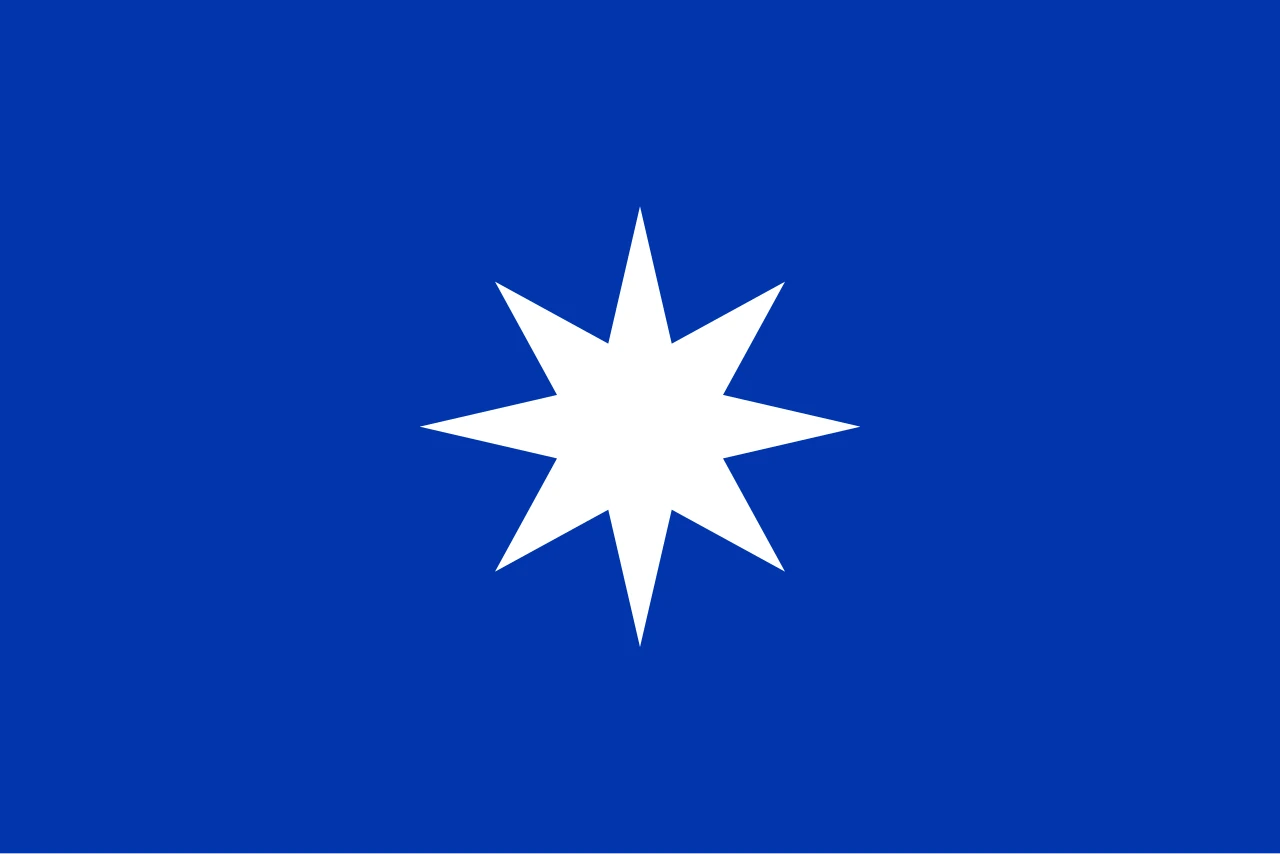
  • Blue flag with a white eight-pointed star in the centre
    Autor desconocido · Public domain

    No oficial

    The morning star flag

    Blue with the wünelfe, the eight-pointed star that stands for the morning star. A chronicle of 1839 places it in the wars of the 18th century, and today it is used above all in ceremonies.

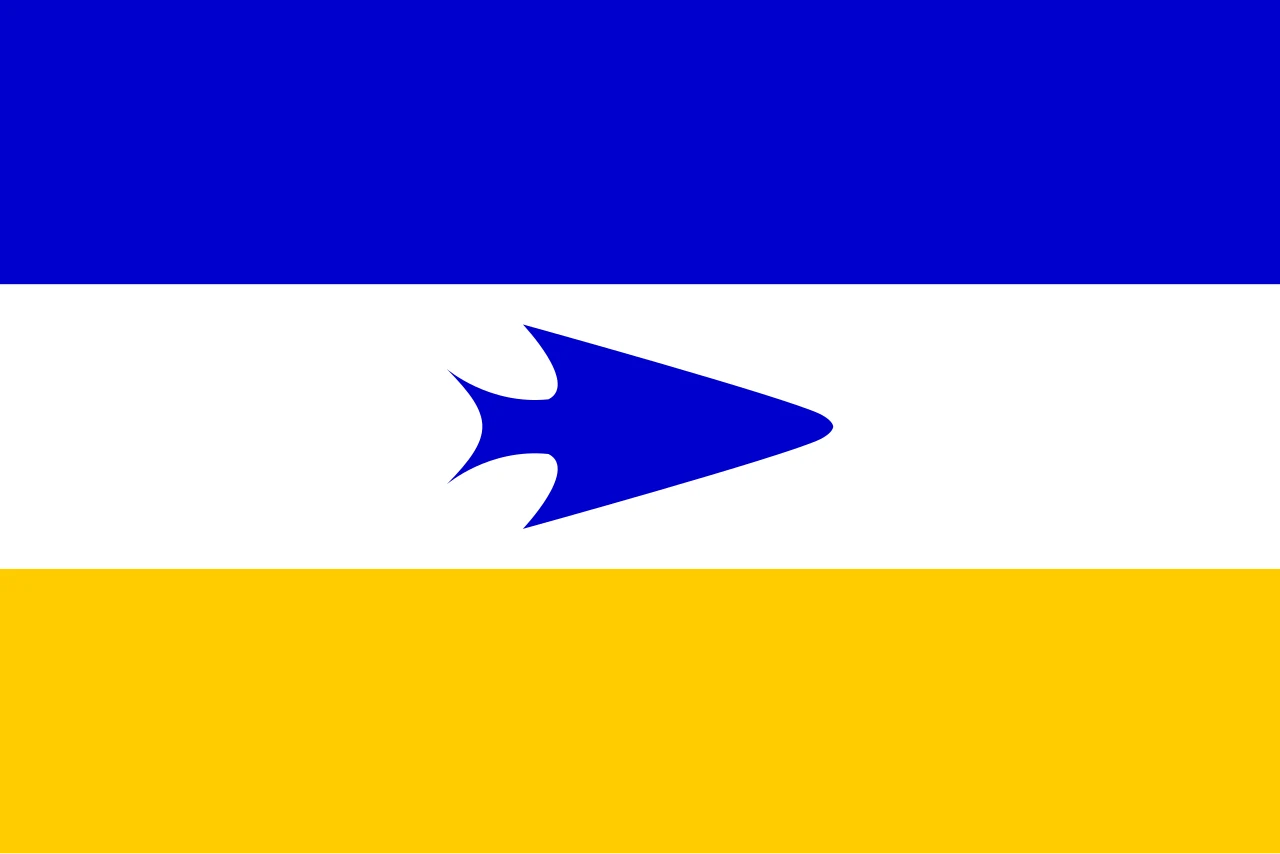
  • Flag of blue, white and yellow stripes with a blue arrowhead
    Spiridon Ion Cepleanu, vector de Al2 · Public domain

    No oficial

    The Mapuche-Tehuelche flag

    Blue, white and yellow, with an arrowhead. The Argentine province of Chubut recognised it in 1995 as the emblem of its indigenous communities.

What it means

Each colour has its name in mapudungun, the Mapuche language.

  • Blue (kallfü)

    order, life and the universe; what is sacred.

  • Green (karü)

    the land, nature and healing.

  • Red (kelü)

    the strength and the history of struggle of the Mapuche people.

  • Yellow (chod)

    renewal and the sun.

  • White (lüq)

    cleanliness, healing and wisdom.

  • Kultrun

    its surface is the Earth, with the four cardinal points, the sun, the moon and the stars.

  • Guemil

    the stepped figure on the edges. It represents art, science and knowledge.

Fun facts

  1. Painted in one night

    Jorge Weke told that he painted it on the night of 5 October 1992, after the assembly, and the next day it was shown in public. For him it was ‘our first daughter’.

  2. The photo of the outbreak

    On 25 October 2019, in the biggest march in Chile since the end of the dictatorship, the actress Susana Hidalgo photographed a man holding the Wenufoye above the statue of General Baquedano, in Santiago. It was the most shared image of those protests.

  3. Its creators do not want it in the town halls

    Since 2010 the Comptroller General of Chile has allowed it to be flown alongside the national flag. Aucán Huilcamán, one of its promoters, criticised that use in 2017: he says the flag belongs to the Mapuche struggle and that the Comptroller has no authority over it.

  4. Five hundred designs

    The competition for the Wenufoye received about 500 entries. That for the flag of the Sámi people, in northern Europe, got barely seventy.

Location

Buy the flag

Buy the flag on AmazonAffiliate link: if you buy, Wiki Banderas receives a small commission.

How much have you learnt?

Test what you have read about the flag of Mapuche.

  1. 1. Which one is the flag of Mapuche?

  2. 2. Which of these elements appears on the flag?

  3. 3. What are the proportions (height:width) of the flag?

  4. 4. In which year was the current flag adopted?

More flags

Accessibility preferences

Accessibility statement

Quick profiles

Text and reading

Text size
Default
Line height
Default
Letter spacing
Default
Word spacing
Default

Colour

Motion and orientation

Cursor