Skip to content

Wiki Banderas
Open menu

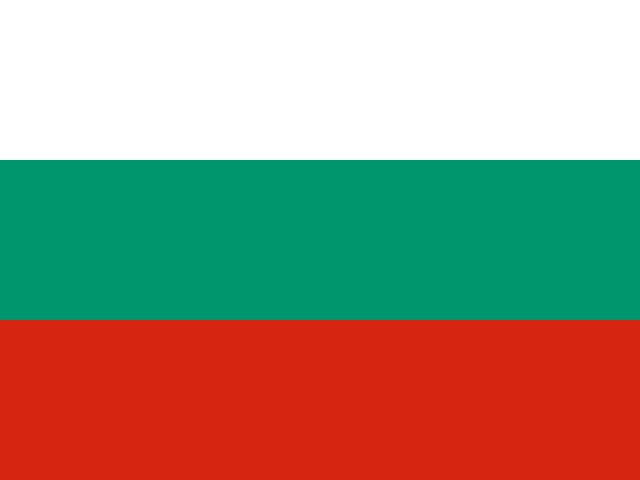
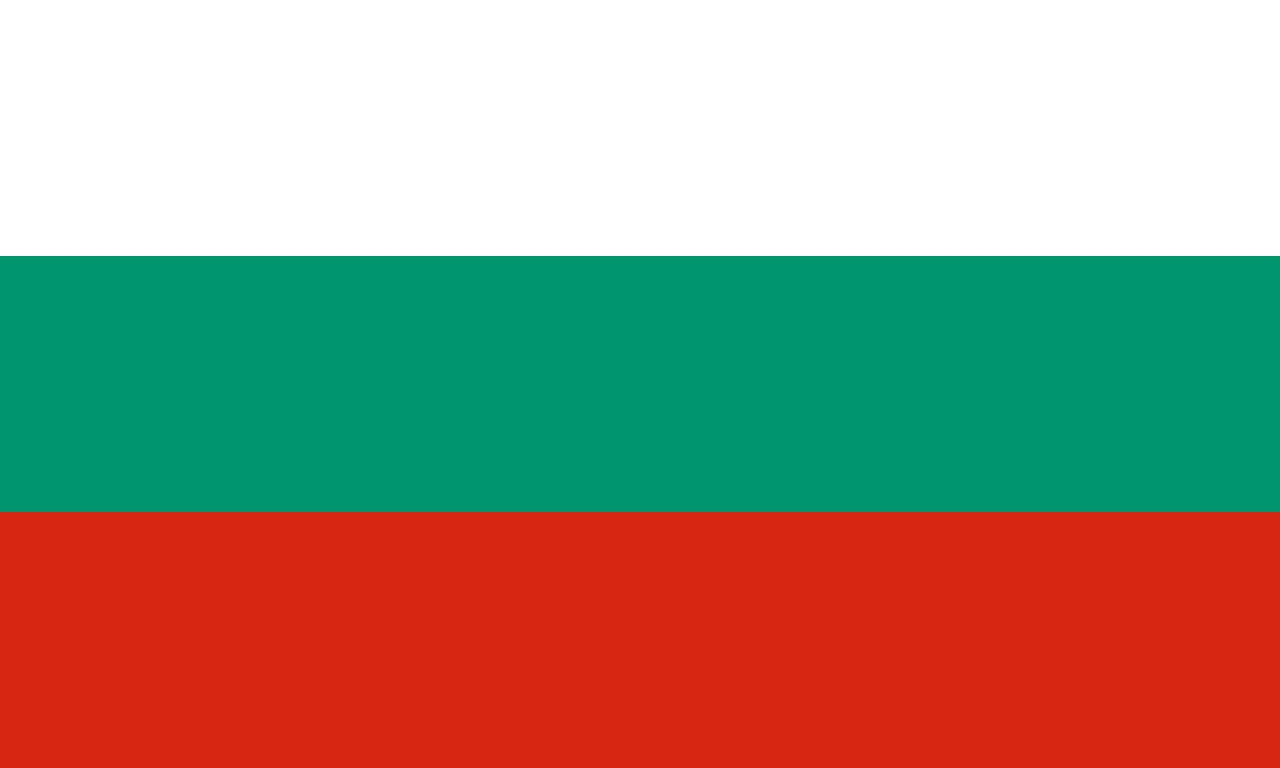
Flag of Bulgaria

Three stripes in white, green and red inspired by the Russian flag and approved in 1879, when Bulgaria became independent again.

Flag of Bulgaria
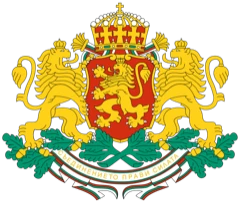
Coat of arms

The flag, in figures

Every fact about the flag, each with what it means.

Proportions
3:55 wide for every 3 high. 24 flags in the catalogue share it.
Properties
Normal flagFIAV symbol: the form of the flag.
Use
Civil and state, on land and at seaFIAV symbol: who may fly the flag.
Adopted
199027 November 1990 · 36 years ago
Colours
  • white
  • green
  • red
Reference shades: the official one may vary slightly.
Coat of arms
YesIt carries the coat of arms on the cloth.
12

Take a closer look

  1. The three stripes

  2. 1

    The white stripe

  3. 2

    The red stripe

How it is described

The flag in the words of vexillology and heraldry.

Vexillological description

It is a rectangular field with a 3:5 ratio divided into three equal horizontal stripes.

Stripes
from top to bottom, white, green and red, of the same thickness.
Field
no coat of arms or figures: the crowned lion only appears on the war flag.
Origin of the colours
they come from Panslavism, the movement that united the Slavic peoples in the nineteenth century; Bulgaria adopted them on gaining independence from the Ottoman Empire.
What it carries

Each element and how many of the 1,390 flags in the catalogue carry it. In yellow, the rarest.

Its history in dates

Every date in its story, at a glance.

  1. 1860

    As early as the 1860s some rebel groups used those colours

  2. 1877

    In 1877 war broke out between Russia and the Ottoman Empire

  3. 1879

    Its first Constitution, approved in 1879 in the city of Tarnovo

  4. 1944

    The coat of arms changes and bears two dates: 681, the year the first Bulgarian state was born,…

The full story

How it was born, how it has changed and what it means.

The flag of Bulgaria has three horizontal stripes of the same size: white, green and red. It carries no coat of arms and no drawing at all. It was born at the end of a war that gave Bulgaria its independence back after almost five centuries.

How it came about

For almost five hundred years Bulgaria was part of the Ottoman Empire. In the nineteenth century, many Slavic peoples who wanted to be free looked to Russia, the only large independent Slavic country. According to many historians, the Bulgarians took the Russian flag —white, blue and red— and swapped the blue for the green. As early as the 1860s some rebel groups used those colours.

In 1877 war broke out between Russia and the Ottoman Empire, and thousands of Bulgarian volunteers fought alongside the Russians. When it ended, Bulgaria became a state again. Its first Constitution, approved in 1879 in the city of Tarnovo, fixed the white, green and red tricolour.

How it has changed

The stripes have not changed since 1879. Only under the communist regime did it carry a coat of arms.

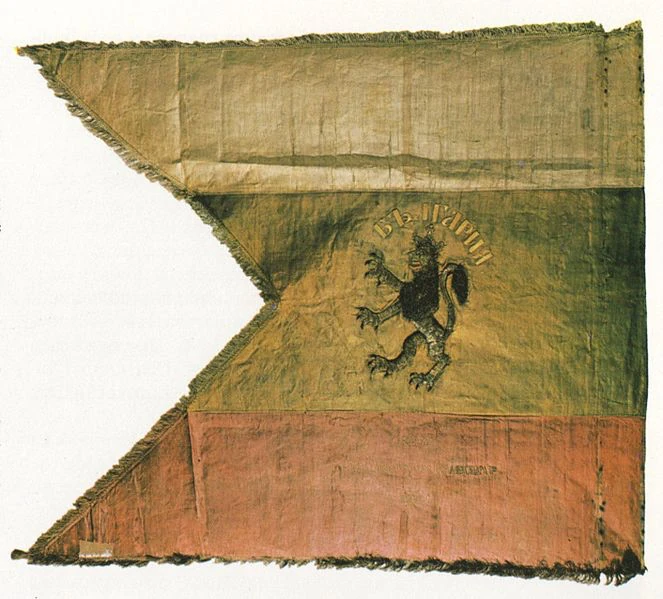
  1. Old cloth flag with white, green and red stripes and an embroidered lion
    Miko Stavrev · CC BY-SA 3.0

    1877

    A flag sewn for the volunteers joins the three colours in this order for the first time. It bears an embroidered lion.

  2. Flag with horizontal white, green and red stripes

    1879-1946

    The Constitution of Tarnovo approves the tricolour without the lion.

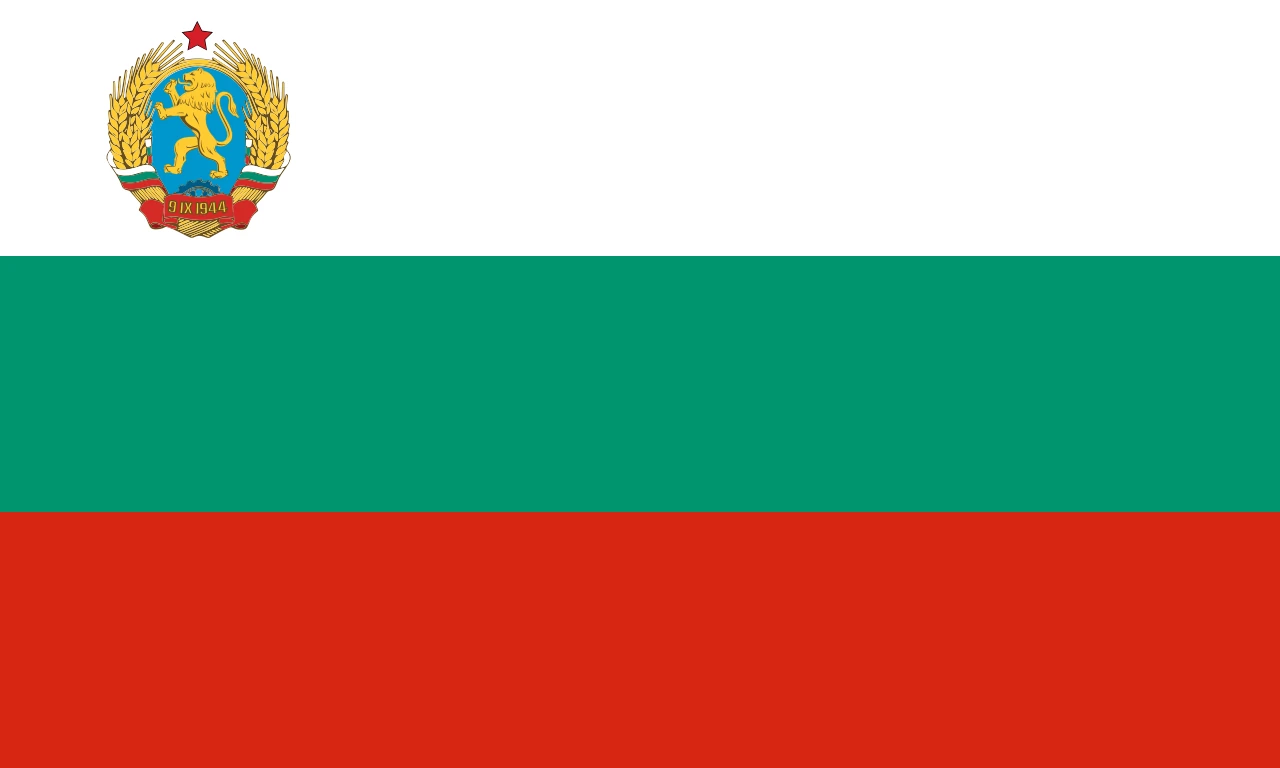
  3. White, green and red flag with a coat of arms with a lion in the corner
    Scroch · CC BY-SA 4.0

    1946-1971

    The communist regime puts its coat of arms on the white stripe: a lion surrounded by ears of wheat and a red star. The drawing changes several times.

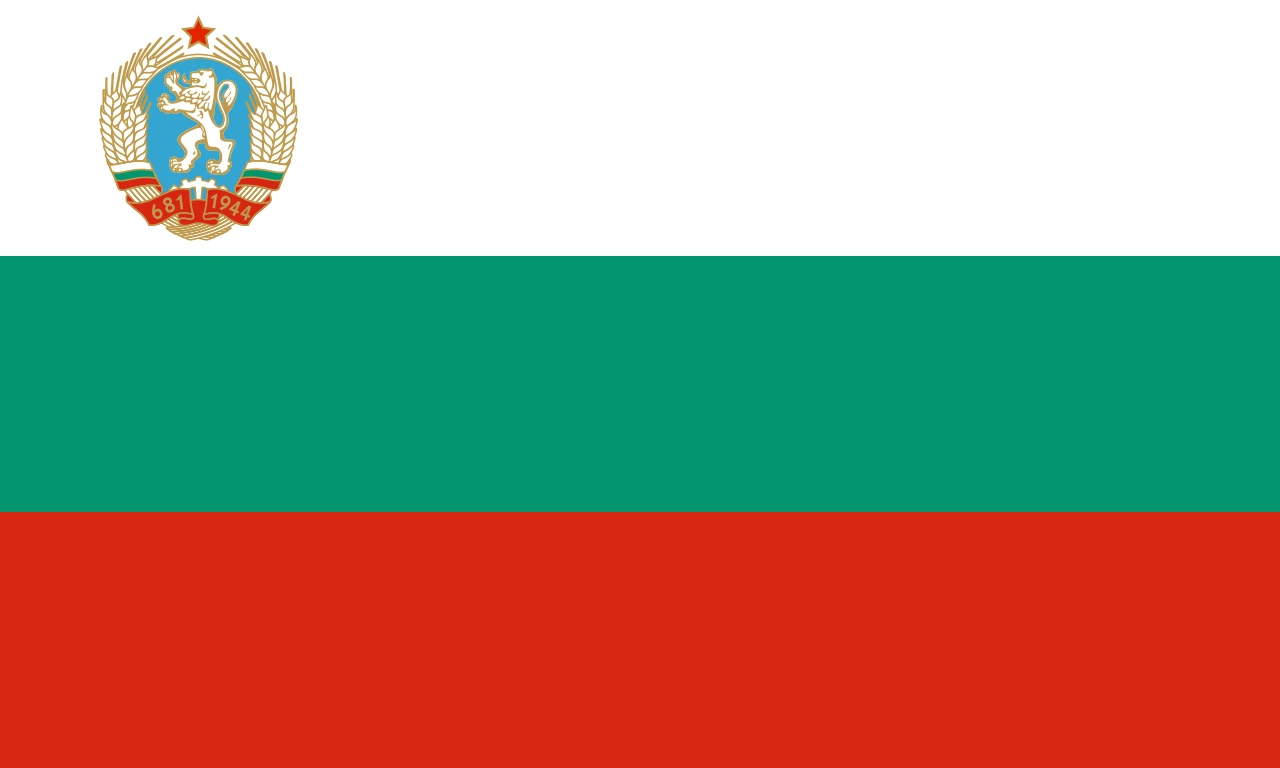
  4. White, green and red flag with a coat of arms bearing the dates 681 and 1944
    Scroch · CC BY-SA 3.0

    1971-1990

    The coat of arms changes and bears two dates: 681, the year the first Bulgarian state was born, and 1944, the year the communists came to power.

  5. Current flag of Bulgaria

    1990

    On 27 November, after the fall of communism, the coat of arms is removed and the plain tricolour returns.

What it means

The law does not explain the colours. The most widespread interpretation is this:

  • White

    peace and freedom.

  • Green

    the fertile land and the countryside, very important to Bulgaria.

  • Red

    the courage of the people and the blood spilled for independence.

Fun facts

  1. A fourteen-year-old girl sewed it

    The flag of 1877 was embroidered by Stiliana Paraskevova in Brăila, a city in Romania, on her father’s commission. It took her six months and she did it in secret. In 1930, already grown up, she was able to see it again in the palace where it was kept, and she kissed it weeping.

  2. Mysterious maps

    Some charts by Italian navigators from the fourteenth century draw a flag for Bulgaria. Nobody can check whether it was really used.

  3. The coat of arms that does not go away

    Although the official flag carries no coat of arms, a version with the current coat of arms on the left is still often seen. It is probably nostalgia for the flag of the communist era.

Country facts

Where it is and what borders it.

Capital
Sofia
Area
110,879 km²
Country
Republic of Bulgaria
Continent
Europe
Subregion
Southeast Europe
Independent state
Yes
UN member
Yes
ISO code
BGR · BG

How much have you learnt?

Test what you have read about the flag of Bulgaria.

  1. 1. Which one is the flag of Bulgaria?

  2. 2. What are the proportions (height:width) of the flag?

  3. 3. In which year was the current flag adopted?

Sources

Text based on the article “Bandera de Bulgaria” from the Spanish Wikipedia, published under the licence CC BY-SA 4.0.

Sources consulted:

Credits

Flag image: SKopp, Wikimedia Commons · Public domain.

More flags

Accessibility preferences

Accessibility statement

Quick profiles

Text and reading

Text size
Default
Line height
Default
Letter spacing
Default
Word spacing
Default

Colour

Motion and orientation

Cursor