Every fact about the flag, each with what it means.
Proportions
2:33 wide for every 2 high. 989 flags in the catalogue share it.
Properties
Normal flagFIAV symbol: the form of the flag.
Use
Civil and stateFIAV symbol: who may fly the flag.
Adopted
199913 August 1999 · 27 years ago
Colours
white
red
Reference shades: the official one may vary slightly.
Coat of arms
YesIt carries the coat of arms on the cloth.
Nickname
Hinomaru
Take a closer look
Field
Disc
Position
How it is described
The flag in the words of vexillology and heraldry.
Vexillological description
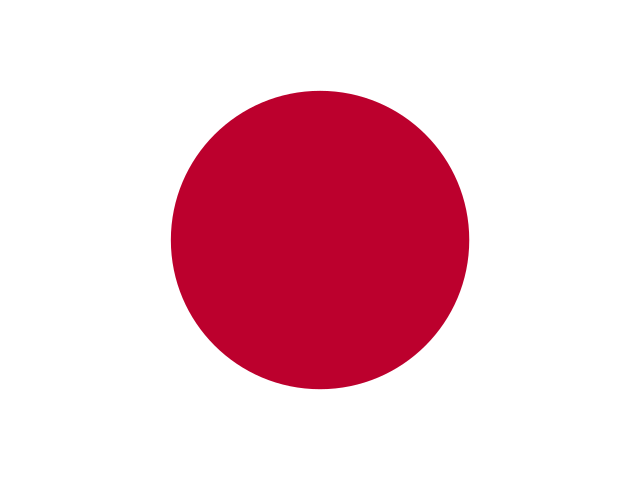
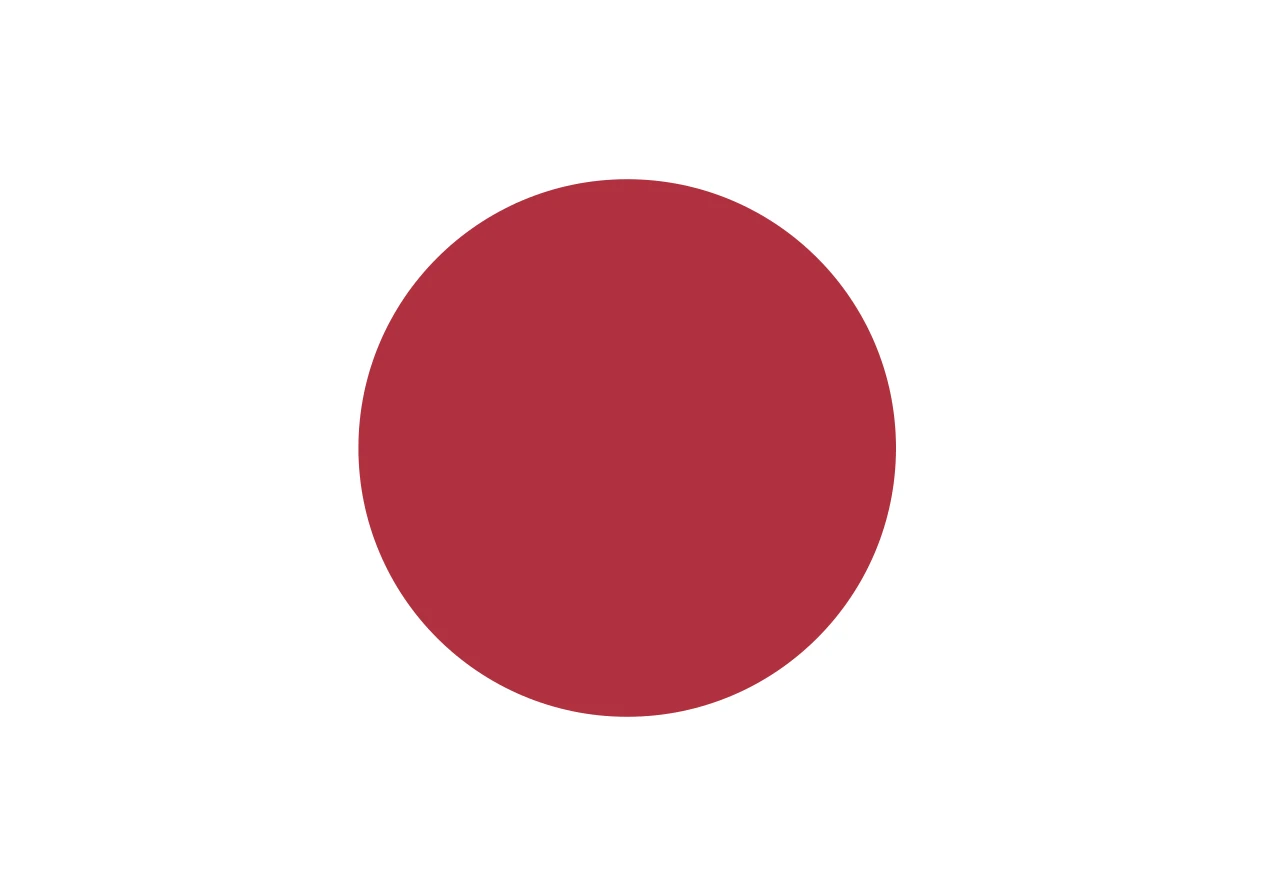
It is a rectangular field with a 2:3 ratio, white, with a red disc in the centre. The 1999 law on the national flag and anthem defines it with exact measurements.
Field (the cloth)
white, plain, with no stripes or borders.
Disc
red, the rising sun, with a diameter of three fifths of the height of the flag.
Position
the centre of the disc at the centre of the field. The law allows that, for a time, the 7:10 ratio is admitted and that the disc is shifted towards the flagpole.
What it carries
Each element and how many of the 1,390 flags in the catalogue carry it. In yellow, the rarest.
In 1854, when the United States forced Japan to open up to foreign trade
1870
In 1870 it became the official flag of merchant ships and from then on it worked as the flag…
1999
But no law declared it the national flag until 1999
The full story
How it was born, how it has changed and what it means.
The flag of Japan is one of the simplest in the world: a red circle in the centre of a white field. The circle is the sun. The Japanese call it Hinomaru, ‘the circle of the sun’, although its official name is Nisshōki, ‘the flag of the sun’.
How it came about
The sun has been tied to Japan for many centuries. The name of the country in Japanese, Nihon, means ‘origin of the sun’, which is why it is known as ‘the land of the rising sun’. Also, according to Shinto tradition, the emperors descend from Amaterasu, the sun goddess.
Samurai and feudal lords were already painting sun discs on their fans and standards. In 1854, when the United States forced Japan to open up to foreign trade, the government ordered Japanese ships to carry the red disc so as to be distinguishable from foreign ones. In 1870 it became the official flag of merchant ships and from then on it worked as the flag of the country. But no law declared it the national flag until 1999.
How it has changed
The drawing has been the same for more than 150 years. Only its measurements have been touched up.
1854
The government orders Japanese ships to hoist a red disc on a white field to be distinguishable from foreign ships.
The first rule fixes its measurements: the flag is a little longer than the current one and the disc is slightly shifted towards the flagpole.
1999
A law finally declares it the national flag. It comes to measure two high by three long and the disc sits exactly in the centre.
What it means
The 1999 law describes the flag but does not explain what it means. The traditional interpretation is this:
Red disc
the sun, tied to the name of the country and to the goddess Amaterasu. The law only says it is an intense red, without fixing the exact tone.
White field
according to a popular reading, purity and honesty. It is not an official meaning.
Fun facts
A flag you can eat
In 1937, during the war with China, the Hinomaru bentō became popular: a box of white rice with a red pickled plum in the centre. It was a simple meal and a way of showing support for the soldiers.
Signatures around the sun
In the Second World War, relatives and friends gave soldiers a flag covered in signatures and good wishes, the Hinomaru yosegaki. The custom said that nobody could write over the red disc.
Retouched for the Olympic Games
Before the 1964 Tokyo Olympic Games, the colour expert Tadamasa Fukiura reviewed the size and the tone of the disc so that it would stand out next to the flags of the other countries.
Buy the flag
Buy the flag on AmazonAffiliate link: if you buy, Wiki Banderas receives a small commission.
Buy the flag on AmazonAffiliate link: if you buy, Wiki Banderas receives a small commission.
Country facts
Where it is and what borders it.
Capital
Tokyo
Area
377,930 km²
Country
Japan
Continent
Asia
Subregion
Eastern Asia
Independent state
Yes
UN member
Yes
ISO code
JPN · JP
How much have you learnt?
Test what you have read about the flag of Japan.
Sources
Text based on the article “Bandera de Japón” from the Spanish Wikipedia, published under the licence CC BY-SA 4.0.