Every fact about the flag, each with what it means.
Proportions
2:33 wide for every 2 high. 989 flags in the catalogue share it.
Properties
Normal flagFIAV symbol: the form of the flag.
Use
CivilFIAV symbol: who may fly the flag.
Adopted
197315 March 1973 · 53 years ago
Colours
Green
White
Reference shades: the official one may vary slightly.
Coat of arms
YesIt carries the coat of arms on the cloth.
Take a closer look
The green cloth
1
The shahada
2
The sword
How it is described
The flag in the words of vexillology and heraldry.
Vexillological description
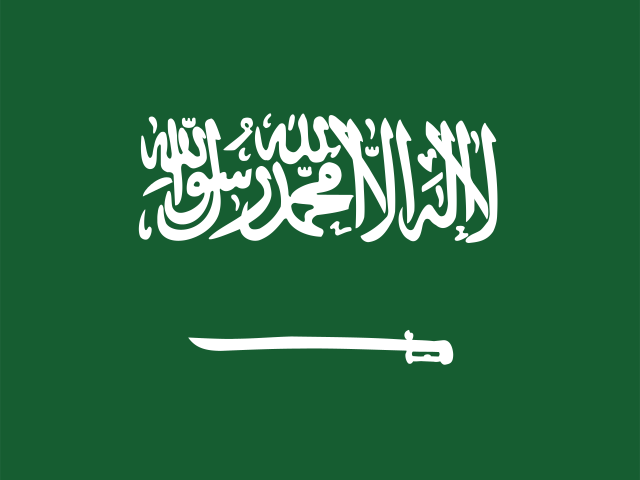
It is a green field with a 2:3 ratio, with no stripes or divisions, with the shahada written in white in the centre and a sword below it. The basic law of the country describes it like this: green, with the declaration of faith in the middle and ‘an unsheathed sword’ below, and the width equal to two thirds of the length.
Text
the shahada in white, in an Arabic calligraphy style called thuluth, which is read from right to left; that is why in correct drawings the flagpole is under the end of the phrase.
Sword
with a straight blade —since 1973 it replaced the curved sabre— with the hilt on the right and the point towards the left, in the direction of reading.
The two sides
the rule obliges it to be made with two layers of cloth sewn together, so that the text can be read properly from both sides.
What it carries
Each element and how many of the 1,390 flags in the catalogue carry it. In yellow, the rarest.
In the early 20th century, Abdulaziz Al Saud, who would go on to found the kingdom in 1932, added…
1937
The king approved the design as a symbol of the country on 11 March 1937
The full story
How it was born, how it has changed and what it means.
The flag of Saudi Arabia is green and carries a religious phrase written in white, with a sword below it. It is one of the few national flags with text, and that text decides how it is made, how it is hoisted and where it may be used.
How it came about
The phrase is the shahada, the Islamic declaration of faith: ‘There is no god but God, and Muhammad is the messenger of God’. Since the 18th century, the followers of the preacher Muhammad ibn Abd al-Wahhab, allies of the Al Saud family, carried it on green flags.
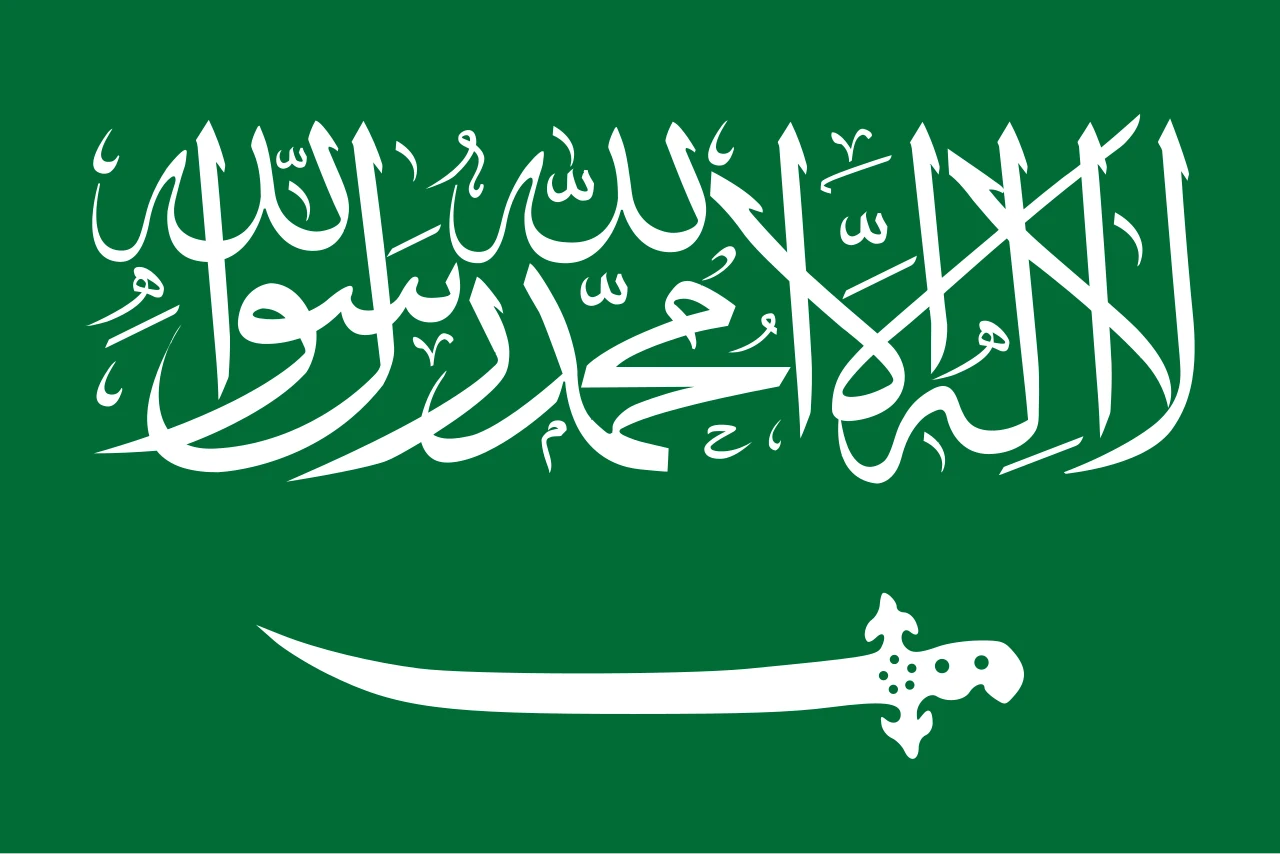
In the early 20th century, Abdulaziz Al Saud, who would go on to found the kingdom in 1932, added a sword. For decades different versions coexisted: with one sword or with two, with a white stripe next to the flagpole or without it. The king approved the design as a symbol of the country on 11 March 1937, but the exact drawing was not fixed by law until 15 March 1973.
How it has changed
The elements have been the same for more than a century. What has changed is the drawing.
18th century
The followers of the Wahhabi movement use green flags with the declaration of faith written in white.
Early 20th century
Abdulaziz Al Saud adds a sword. Variants with two swords or with a white stripe next to the flagpole circulate.
The flag already looks like the current one, but the text covers almost the whole cloth and the sword is a curved sabre.
1973
A royal decree fixes the design: the text is made smaller and the sabre is replaced by a straight sword.
What it means
Every element of the flag has a religious or historical meaning:
Green
the colour traditionally associated with Islam.
Inscription
the shahada, the Muslim declaration of faith, written in a style of Arabic calligraphy called thuluth.
Sword
strength and justice. It also recalls Abdulaziz Al Saud, who unified the country.
Fun facts
It is never flown at half mast
The basic law of the country expressly forbids it: lowering a flag that carries the declaration of faith would be considered a lack of respect. That is why it is not used as a sign of mourning.
It reads well on both sides
The law obliges it to be made with two layers of cloth, so that the phrase can be read correctly, from right to left, on both sides. The sword always points in the direction of reading, which is why in the drawings the flagpole usually ends up on the right.
It never touches the grass
At the 2026 football World Cup, before each match giant flags of the two teams were spread out on the ground. The Saudi one was held high, so that the text would not touch the ground.
It has its own day
Since 2023, every 11 March is Flag Day, in memory of the day in 1937 when King Abdulaziz approved its design.
Buy the flag
Buy the flag on AmazonAffiliate link: if you buy, Wiki Banderas receives a small commission.




 Iraq
 Jordan
 Kuwait
 Oman
 Qatar
 United Arab Emirates
 Yemen