Skip to content

Wiki Banderas
Open menu

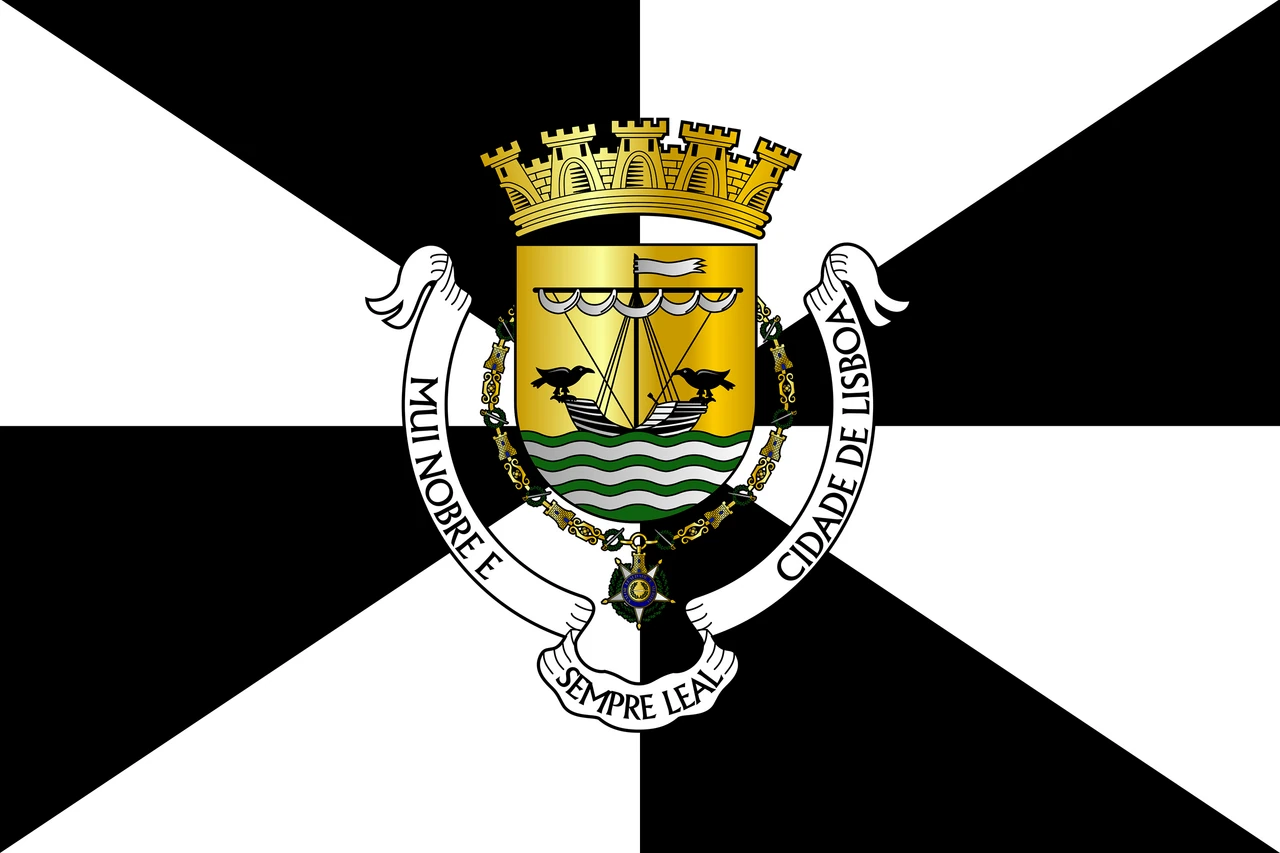
Flag of Lisbon

Eight white and black gironnies with the ship and the crows of Saint Vincent: the 1920 model served as a pattern for the flags of Portuguese towns.

Flag of Lisbon
Coat of arms

The flag, in figures

Every fact about the flag, each with what it means.

Proportions
2:33 wide for every 2 high. 989 flags in the catalogue share it.
Properties
Normal flagFIAV symbol: the form of the flag.
Use
CivilFIAV symbol: who may fly the flag.
Adopted
194028 February 1940 · 86 years ago
Colours
  • white
  • black
  • gold
  • green
Reference shades: the official one may vary slightly.
Coat of arms
YesIt carries the coat of arms on the cloth.
123

Take a closer look

  1. The gyronny cloth

  2. 1

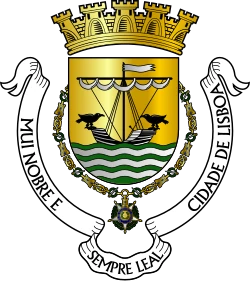
    The coat of arms

  3. 2

    The mural crown

  4. 3

    The scroll

How it is described

The flag in the words of vexillology and heraldry.

Vexillological description

It is a rectangular field with a 2:3 ratio divided into eight gironnies, which are eight triangles starting from the centre and alternating in white and black, with the coat of arms of the town in the middle.

Field (the cloth)
it has no outer border; the gironnies reach all four sides.
Gironnies
four white and four black, arranged around the centre.
Coat of arms
in the centre; it bears a ship with a crow on each side, a mural crown and a collar.
Its history in dates

Every date in its story, at a glance.

  1. 1385

    There are already records of a flag of Lisbon in 1385

  2. 1508

    An alvará of King Manuel I of 1508 ordered six square ones, carmine and white

  3. 1552

    The colours white and black appear around 1552 on the awnings and liveries of the town council’s…

  4. 1830

    After the liberal victory, a blue and white standard, imitating the Portuguese flag of 1830

  5. 1863

    It burned in 1863 in the fire at the town hall

  6. 1880

    Standards of white silk with the arms embroidered on them, like that of 1880 for the tricentenary…

  7. 1910

    The Republic of 1910 did not change them

  8. 1919

    It was proposed in 1919 to recover the one that would have been used at the taking of Ceuta

The full story

How it was born, how it has changed and what it means.

The flag of Lisbon has eight white and black gironnies and, in the centre, the arms of the ship with two crows. Its model served as the pattern for all the town flags of Portugal, and that of Ceuta is identical.

How it came about

There are already records of a flag of Lisbon in 1385. In the fifteenth century it was called the “flag of Saint Vincent”, after the patron of the town. But nobody knows what it looked like then: all that is known is that the letters of King John I mention it. The colours white and black appear around 1552 on the awnings and liveries of the town council’s ships.

The current flag is not medieval. It was proposed in 1919 to recover the one that would have been used at the taking of Ceuta, in 1415. The councillor Eduardo Moreira presented the design in 1920 and it came into force on 5 October 1920. In 1940 the coat of arms was touched up to fit the 1930 heraldic rules.

How it has changed

Before the current one, the town council had several standards. This is their history, according to the Portuguese Wikipedia:

  1. 1508-1833

    Carmine flags and standards, with the royal arms on one side and those of the town on the other. An alvará of King Manuel I of 1508 ordered six square ones, carmine and white.

  2. 1833-1863

    After the liberal victory, a blue and white standard, imitating the Portuguese flag of 1830. It is the same blue and white as the flag of the Azores. It burned in 1863 in the fire at the town hall.

  3. 1871-1920

    Standards of white silk with the arms embroidered on them, like that of 1880 for the tricentenary of Camões. The Republic of 1910 did not change them.

  4. 1920-1940

    The gironnied flag in white and black appears. The arms become a Roman bireme with a crow. In 1927 the ship with two crows is recovered.

  5. Current flag of Lisbon: eight white and black gironnies with the coat of arms of the town
    Sérgio Horta, a partir de orginal de Ornellas e outros · Public domain

    1940

    Current flag. Portaria 9468, of 28 February 1940, changes the field of the coat of arms from silver to gold and stylises the ship.

What it means

  • White and black

    the official colours of the town since the mid sixteenth century. Their origin is unknown.

  • Ship with two crows

    according to tradition, the crows guarded the body of Saint Vincent when they brought it to Lisbon.

  • Silver and black cords and tassels

    it carries the pole and spear in gold.

Fun facts

  1. Ceuta has the same flag

    The town of Ceuta uses an identical one, because the flag of Lisbon was the first to be hoisted in its castle when the Portuguese took it on 21 August 1415.

  2. Twins by coincidence

    Castelo Branco, Marco de Canaveses, São João da Madeira and Tavira also have eight white and black gironnies, because the law requires the colours of the coat of arms to be used.

  3. The crows of Saint Vincent are a legend

    The crows of the coat of arms recall the transfer of the body of Saint Vincent to Lisbon. It is a tradition, without proof. Flags of the World adds that there are hardly any crows in the city.

Localisation

How much have you learnt?

Test what you have read about the flag of Lisbon.

  1. 1. Which one is the flag of Lisbon?

  2. 2. Which of these elements appears on the flag?

  3. 3. What are the proportions (height:width) of the flag?

  4. 4. In which year was the current flag adopted?

Sources

Text based on the article “Bandera de Lisboa” from the Spanish Wikipedia, published under the licence CC BY-SA 4.0.

Sources consulted:

Credits

Flag image: Sérgio Horta, a partir de orginal de Ornellas e outros, Wikimedia Commons · Public domain.

More flags

Accessibility preferences

Accessibility statement

Quick profiles

Text and reading

Text size
Default
Line height
Default
Letter spacing
Default
Word spacing
Default

Colour

Motion and orientation

Cursor